Google’s AI Chips Are Already in Orbit. How Project Suncatcher Works
At 6:42 p.m. EDT on Oct. 1, SpaceX’s Transporter-18 rideshare lifted off from Vandenberg Space Force Base in California. Among its payloads was a refrigerator-sized satellite developed by Google with Planet that carries four of Google’s Tensor Processing Units, the custom AI chips that normally sit in Google’s data centres. Google says its team has confirmed contact and the satellite is “operating as expected.”
This is Project Suncatcher, which Google calls a long-term research moonshot. When Google first described it in November 2025, the plan was to launch two prototype satellites with Planet “by early 2027.” Headlines still talk about 2027 as the year Google goes to orbit. It already has: the first prototype is up, and the 2027 launches are the follow-ups.
Travis Beals, the senior director who leads the project, has been careful not to oversell it. He called the launch “a very minimal test” to make sure the chips can run in space, NPR reported.
What Google launched on Oct. 1
The facts Google has confirmed are thin, and its Oct. 1 post is short. It names the rideshare and the partner, says the team will spend the coming weeks collecting data on how the TPUs handle radiation and thermal extremes, and points to a peer-reviewed paper in the journal Joule. Planet’s own Business Wire release confirms the launch time and site and describes the goal as testing “the feasibility of running machine learning (ML) compute systems in-orbit.”
Reporters filled in the rest. According to NPR, the satellite runs a version of Google’s open Gemma model for 15 minutes at a time and is expected to operate for a year. CNN quoted a Google spokesperson saying the test vehicle will “have to power down every 20 minutes, because we don’t want it to overheat.” The two outlets don’t agree on the exact interval, but they agree on why: heat. CNN also cited The New York Times reporting that the satellite supplies only about one kilowatt of power to the TPUs.
One correction matters for anyone reading early coverage. NPR first reported that the prototype was in a sun-synchronous orbit with no batteries, then corrected the story on Oct. 2: this satellite is in a standard orbit and uses batteries. The always-sunny orbit is the plan for future satellites.
Why put AI chips in orbit at all
The pitch is solar power. In the right orbit, Google’s 2025 research post says, a solar panel can be “up to 8 times more productive than on earth.” That orbit is a dawn-dusk sun-synchronous low Earth orbit, which rides the line between day and night so the panels see the sun almost constantly. Less need for heavy batteries, and no fight with neighbours over grid connections and water.
Beals put it more bluntly to NPR. “The sun puts out almost all of the power in our solar system,” he said. “All of the other power sources that humanity has tapped into are just a tiny fraction of a percent.”
The backdrop is the scramble for electricity on the ground, which we’ve tracked in our breakdown of AI’s power bill. Google is betting that, at some point, the cheapest new kilowatt for AI might be one that never touches a utility.
Heat, radiation and lasers: the hard parts
Space is cold, but it is a terrible place to cool a chip. There is no air to carry heat away, so everything has to be radiated off through panels. Google has called cooling “a crucial research challenge” and described a combination of heat pipes and radiators, according to NPR. That is why the prototype runs in short bursts.
Radiation worried Google less than expected. Before launch, the team fired a 67 MeV proton beam at a Trillium v6e Cloud TPU at the UC Davis Crocker Nuclear Laboratory, according to its preprint. The high-bandwidth memory was the weak point, showing irregularities after a cumulative dose of 2 krad(Si). That is almost three times the 750 rad(Si) the team expects a shielded chip to absorb over five years. Nothing failed outright up to the maximum tested dose of 15 krad(Si). Google told CNN the chips fared “remarkably well.”
The third problem is bandwidth. AI training needs chips to talk to each other constantly, and in a data centre that happens over fibre. Google’s design swaps fibre for free-space lasers between satellites flying unusually close together: an illustrative cluster of 81 satellites within a 1 km radius, spaced roughly 100 to 200 metres apart. In bench tests, a single pair of optical transceivers hit 800 Gbps each way, or 1.6 Tbps total. That was on a lab bench, not in orbit. Linking satellites is what the next launches are meant to test.
“It doesn’t help a lot if this is technically possible, if it’s always going to be too expensive to be practical.” Travis Beals, Project Suncatcher lead, to NPR
The launch-cost math behind Project Suncatcher
Everything hinges on launch prices. Google’s researchers project that prices to low Earth orbit could fall below US$200 (about CA$280) per kilogram by around 2035, if SpaceX keeps up its historical learning rate.
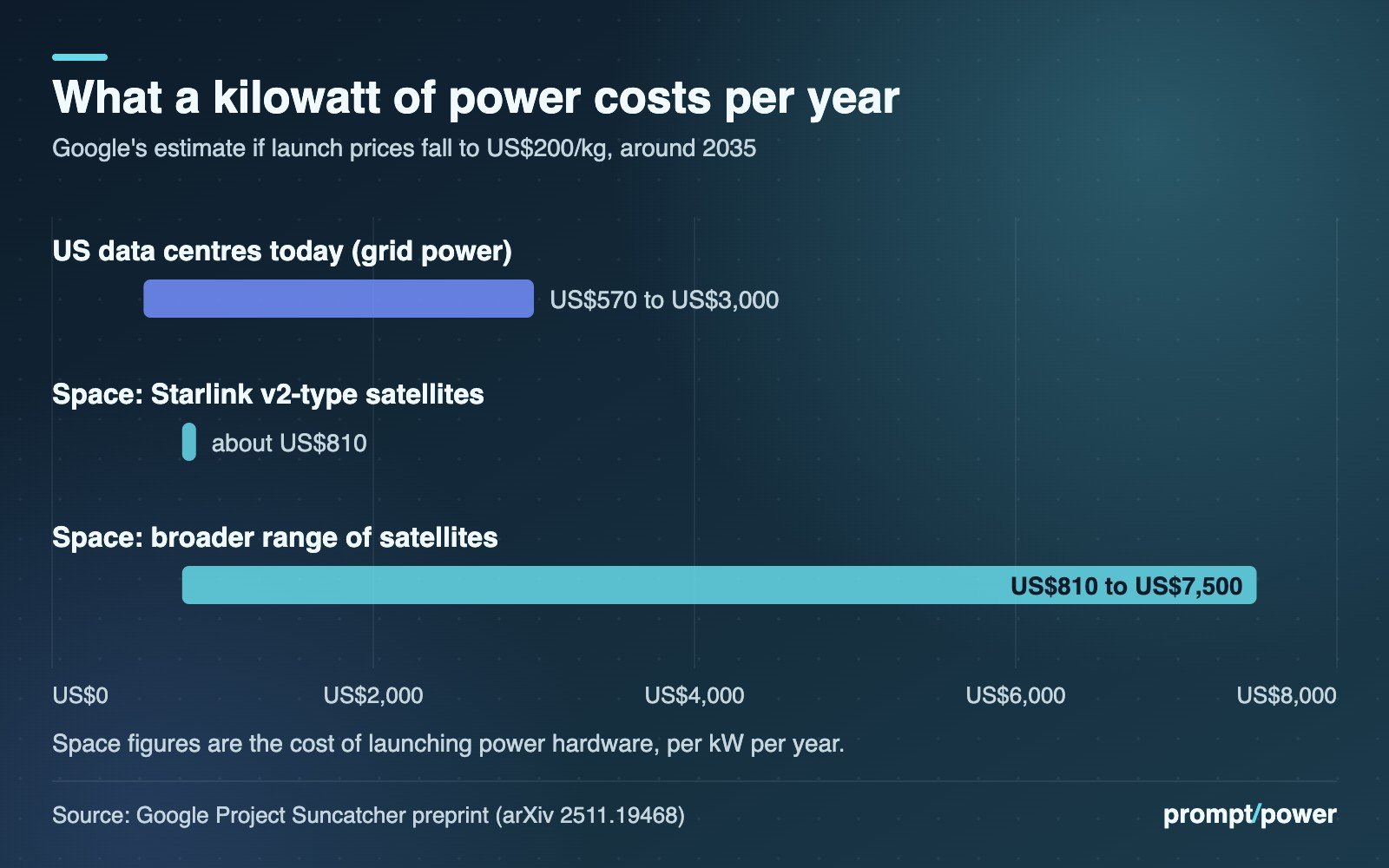
At that price, the paper estimates the cost of launching power-generating hardware at about US$810 per kilowatt per year for a Starlink v2-type constellation, and US$810 to US$7,500 across a broader range of satellites. US data centres, it says, spend roughly US$570 to US$3,000 per kilowatt per year on power. So the Starlink-style case lands inside what data centres pay for power today, while most of the broader range doesn’t. And that is the best case, about a decade out.
Beals doesn’t pretend otherwise. “I don’t see this being something where it’s cheaper to do this in the next five years,” he told NPR. “I think it will take longer than that.”
Carnegie Mellon engineering professor Brandon Lucia told NPR that the hard parts of running hardware in orbit “have their cost and complexity amplified by a factor of 10, maybe a factor of 100. And so there has to be a big payoff.” JLL Research made a related point in a June report quoted by CNN: AI chips “advance every 1–2 years, while satellites last 5–7 years.”
Starcloud, SpaceX and the race for orbital compute
Google isn’t first. Starcloud, a startup backed by Nvidia, launched its Starcloud-1 satellite with an Nvidia H100 GPU in November 2025 and demonstrated a version of Google’s AI from space, NPR reported. Its CEO, Philip Johnston, said in an Nvidia blog post before launch: “In 10 years, nearly all new data centers will be being built in outer space.”
SpaceX is the giant in the room, and it is also Google’s launch provider. SpaceX has said it plans a constellation of up to one million AI-computing satellites, CNN reported, and Light Reading reported in August that its orbital data centres are slated to reach “significant scale” in 2028. Those are company plans, and SpaceX’s timelines have a habit of slipping.
Planet’s CEO Will Marshall told CNN: “I do think it’s a very viable project long-term.” Planet is Google’s partner on the spacecraft. It has an obvious interest in that sentence being true.
What to watch next
- First results: Google says it will share more as the mission unfolds. The real test is whether the TPUs behave in orbit the way they did under the UC Davis beam.
- 2027: Google intends to send up two more satellites in 2027, according to CNN, the step where satellite-to-satellite links get tried for real.
- Launch prices: The whole business case rides on reaching about US$200 per kilogram. Watch Starship’s cadence more than Google’s press releases.
For now, the most advanced AI chip project in orbit is a one-kilowatt box that has to stop and cool off every quarter-hour or so. Google’s own paper puts the break-even near 2035.

Elena Vasquez covers space and frontier tech for prompt/power: launches, satellites, robotics, autonomy and defence tech. She counts rocket launches the way some people count sheep, and somehow sleeps less for it.
Keep reading

Latest from prompt/power
- Thomson Reuters Won the First AI Training Appeal. Footnote 7 Is the CatchOct 7
- The Family Safe Word: How to Beat AI Voice-Clone Emergency ScamsOct 7
- Reflection AI’s Beam, Explained: The 501B Open-Weight Model Aimed at ChinaOct 7
- Your SSN or SIN Leaked in a Breach? Do These 8 ThingsOct 7
- Apple’s Oct. 13 Event Rumour, Plus iPhone Duo Pre-Order Dates for CanadaOct 7
Leave a Reply