Ghost’s US$3,499 Core Is a Screenless PC Built for Your AI Agent
Ghost, a four-person San Francisco startup, came out of stealth on Oct. 5 with an US$11 million seed round led by Andreessen Horowitz and a computer that ships without a screen, a keyboard or any intention of being used by a person directly. Core is a US$3,499 (about CA$4,860) stainless-steel box that runs AI agents on your desk instead of in a cloud provider’s data centre, as TechCrunch first reported.
Its founder and CEO, Zain Javaid, is 19. He left quantitative investing after ChatGPT’s release in 2022, according to TechCrunch, and built the company with Nicholas Chua, 19, Yifei Chen, 24, and Gautam Sharda, 23. Abstract, Audacious Ventures, SV Angel and Nova also joined the round.
Preorders opened the same day. Ghost’s product page says the first batch ships Oct. 31, with free shipping, a 30-day return window and a one-year warranty.
Ghost Core specs: what US$3,499 buys
Inside is an Nvidia RTX Pro 4000 Blackwell SFF Edition graphics card with 24GB of GDDR7 ECC memory and 432 GB/s of memory bandwidth, which Ghost rates at 770 AI TOPS. Around it sit a six-core AMD Ryzen 5 7600, 64GB of DDR5 system RAM and a 1TB NVMe SSD. You talk to it through an app on your phone.
Ghost lists four preinstalled open-weight models: Qwen 3.8-Next, Qwen 3.8-27B, Gemma 4-31B and Muse-Glimmer-30B. Owners can add others from Hugging Face or load their own. Javaid told TechCrunch the company can push new models over the air, “similar to how Tesla works,” and will ask before swapping a user to a new generation.
The spec that sets the ceiling is the 24GB. Our read: that is enough for models around 30 billion parameters only in compressed, lower-precision form, and it rules out the 100-billion-parameter class that bigger-memory machines are now sold on. Ghost is betting that mid-sized models, tuned well, are good enough to run your life.
“You can run models on existing hardware, but it’s a terrible experience on many levels.” Zain Javaid, Ghost CEO, to TechCrunch
How Core compares with DGX Spark and Mac Studio
The timing is either lucky or shrewd. On Oct. 2, Nvidia announced a 64GB DGX Spark starting at US$4,999 (about CA$6,950), on sale Oct. 23. The Register reported that the 128GB Spark now costs US$6,950 (about CA$9,660), nearly 75 per cent more than a year earlier, and blamed memory prices.
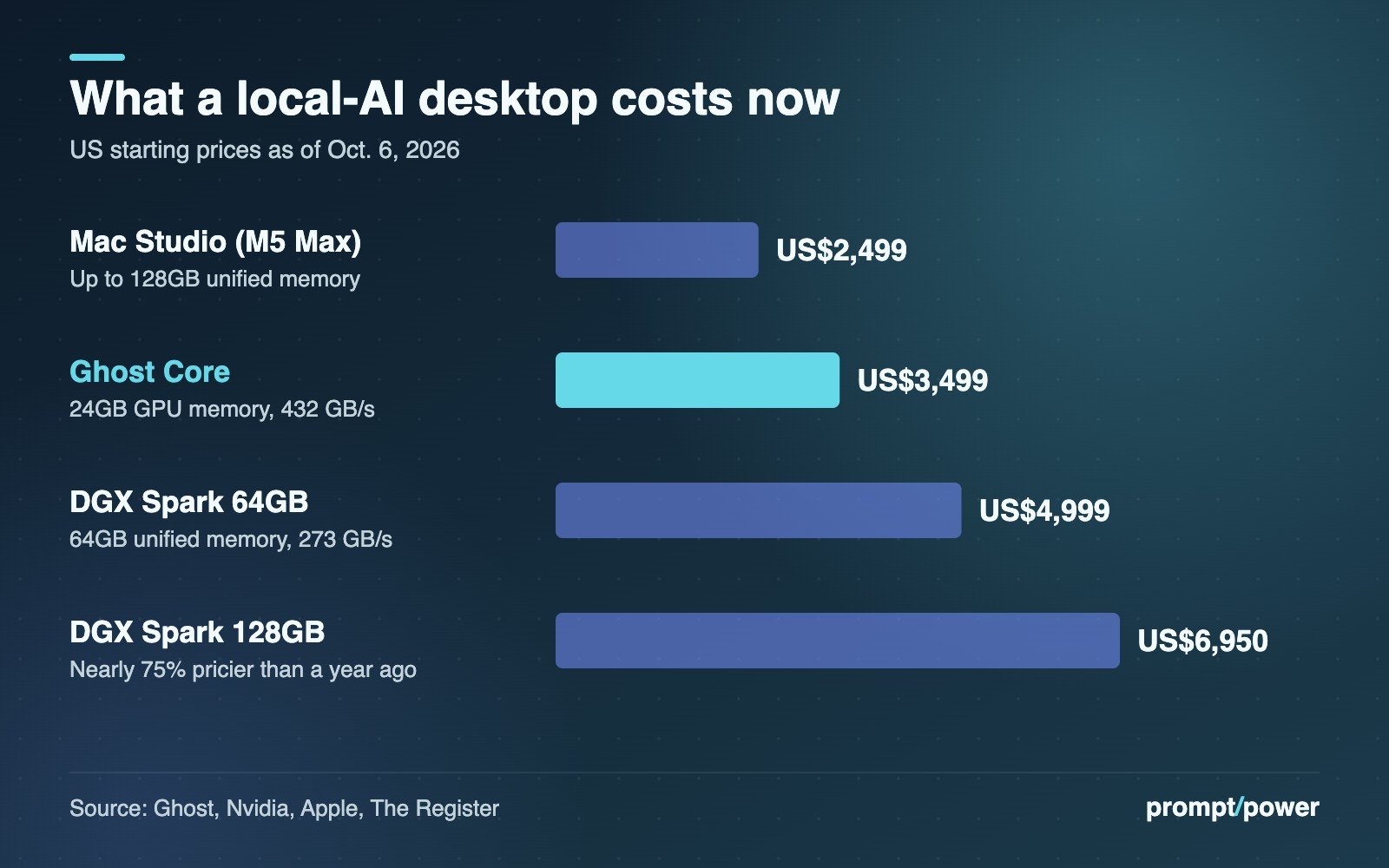
Then there is Apple. The Mac Studio with M5 Max starts at US$2,499, and Apple’s own release promises you can “run massive models entirely on device with complete privacy.” In Canada that machine starts at CA$3,499, the same number as Core’s American sticker.
The trade-off is capacity against speed. Spark and Mac Studio use unified memory, so the 64GB and 128GB Sparks, and a Mac Studio configured up to 128GB, can hold far bigger models. But the Spark moves that memory at 273 GB/s, according to The Register, while Core’s card does 432 GB/s. Our read: Core should answer faster on the mid-sized models it ships with and simply cannot load the largest ones.
Asked how Core differs from a Mac Mini set up for AI, Javaid told TechCrunch that Core’s hardware and software were built specifically for agents with the models already installed, while Apple’s machine is a general-purpose computer you configure yourself. That is the honest pitch. Ghost is selling software and setup as much as silicon.
Does Core’s data really stay home?
Mostly. Ghost’s privacy policy, dated Oct. 4, says plainly that “online features can still send task information to external services.” Web search, email and over-the-air updates need a connection. Those features run through a Ghost-operated gateway that, the policy says, “does not save that content,” but the third-party provider that handles the request keeps it under “its own policies and applicable agreements.”
TechCrunch reports Core includes a firewall that watches every outgoing network request and flags suspicious ones for the user to review. It will need it. Martin Cid Magazine lists integrations with email, calendars, files, browser history, health records and Whoop, Oura and Eight Sleep wearables. Javaid’s own example for TechCrunch was Core warning you that you might be getting sick because your resting heart rate is up and you were working late.
What it means for you in Canada
There is no Canadian price. Ghost has priced Core only in US dollars and has not said which countries it ships to, Martin Cid Magazine noted. Converted, US$3,499 is about CA$4,860 before any duties, taxes or cross-border shipping, none of which Ghost has addressed.
- Buy it if you want an always-on agent with access to your inbox and health data, and you trust a seed-stage company’s software more than a cloud provider’s servers.
- Skip it if you already own a desktop with a 24GB graphics card. The same open models run there; what you would miss is Ghost’s agent layer, which has not shipped yet.
- Wait if you are weighing bigger-memory options. Microsoft and Nvidia’s RTX Spark event on Oct. 7 could reset Windows prices for local AI.
If you want an agent working while you sleep but do not want to buy hardware, our comparison of always-on AI agents covers the cloud options and what has already gone wrong with them.
The first units are due Oct. 31 from a San Francisco facility where, FourWeekMBA reports, the four-person team is assembling them in-house. Javaid argued to TechCrunch that big companies get too much credit for owning the ingredients, and that the real product is how a model reasons over your life and knows when to reach out. “If we can’t do that, Apple isn’t the reason we failed,” he said.

James Whitfield covers hardware for prompt/power: chips, semiconductors, laptops, components and the benchmarks behind the launch-day claims. He thinks the most important number on any spec sheet is usually the one in the footnote.
Keep reading

Latest from prompt/power
- Thomson Reuters Won the First AI Training Appeal. Footnote 7 Is the CatchOct 7
- The Family Safe Word: How to Beat AI Voice-Clone Emergency ScamsOct 7
- Reflection AI’s Beam, Explained: The 501B Open-Weight Model Aimed at ChinaOct 7
- Your SSN or SIN Leaked in a Breach? Do These 8 ThingsOct 7
- Apple’s Oct. 13 Event Rumour, Plus iPhone Duo Pre-Order Dates for CanadaOct 7
Leave a Reply