
Nvidia’s China Freeze Is Now Just the Weather
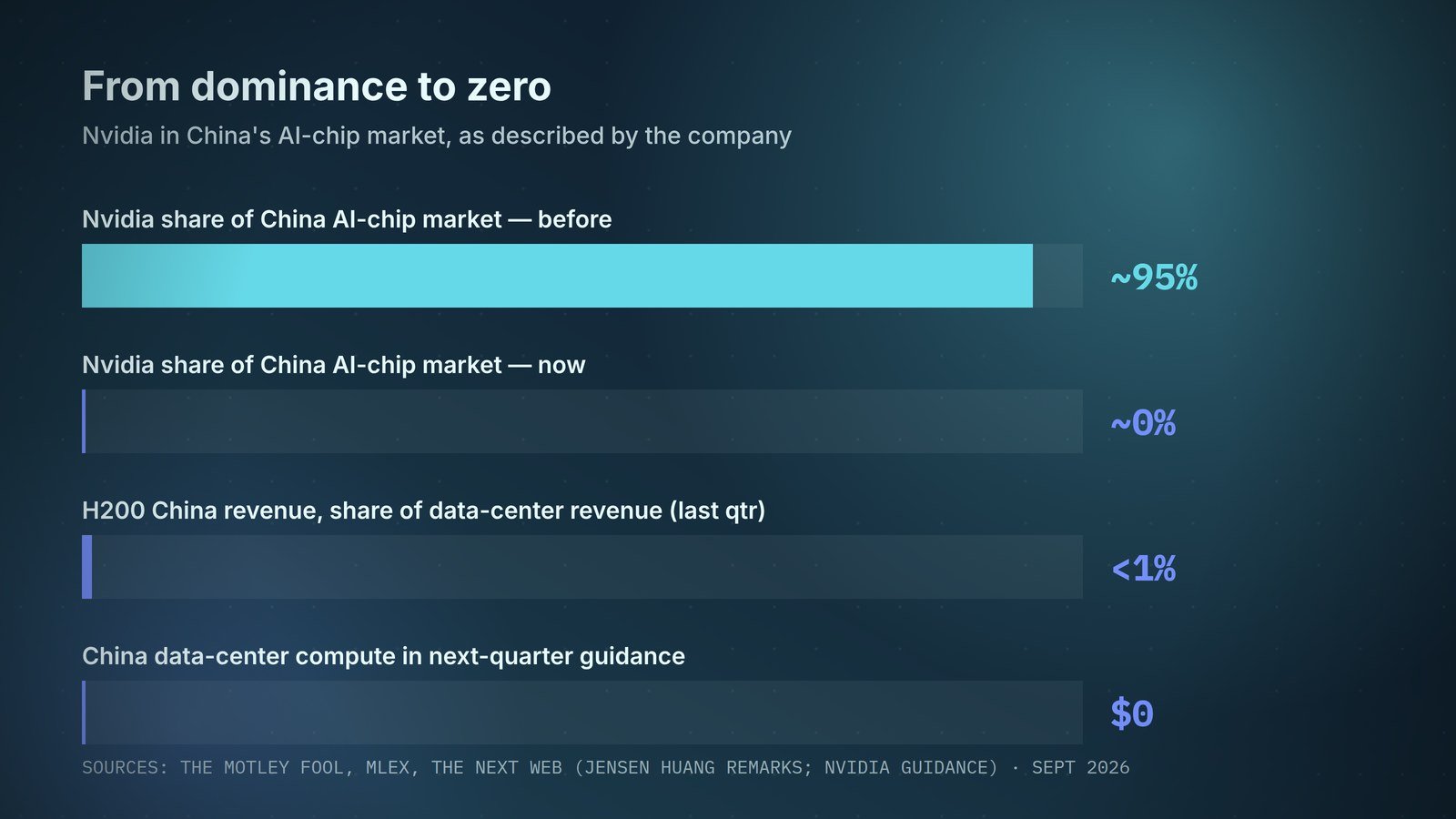
The most telling number in Nvidia’s outlook is one that isn’t there. The company’s guidance — around $108 billion for the quarter — is built, in its own words, on “not assuming any Data Center compute revenue from China.” Not a haircut. Not a discount. Zero. A market that not long ago supplied a fifth to a quarter of Nvidia’s data-center business has been zeroed out of the model entirely, and the stock did not blink, because everyone has already accepted the new normal. That acceptance is the story. The freeze is no longer an event; it’s the weather.
Consider how fast the collapse ran. Nvidia’s Jensen Huang has said the company’s share of China’s AI-chip market fell “from about 95% to zero.” Last quarter, H200 data-center revenue from China came in at under 1% of data-center revenue. China-headquartered billings were about $7.9 billion — roughly 8% of total revenue — but that figure leans on categories outside the advanced data-center silicon that is the whole fight. The advanced stuff, the chips that actually train frontier models, is effectively not selling into China at all, and Nvidia has stopped pretending otherwise in its guidance.
This week’s Trump-Xi summit was the moment the thaw could have come, and pointedly didn’t. Export controls were kept off the agenda by mutual design; the restrictions on Nvidia’s most advanced silicon stayed exactly in place. So the “no news” is the news: the single event most likely to change the picture came and went, and the picture held. What had looked like a policy fight with a possible resolution now looks like a settled structural condition — a permanent feature of the map that both Washington and Beijing have reasons to keep.
Because the freeze is no longer one-directional. It isn’t only that the U.S. won’t let the best chips flow east; it’s that Beijing increasingly doesn’t want them to. China has been steering its own buyers away from American silicon and toward domestic supply, capping and discouraging purchases even where U.S. licenses exist — Nvidia has told investors it has shipped only “a fraction of the allowed shipments” the licenses permit. When both governments are actively engineering the same outcome, that outcome stops being a dispute and becomes a policy both sides own.
Which brings us to who benefits, and the answer is the company that has spent two years being handed a captive market: Huawei. Every quarter that Nvidia’s best parts are unavailable — whether by U.S. rule or Chinese preference — is a quarter Huawei’s domestic buildout faces less competition for the largest pool of AI demand outside the United States. Export controls were designed to slow China’s AI progress; their durable second-order effect is to guarantee China’s national champion the room to scale. That is not an argument for or against the controls. It is the P&L reality underneath them: the policy that zeroes Nvidia’s China line is the same policy underwriting Huawei’s.
For Nvidia the near-term math is, remarkably, fine — demand elsewhere is strong enough that the company can absorb a zeroed China line and still guide to $108 billion. The longer-term question is the one the guidance quietly concedes: a generation of Chinese AI infrastructure is now being built on non-Nvidia silicon, by necessity, and infrastructure decisions calcify. Ecosystems, tooling, and developer habits form around whatever hardware is actually available. The revenue Nvidia is writing off today is the easy part. The market it may be ceding — the one that gets built while the freeze holds — is the part that won’t thaw just because a future summit finally puts export controls on the table.
The freeze, in other words, has done what freezes do when they last long enough. It has stopped being an emergency anyone manages and become the environment everyone plans around. Nvidia already has. Its guidance says so, one missing number at a time.
Sources

James Whitfield covers hardware for prompt/power: chips, semiconductors, laptops, components and the benchmarks behind the launch-day claims. He thinks the most important number on any spec sheet is usually the one in the footnote.
Keep reading




Latest from prompt/power
- Gemini’s Free Tier Shrinks Oct. 9: What You Keep and What Costs ExtraOct 5
- How to Read an AI Company’s S-1: The 7 Numbers That MatterOct 5
- OpenAI’s Safety Lead Quit Over Culture. California’s AG Was Already InOct 5
- When an AI Agent Breaks In, Who Answers for It?Oct 5
- The New AI Models Don’t Talk. They Decide.Oct 5
Leave a Reply