
Gemini’s Free Tier Shrinks Oct. 9: What You Keep and What Costs Extra
On Friday, Oct. 9, the free version of the Gemini app gets one model. Not three. Google’s help page on the change lays it out in a single table: people without a paid plan keep Gemini Flash-Lite and lose Flash and Pro. The free plan that today advertises access to Gemini 3.6 Flash and “varying access” to Gemini 3.1 Pro becomes a Flash-Lite plan.
The cheapest paid tier takes a hit too. Google AI Plus, which costs US$4.99 a month (CA$6.99 in Canada), keeps Flash-Lite and Flash but loses Pro. Meanwhile the US$19.99 (CA$26.99) AI Pro plan picks up Deep Think, a feature that until now sat behind the far pricier Ultra plan, as 9to5Google’s Abner Li first spotted on Oct. 3.
Here is what changes for each plan, how to check where you stand, and whether any of it is worth paying for.
Gemini free tier changes on Oct. 9: the short version
Google’s wording is plain: “These changes will start to take effect for users without an AI subscription on October 9th.” AI Plus subscribers get no fixed date. Instead, Google says, “you should receive an email that explains when these changes will take effect for you.” Android Headlines reads that the same way: Google is notifying Plus users individually. So if you pay for Plus and haven’t had that email, Pro may still be in your model picker for a while.
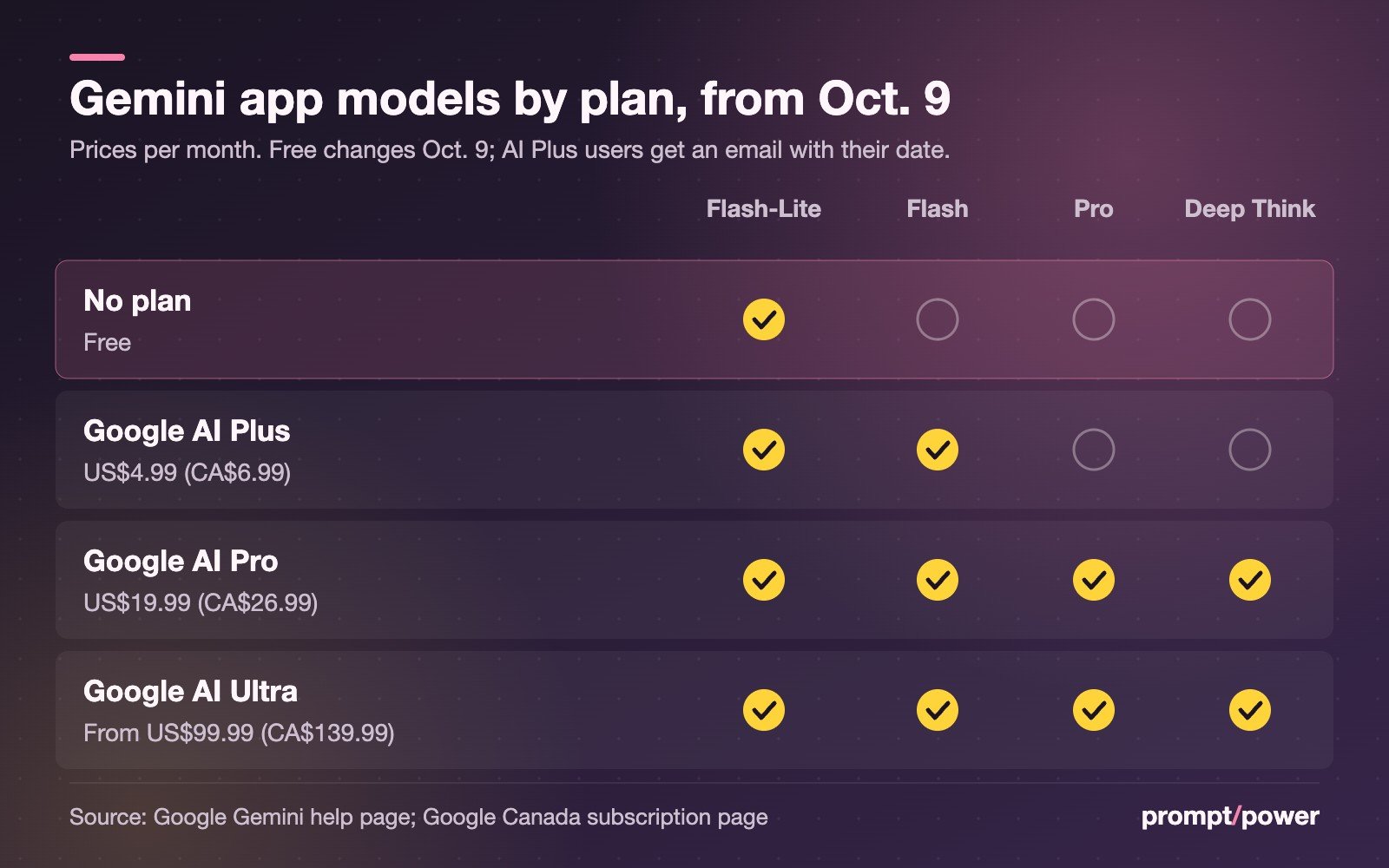
The new access table, from Google’s support document, with Canadian prices from Google’s Canadian subscription page:
| Plan | Price per month | Flash-Lite | Flash | Pro | Deep Think |
|---|---|---|---|---|---|
| No plan | Free | Yes | No | No | No |
| Google AI Plus | US$4.99 (CA$6.99) | Yes | Yes | No | No |
| Google AI Pro | US$19.99 (CA$26.99) | Yes | Yes | Yes | Yes |
| Google AI Ultra | From US$99.99 (CA$139.99) | Yes | Yes | Yes | Yes |
Ultra comes in two sizes. Google’s U.S. plans page lists US$99.99 for “5x higher usage limits vs. AI Pro” and US$199.99 for 20 times; in Canada those are CA$139.99 and CA$279.99. Canadian prices here are Google’s own, not conversions.
What you keep on the free plan, and what Flash-Lite is for
Google describes Flash-Lite, in its limits page, as an “efficient workhorse model designed for speed.” Flash is the middle option that balances speed and reasoning, and Pro is the one Google calls its “most advanced model that excels at complex math and coding prompts.”
In practice, Flash-Lite will handle quick lookups, rewrites, summaries of a pasted email and simple brainstorming. Where you’ll notice the drop is on long documents, multi-step reasoning, careful code and anything where you’d previously flipped to Pro because the first answer was shallow. That’s our read of how small models behave generally; Google hasn’t published benchmark comparisons for the app tiers.
Two other things will eat into a free allowance faster. Google’s support page lists “Images, videos and music,” “Deep Research” and the Pro model as features that use more of your limit. Its documents don’t say whether free accounts keep Deep Research after Oct. 9, so check the app before you rely on it.
The new effort setting is a quiet cost
Google is also adding a dial. “For each available model, you can also select the model’s effort level from low, medium, and high,” the help page says. Higher effort means more thorough answers and, per 9to5Google’s reading of the document, faster consumption of your allowance. If you’re on the free plan, leave it on low or medium for routine work and save high for the question that matters.
Gemini usage limits: the 5-hour refresh
Gemini’s limits are compute-based rather than a fixed number of prompts. According to Google’s limits page, they “refresh every 5 hours until you reach your weekly limit.” Google expresses the tiers as multiples rather than counts: AI Plus gets two times the standard (free) limit, AI Pro four times, and Ultra five or 20 times the AI Pro limit depending on which Ultra plan you buy.
When a paying subscriber hits the ceiling, Google says “you can continue your conversation with Flash-Lite.” Free users have nowhere lower to fall, so they wait for the refresh.
How to check your plan and usage:
- Go to gemini.google.com on a computer and sign in with your personal Google account.
- At the bottom left, select Settings, then Usage Limits. That path comes from Google’s own instructions.
- Not sure whether you pay for anything? Google AI plans are sold as Google One subscriptions, so your plan shows up there. Compare it against the list at gemini.google/subscriptions.
Work or school accounts are a different product. The Oct. 9 change, per Google, applies “when you use a personal account.”
Should you upgrade to AI Plus or AI Pro?
The awkward plan is now AI Plus. At CA$6.99 it restores Flash, doubles your limits and adds 400 GB of storage, but once your switchover email arrives it no longer gets you Pro. If you were buying Plus mainly as a cheap way into Gemini’s best model, that reason is gone.
AI Pro at CA$26.99 is where Google is pushing people. You get all three models, four times the free limits, Deep Think and 5 TB of storage, and Google’s Canadian page bundles in a YouTube Premium Lite plan. If you already pay for Google storage or YouTube, the math may work. If you don’t, you’re paying mostly for the chatbot.
Our rough rule:
- Stay free if Gemini is a quick-question tool for you and you rarely touched Pro.
- Consider Plus if you hit Flash-Lite’s ceiling on everyday writing and want Flash back, and the storage is useful anyway.
- Consider Pro if you use Gemini for coding, research or long documents, or you want Deep Think.
Free alternatives to Gemini: Claude, ChatGPT, Copilot
Before you pay, it’s worth knowing what rivals give away. Anthropic’s pricing page lists Sonnet and Haiku models on Claude’s free plan, along with web search, file creation and memory, under rolling usage caps. ChatGPT and Microsoft Copilot both still offer free access, but their caps shift by model, feature and demand, as Tech Insider’s comparison notes, so check the current limits in each app rather than trusting a chart from last month.
If you switch assistants, look at the data settings before you paste in anything personal. Our guide to stopping ChatGPT, Claude, Gemini and Meta AI from training on your chats walks through each one.
Where Gemini 4 Argon fits
Not on the free plan, and not on Pro yet. Google announced Gemini 4 Argon on Sept. 30 and, in its launch post, said it is rolling out first to “trusted cyber defenders” through its Fairwind Program. The broader release will start “with paid API customers and Google AI Ultra subscribers,” with no date given. Google also says it is taking part in “the U.S. government’s voluntary process for pre-release model access.” (If the model names are blurring together, our field guide to Astra, Sol, Argon and Mythos sorts them out.)
That ordering matters for reading the Oct. 9 changes. Google’s newest model is going to its highest-paying customers first, and its oldest free promise is shrinking to a single model.
What to do before Oct. 9
- If you’re on the free plan and have a long Pro conversation going, finish it or copy out what you need before Friday.
- If you pay for AI Plus, watch your inbox for Google’s timing email and decide whether Flash alone is worth CA$6.99.
- Open Settings, then Usage Limits, after the switch and see how fast Flash-Lite drains on your normal week.
Google’s own access table has exactly one row with a single “Yes” in it. Starting Oct. 9, that’s the free row.

Lauren Smith covers consumer apps and services for prompt/power: streaming, subscriptions, e-commerce and everyday tech worth your money. She keeps a running tally of every free trial that quietly turned into a subscription.
Keep reading




Latest from prompt/power
- How to Read an AI Company’s S-1: The 7 Numbers That MatterOct 5
- OpenAI’s Safety Lead Quit Over Culture. California’s AG Was Already InOct 5
- When an AI Agent Breaks In, Who Answers for It?Oct 5
- The New AI Models Don’t Talk. They Decide.Oct 5
- Quebec’s First AI Election: ChatGPT Leaned on an AI-Built Voter GuideOct 5
Leave a Reply