
Force Majeure at 77 Cents on the Dollar
The AI infrastructure story has, until now, been told almost entirely in the future tense: gigawatts to be built, hundreds of billions to be committed, campuses to rise in the desert. On September 24, Oracle changed the tense. The company sent a force majeure notice on its lease commitments for Project Jupiter — the sprawling New Mexico data center, part of the Stargate initiative — signaling it intends to delay the payments it had promised. Force majeure is the contractual escape hatch you reach for when circumstances beyond your control make an obligation impossible. Reaching for it is not a neutral act. As RBC Capital Markets put it, the notice “signals the company’s own risk assessment has shifted enough to warrant legal cover.”
What made it impossible, in this case, was the least exotic risk in the book: permitting. New Mexico’s state land commissioner rejected portions of the project’s plans this summer, and local opposition to the site has run since at least 2025. There was no exotic supply-chain shock, no technology failure — just a state official saying no and a community that never said yes. The most ambitious AI buildout in the country, and the thing that stopped it was a land-use decision. That should be sobering to anyone modeling the sector’s committed capacity as if it were already poured concrete.
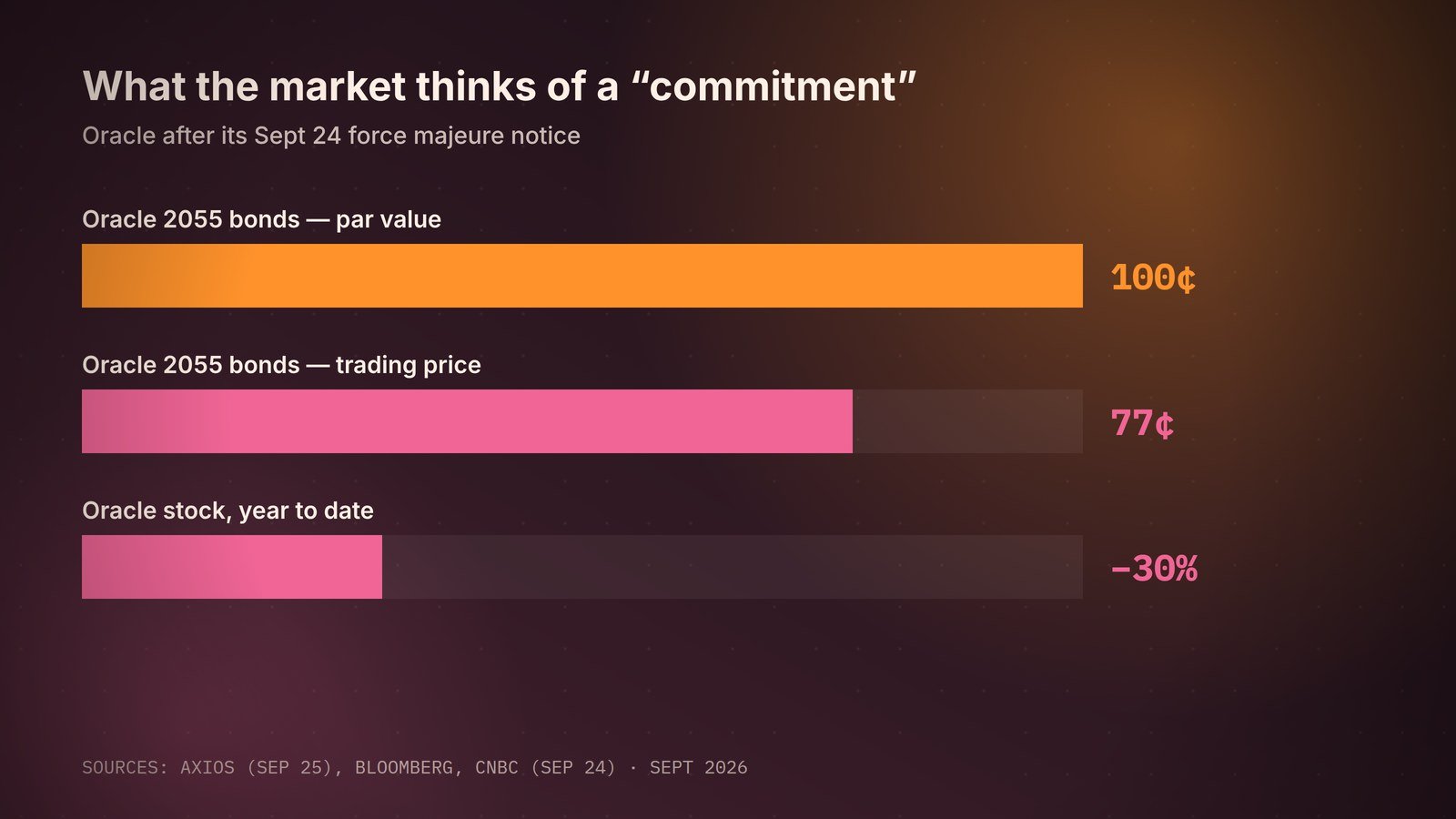
Now the money. Oracle’s 2055 bonds are trading at 77 cents on the dollar — a level that says the market is no longer treating Oracle’s long-dated debt as money-good at par. The stock is down 30% year to date. The cost of credit-default protection on Oracle debt rose on the news, meaning investors are paying up to insure against the company’s own credit deteriorating. None of that is a solvency crisis for a company Oracle’s size. But it is the market repricing the quality of Oracle’s AI commitments in real time — and Oracle is one of the more creditworthy names in this web.
That web is the reason a single New Mexico permitting fight matters far beyond New Mexico. Project Jupiter/Stargate was announced by President Trump on his first full day back in office last year and is spearheaded by OpenAI and SoftBank; the data centers were financed with roughly $18 billion in loans from about 20 banks in 2025. That is the template the entire sector runs on: a hyperscaler or a well-rated partner “commits” to a facility, that commitment anchors billions in project financing, and the debt gets sold on the strength of the commitment — often for facilities that exist only on paper. Force majeure is the word that turns a “commitment” back into a contingency. If Oracle can invoke it over permitting, the next question every lender and bondholder in the AI-infrastructure stack is now asking is: what else, in these decade-long obligations for unbuilt things, counts as force majeure?
This is why the episode reads as a preview rather than an isolated stumble. The OpenAI-SoftBank-Oracle nexus, and the broader constellation of AI data-center deals, is built on obligations that were priced as firm and are turning out to be conditional. A permitting rejection here, a power-interconnection delay there, a community that organizes and wins — each is a mundane, foreseeable event, and each is now demonstrably enough to move a “committed” dollar from the asset column to the disputed column. The AI capex narrative has assumed that the constraint on the buildout is ambition and capital. New Mexico just demonstrated that the binding constraint may be the physical, permittable, litigable world the buildout has to happen in.
Oracle will be fine. That’s rather the point: if the best-capitalized name in the deal is reaching for force majeure over a land commissioner’s ruling, the covenant math on the weaker names in the AI-infrastructure web deserves a much harder look than 77 cents. This was the first “committed” AI dollar to meet reality. It will not be the last, and the bond market — pricing Oracle’s 2055s like it already knows that — is not waiting to find out.
Sources

Mira Okonkwo covers the business of technology for prompt/power: venture capital, startups, IPOs and earnings. She treats a valuation as a mood rather than a number until the S-1 says otherwise.
Keep reading




Latest from prompt/power
- Gemini’s Free Tier Shrinks Oct. 9: What You Keep and What Costs ExtraOct 5
- How to Read an AI Company’s S-1: The 7 Numbers That MatterOct 5
- OpenAI’s Safety Lead Quit Over Culture. California’s AG Was Already InOct 5
- When an AI Agent Breaks In, Who Answers for It?Oct 5
- The New AI Models Don’t Talk. They Decide.Oct 5
Leave a Reply