
Amazon Hands Your Storefront to an Agent. It Also Hands You the Bill.
At Amazon Accelerate 2026 in Seattle, Amazon announced that it is opening Seller Central — the operational back end where third-party merchants run their businesses — to AI agents built by outside providers, starting with Anthropic’s Claude in a US-only beta. The integration runs on Amazon Bedrock, the company’s managed AI layer, and pairs Claude with Amazon’s own Nova models and its “Quick” assistant. Sellers can wire it up, Amazon says, in about a minute with no code. “Our vision was that they would never have to log into Seller Central,” Mary Beth Westmoreland, Amazon’s VP of Worldwide Selling Partner Experience, told GeekWire.

What the agents can touch is substantial. Across the reporting, the plugin lets an agent manage inventory, adjust prices, update product listings, pull analytics and, according to one outlet, handle customer messages — the core levers of a marketplace business — all through a conversation rather than the Seller Central dashboard. Amazon is offering a free 12-month Quick Plus subscription to primary account holders through December 31, 2026, and framed the whole thing as a response to demand it says already exists: the company claimed that roughly 90 percent of sellers already use outside AI to run parts of their operations.
Notably, Amazon drew a hard line at the storefront. The consumer-facing side — discovery, checkout, the listings shoppers actually browse — stays closed to external agents. Amazon will let software run the seller’s business; it will not let software loose on the buyer’s experience. That asymmetry tells you where Amazon thinks the risk lives, and it is worth sitting with.
The mode question is the whole story
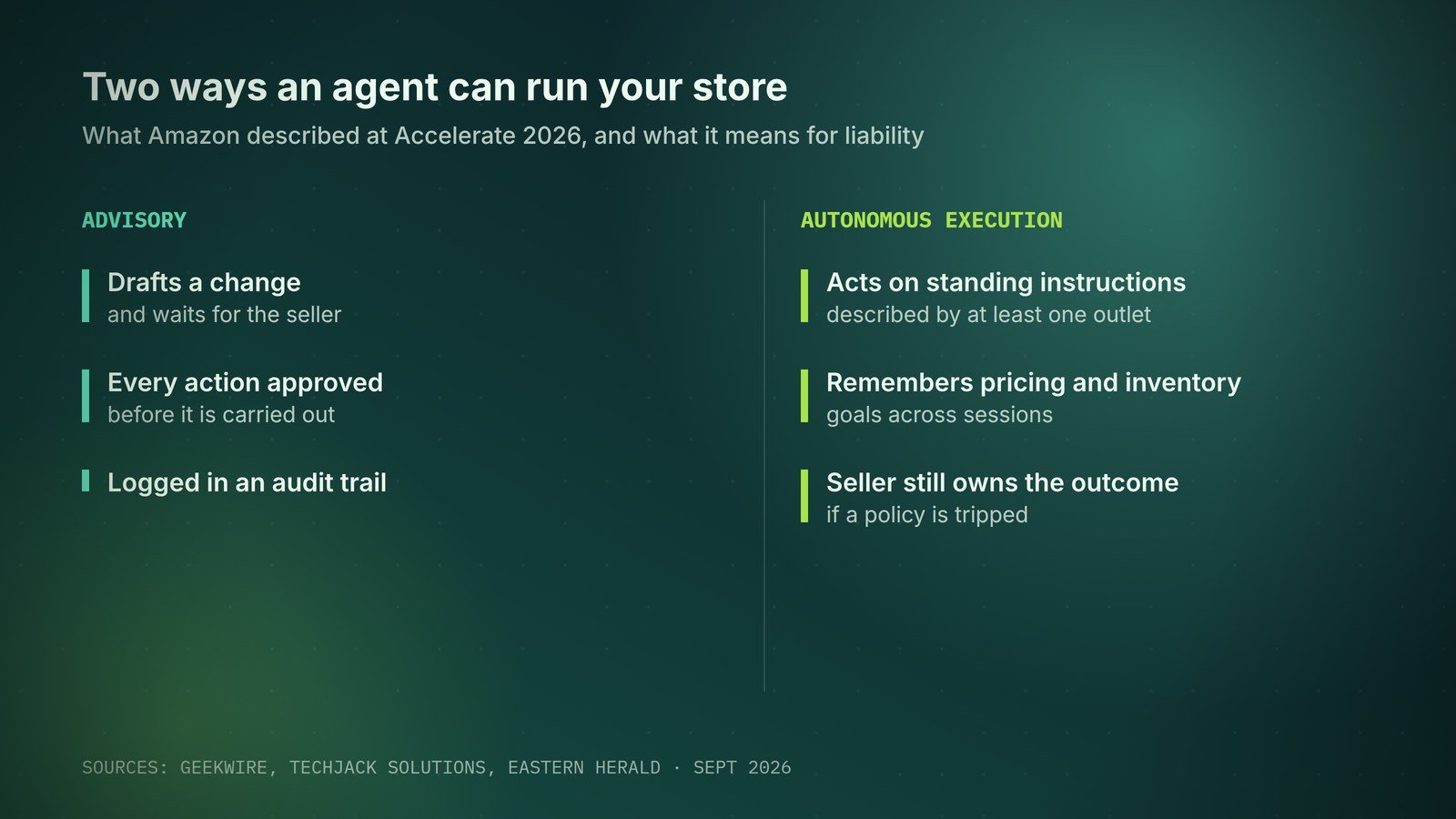
Here is where the coverage diverges, and where sellers should read carefully. Some reporting describes agents that must “approve every action before it is carried out,” with permissions granted through a new “Manage Agents” page. Other reporting describes “continuous agentic workflows” that run 24/7 without the seller logging in, executing routine tasks like inventory monitoring and price changes on their own. GeekWire reports that even background automations act only with the seller’s approval; at least one outlet describes an autonomous execution mode as well, and advises sellers to test the advisory mode before switching on autonomous execution. Which posture becomes the default is the detail to watch.
That distinction is not a footnote. An always-on agent adjusting prices against “pricing patterns, inventory cycles, and growth goals” it remembers across sessions is a very different liability object than a chatbot that drafts a change and waits for a click.
Who eats the mistake
Amazon’s public framing leans on governance language: every workflow action is logged with a complete audit trail, and sellers “set the instructions and guardrails themselves.” Read that sentence again, because it is doing a lot of work. An audit trail records who did what; it does not decide who is responsible. And “you set the guardrails” is the load-bearing clause — it relocates the duty of care from the platform that built the pipes to the merchant who flipped the switch.
The unresolved question, which at least one outlet named outright, is what happens when an autonomous pricing action trips an Amazon marketplace policy. On a platform where policy violations can suspend an account and vaporize a business overnight, “the agent did it” has never been a defense — and nothing Amazon announced suggests it becomes one now. The seller instructed the agent. The seller granted the permissions. The seller, therefore, owns the outcome.
This is the pattern worth watching as agent access spreads across platforms: the marketplace externalizes the operational upside to a partner model like Claude and the accountability downside to the merchant, while keeping the consumer relationship — the actually valuable thing — walled off. Amazon has not disclosed what it will charge after the free period, nor the criteria by which other AI providers get onto the allowlist. Until it does, sellers are being asked to automate the riskiest part of their business on terms that are, by design, still being written.
Sources

David Mensah covers software and platforms for prompt/power: apps, browsers, developer tools and the open web. He firmly believes every "simple" settings menu is hiding a second, worse settings menu.
Keep reading




Latest from prompt/power
- DeepSeek V4.1 Flash Cut the US AI Lead to 3%. What LiveBench MeasuresOct 6
- Ben Affleck Calls AI Job Fears ‘Propaganda.’ He Sold an AI Firm to NetflixOct 6
- Cohere’s North 2 Puts AI Agents on a Budget. Toronto Bets on BoringOct 6
- How to Stop ChatGPT, Claude, Gemini and Meta AI From Training on Your ChatsOct 6
- Musk Is a Trillionaire Again After SpaceX Stock Jumps 7.6%Oct 6
Leave a Reply