Ben Affleck Calls AI Job Fears ‘Propaganda.’ He Sold an AI Firm to Netflix
Affleck told Bloomberg AI is "another form of computing" and says films using it employ more people. He founded InterPositive, which Netflix bought this year for a reported US$587 million, and Labor Department data shows a 21% drop in film-production jobs since 2016.


Ben Affleck has a word for the warning that AI will kill us all, or at least half of white-collar work: propaganda. Once people stop picturing “this nebulous, abstract, terrifying alien,” he told Bloomberg, and “actually see what it is, it’s like another form of computing that does tools and is a technological advancement.”
Fortune, which wrote up the interview on Oct. 2, put the more interesting fact in its first sentence. Affleck is not a bystander to the AI argument. In 2022 he founded InterPositive, an AI filmmaking startup, and Netflix announced its acquisition of the company this year. Netflix paid US$587 million (about CA$816 million), according to Variety, as cited by Fortune; Netflix has not been quoted confirming a price in anything we reviewed.
None of that makes him wrong. It does mean he has money riding on the answer.
What Ben Affleck said about AI and jobs
The headline claim is about employment on his own projects. “It’s being used on films now where they have the same number of people—in fact, more people technically are being employed,” Affleck said, per Fortune’s account.
Which films, and doing what, he would not say. Asked about AI’s role in his new movie Animals, he said he was “a little bit hesitant to point out what they are or even talk about it because in my business, we’re trying to foster the illusion of reality.” He compared it to a magician announcing, before the show, that “there’s another bunny under here, this guy’s a plant—it sort of ruins it.”
That is a reasonable thing for a director to say about craft. It also means the evidence for his jobs claim is the claimant’s word, on productions whose AI use he declines to describe.
He is not a pure booster, either. “When I worry about AI, I worry about my kids in school, I worry about the 30% rise in the number of As given out at colleges in the last three years,” he said, adding: “I worry about learned helplessness. I worry about responsible use.” (The 30% figure is his; Fortune did not source it, and we could not check it.)
He has been saying this since 2024
The position is consistent. At CNBC’s Delivering Alpha conference in November 2024, as Fortune reported then, Affleck argued that “movies will be one of the last things, if everything gets replaced, to get replaced by AI,” and that “what AI is going to do is disintermediate the more laborious, less creative, and more costly aspects of filmmaking.”
Read the two interviews together and the InterPositive pitch is visible in outline: AI as a back-office tool that cheapens the expensive, unglamorous parts of production while the director and actors stay in charge. Netflix evidently found that pitch worth buying.
What the Hollywood job numbers say
The counterpoint is in Fortune’s own story. Between 2016 and 2026, the motion picture and video production industry shed 49,000 jobs, a 21% decline, according to Labor Department data the outlet charted. Our read: that decade includes the streaming pullback, the pandemic shutdowns and the 2023 strikes, so it does not prove AI is cutting jobs. It also does not square with the idea that the industry as a whole is hiring more people.
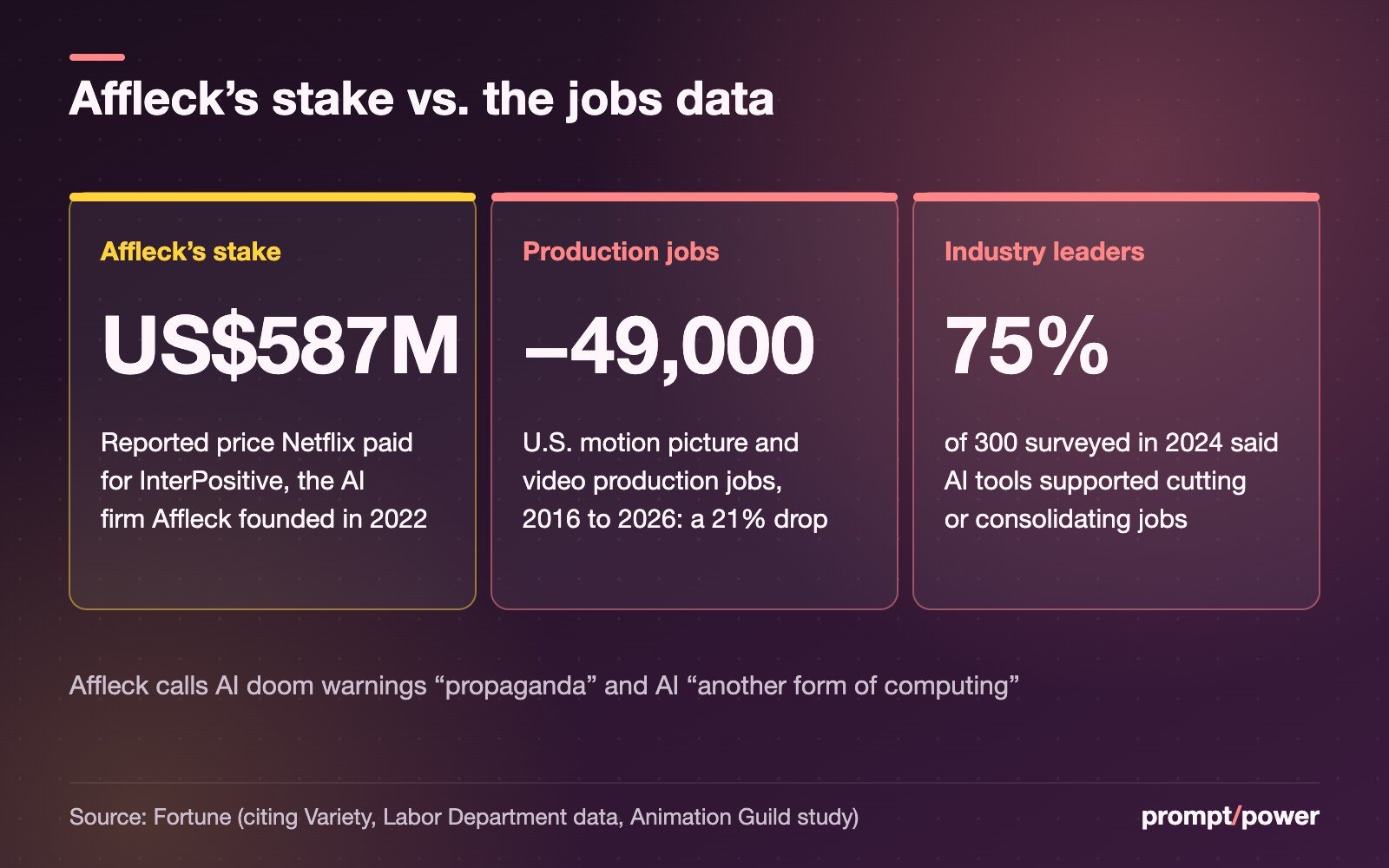
The people who do those jobs have been less relaxed than Affleck. Writers and actors both went on strike in 2023 and, in Fortune’s words, “found some success in issuing guardrails” on AI in their new contracts. And a 2024 study of 300 entertainment-industry leaders, commissioned by the Concept Art Association and the Animation Guild, found that 75% “indicated that AI tools supported the elimination, reduction or consolidation of jobs at their companies,” as Fortune reported.
Both things can be true at once. A given film can carry the same crew while the tools take work that used to go to a vendor, an assistant or a junior artist who was never on that crew list. Headcount on one set is a narrow way to measure a labour market.
Affleck is not alone in Hollywood
Plenty of famous names have picked a side. James Cameron joined the board of Stability AI in 2024. Natasha Lyonne co-founded Asteria, a studio built around what it pitches as copyright-friendly generative AI. Matthew McConaughey told a CNN town hall in February, per Fortune: “It’s not coming. It’s here.” If you want to see what the tools in question can do now, our rundown of the best AI video generators after Sora is a fair starting point.
What sets Affleck apart is that he has sold a company into the argument, which is why “propaganda” lands differently coming from him. He is right that much of the AI debate is pitched in apocalyptic terms that do not help anyone understand a VFX pipeline. But the people warning about jobs are mostly not talking about paperclips. They are talking about the junior roles that vanish quietly, which is exactly the kind of change that never shows up as a credit.
Affleck’s own analogy is the useful one. The audience should not be told about the second bunny under the hat. Netflix reportedly paid US$587 million for the hat.
Researched and drafted with AI tools, fact-checked against primary sources and approved by a human editor before publishing. Prices and dates are as of publication. Our standards →
Sources- fortune.com — told Bloomberg
- fortune.com — announced its acquisition
- variety.com — according to Variety
- cnbc.com — Delivering Alpha conference
- fortune.com — as Fortune reported
- fortune.com — co-founded Asteria
Casie Stewart covers the creator economy, social platforms and wellness tech for prompt/power: who gets paid, who gets seen, and what the algorithm is really asking of the people who feed it. She has been publishing online since 2005, long before "creator" was a job title, and has spent most of that time on the other side of the platforms she now writes about. Based in Toronto. Her rule for any new app: if it promises to save you time, check how much of it you just spent reading the onboarding. She also writes for Not An Atlas and The Remote.
All stories by Casie →