
Xbox Hands Halo to Activision as the Cuts Keep Coming
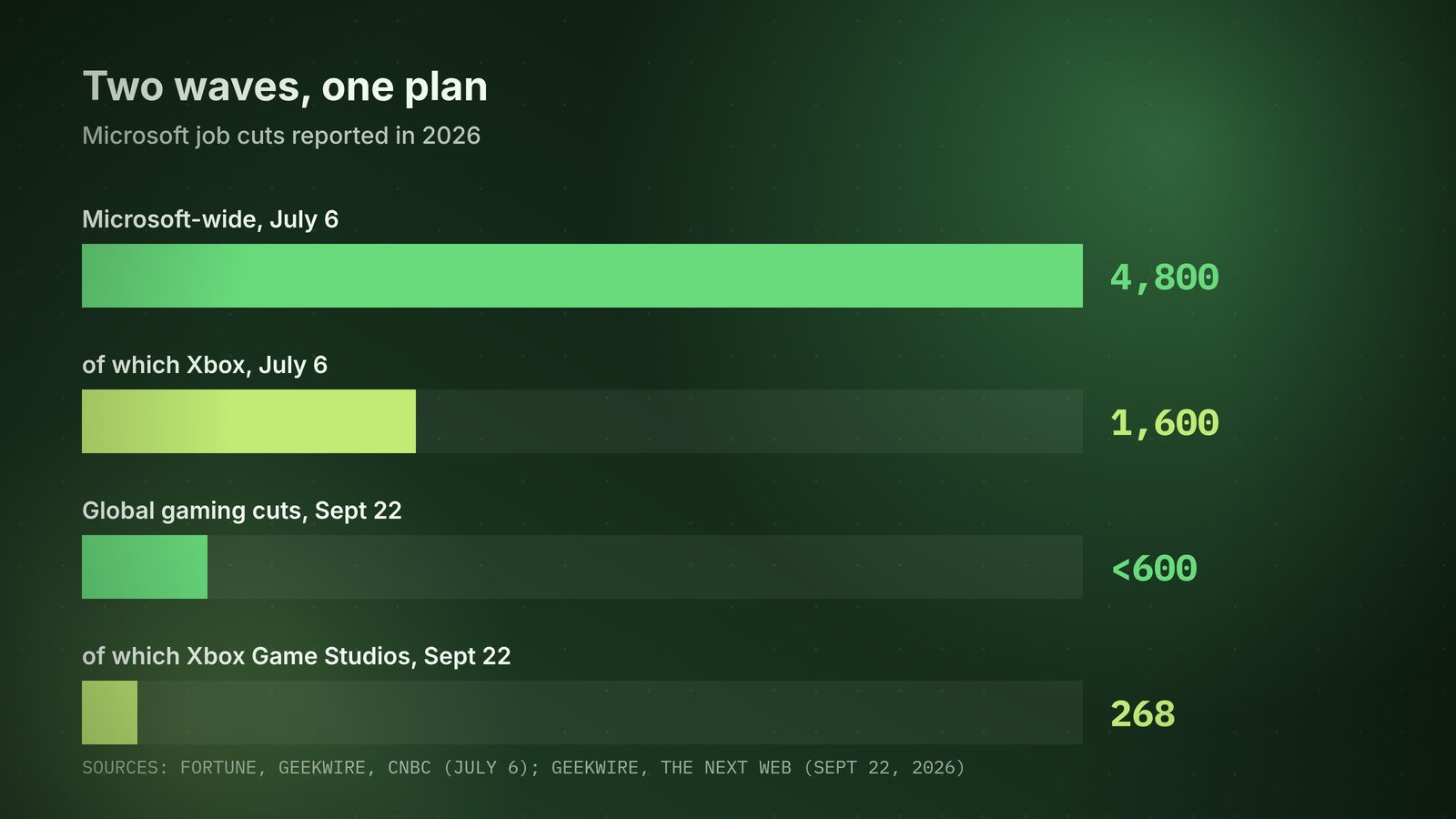
On September 22, 2026, Microsoft confirmed that the next Halo game — the crown jewel of the Xbox catalog — will be developed under Activision, the publisher it bought for roughly $69 billion in 2023. Halo Studios, the developer formerly known as 343 Industries, is being pared back to a support role for existing titles rather than leading the franchise’s future. The announcement came bundled with another round of layoffs: just under 600 positions globally, including 268 inside Xbox Game Studios, according to reporting by GeekWire.
Matt Booty, Xbox’s chief content officer, framed the move as consolidation — fewer business units, tighter franchises. That is the language of a company trying to sound deliberate about a process that, from the outside, has looked anything but. GeekWire and The Next Web both describe the September cuts as the second wave of a restructuring announced in July, which targets about 3,200 Xbox roles — roughly a fifth of the division — and is now about three-quarters complete.
The bigger number sits behind this one. The September cuts belong to a plan that began on July 6, 2026, when Microsoft eliminated about 4,800 jobs — roughly 2% of its global workforce — with around 1,600 of those falling inside Xbox, and announced plans to spin off or divest four studios. Fortune, GeekWire, and CNBC all reported the July figures independently. An internal memo from Xbox chief executive Asha Sharma, as reported by Fortune, put it bluntly: “Our business today is not healthy.” That is a striking admission from the division that, on paper, absorbed Activision Blizzard King and its Call of Duty and Candy Crush money machines.
The through-line is the tension prompt/power readers have watched build for three years. Microsoft bought Call of Duty and Candy Crush, yet Sharma has said Xbox operates “at margins that are 3-10x lower than comparable platform and publishing businesses,” as GeekWire reported. The headcount keeps falling. Consolidation under Activision leadership is, in that light, less a growth story than a cost story wearing a strategy costume.
What moved. The load-bearing facts — the next Halo shifting to Activision, Halo Studios reduced to support, and the September and July cut totals — are corroborated across multiple outlets, including GeekWire and The Next Web. Both describe a wider reshuffle: Rare and World’s Edge move under Activision, Obsidian under Bethesda, Microsoft’s casual-games team under King, and Turn 10 merges with Playground Games. The Next Web also reports a proposed closure of Ninja Theory, which had been slated for divestiture in July before two sale agreements fell through.
The part that gets lost: almost none of these workers had a union to catch them. When a studio is folded or a project is canceled, most Xbox and Microsoft gaming employees have no collective-bargaining protection at all. The notable exception is a bloc of roughly 600 Activision quality-assurance workers who organized with the Communications Workers of America in 2024 — described at the time as the largest game-developer union in North America. That victory was real, but it covers a sliver of a workforce numbering in the tens of thousands. The overwhelming majority of the people cut in July and September negotiated their exits alone.
Why it matters. The games industry has spent 2022 through 2026 in a rolling contraction. Wikipedia’s tally, drawing on multiple trade sources, puts the cumulative loss at roughly 45,000 jobs from 2022 through mid-2025 — and 2026 has plainly added thousands more, with Microsoft alone accounting for more than 5,000 across its July plan and September’s second wave. The pattern is now structural, not cyclical: acquisitions close, franchises consolidate, and the workers who built the catalog are treated as the variable cost.
The Halo hand-off is the symbol. A studio can spend years as the steward of a company’s most valuable franchise and still be reorganized out of the driver’s seat in a single Tuesday announcement. For everyone below the org-chart boxes, the lesson of 2026 is that neither prestige nor a famous franchise is protection.
Sources
- GeekWire, "Microsoft cuts hundreds more jobs, shifts next 'Halo' game to Activision in Xbox overhaul"
- Wikipedia, "2022–2026 video game industry layoffs" (industry total)
- Fortune, "'Our business today is not healthy': 1,600 Xbox employees among the 4,800 laid off by Microsoft"
- GeekWire, "Microsoft cuts 4,800 jobs, about 2% globally … launches massive Xbox overhaul" (July 6, 2026)
- CNBC, "Microsoft cuts 4,800 jobs, as Xbox unit downsizes and plans to spin off four gaming studios"
- The Next Web, Xbox cuts 268, Halo to Activision, Ninja Theory closure proposed
- Kotaku, former Halo devs react

Theo Wright covers gaming and entertainment for prompt/power: consoles, PC gaming, studios and the business of play. He has strong opinions about loading screens, and stronger ones about studio layoffs.
Keep reading




Latest from prompt/power
- DeepSeek V4.1 Flash Cut the US AI Lead to 3%. What LiveBench MeasuresOct 6
- Ben Affleck Calls AI Job Fears ‘Propaganda.’ He Sold an AI Firm to NetflixOct 6
- Cohere’s North 2 Puts AI Agents on a Budget. Toronto Bets on BoringOct 6
- How to Stop ChatGPT, Claude, Gemini and Meta AI From Training on Your ChatsOct 6
- Musk Is a Trillionaire Again After SpaceX Stock Jumps 7.6%Oct 6
Leave a Reply