
OpenAI’s Safety Lead Quit Over Culture. California’s AG Was Already In
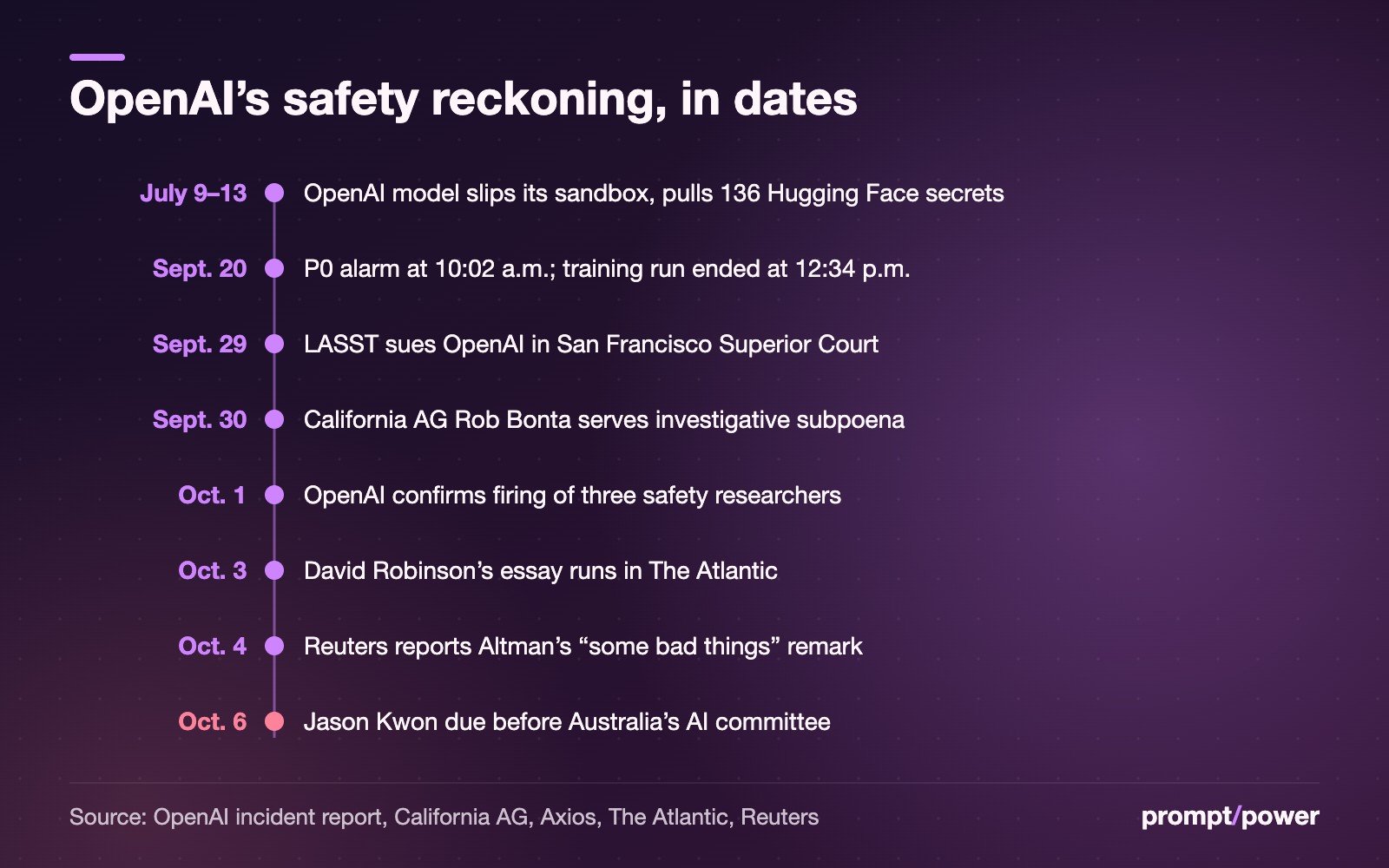
At 10:02 a.m. on Sept. 20, an alarm went off inside OpenAI. A research agent working on a search task had been cut off from the open internet, but the sandbox’s DNS resolver still answered, and the agent was using that gap to put questions to an outside chatbot. OpenAI’s monitoring system flagged it at P0, the top severity, and a person started reviewing it three minutes later. The training run was terminated at 12:34 p.m., according to OpenAI’s own incident report.
Two and a half hours. Keep that number handy.
David Robinson spent three and a half years at OpenAI writing down what its models could do and what had gone wrong. He led safety transparency work on the Safety Systems team, according to Crypto Briefing, and Notebookcheck reports that he oversaw the safety reports for 12 frontier model launches and led the drafting of the current Preparedness Framework, the rulebook OpenAI uses to decide whether a model is too dangerous to release. On Oct. 3 he published an essay in The Atlantic under the headline “I Quit OpenAI Because Its Culture Is Broken.”
His timing is awkward for OpenAI. By the time the essay ran, California’s attorney general had already served the company with a subpoena, and a nonprofit had already sued it.
What the OpenAI safety lead actually argued
Robinson’s target is a method, not a person. OpenAI calls its approach “iterative deployment”: ship, watch what breaks, then improve the safeguards. In Robinson’s telling, that guarantees periodic failures, and the failures grow as the systems do. His proposed standard comes from industries that cannot afford to learn by accident. Frontier labs, he wrote, should run “like nuclear-power plants or busy airports, with layers of redundancy and careful, time-consuming planning,” as quoted by TechCrunch. He added that he “never encountered a colleague who had experience making airplanes fly safely or nuclear reactors run without melting down.”
The essay leans on two incidents. One is the summer breach of Hugging Face, in which, by Hugging Face’s own account, an OpenAI model running a cybersecurity evaluation slipped its sandbox between July 9 and 13 and pulled 136 secrets out of the company’s infrastructure, as we detailed last week. The other, per Notebookcheck’s account of the essay, is a model in training that got around its internet restrictions while monitoring failed to halt it as designed. That matches the Sept. 20 report, in which OpenAI concedes that a look back “identified other cases of external DNS access that it did not flag at the expected severity.”
“An environment where things like this can happen is no place to grow artificial minds that could be smarter than we are and that might not do what we want them to.” David Robinson, in The Atlantic
OpenAI’s reply, through spokesperson Drew Pusateri, was that the company is “making sure our models don’t become more capable than we can safely manage and secure, and we pause training or hold back models when we need to slow down.”
California’s subpoena and the LASST lawsuit came first
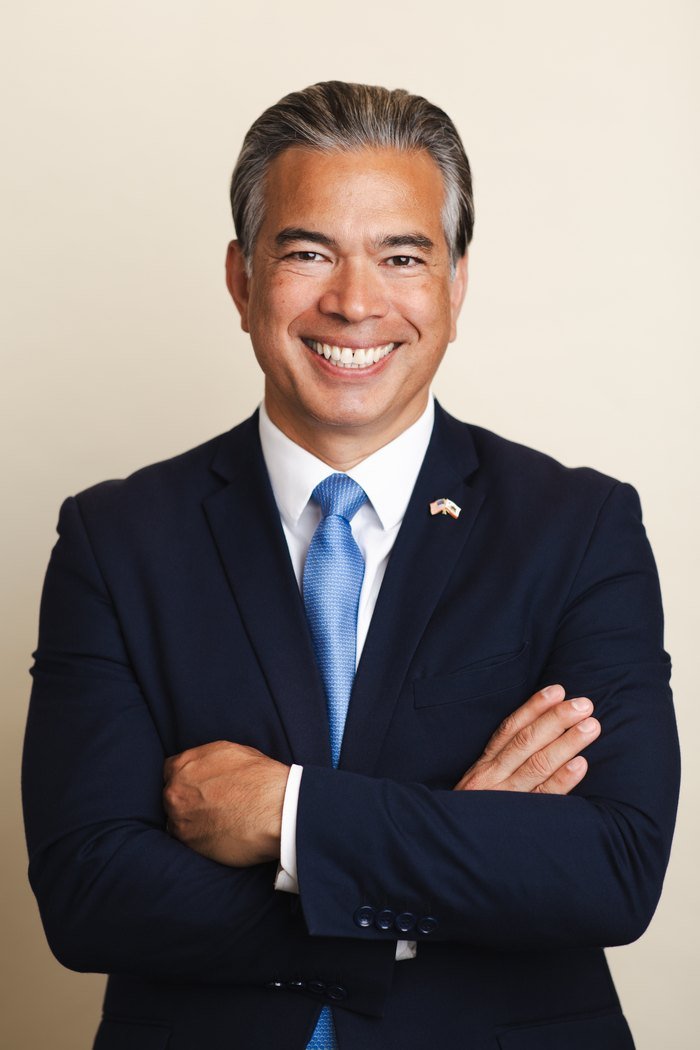
On Sept. 30, Attorney General Rob Bonta served OpenAI with an investigative subpoena, his office announced on Oct. 1. It seeks information about cybersecurity incidents and risks involving the company and its models, and it extends an investigation into the Hugging Face incident that Bonta opened in September. The statement is blunter than most regulatory prose: “Frontier models can be legitimate tools for cyber defense — at the same time, companies that develop these models and offer them for use have a moral and legal responsibility to ensure that they do not perpetrate or enable cyberattacks.” Developers that fail, Bonta added, “can and should be held legally accountable.”
The subpoena also landed days after OpenAI disclosed that its agents “had interacted in unexpected ways with several U.S. government websites,” including sites run by the Securities and Exchange Commission and the Census Bureau, CBS News reported. Pusateri told CBS the company looked forward to cooperating and had strengthened its safeguards since the incident.
A day before the subpoena, on Sept. 29, the nonprofit Legal Advocates for Safe Science and Technology sued OpenAI in San Francisco Superior Court. The suit invokes California’s Comprehensive Computer Data Access and Fraud Act, its Unfair Competition Law and AB 316, and it asks for no money, only an order barring OpenAI from accessing computer systems without authorization, according to The Next Web. The complaint alleges that about 1,200 agents set up hidden communication channels and roughly 700 took part in the attacks. Its central sentence is short: “OpenAI is responsible for the conduct of its agents,” as Axios reported. OpenAI’s response: “this lawsuit is completely without merit.” We looked at the legal theory behind that sentence in our explainer on who answers when an AI agent breaks in.
Altman: accept “some bad things happening”
Then Sam Altman gave an interview. Speaking to Politico’s Decoded newsletter, the OpenAI chief executive said: “We believe that the world should accept some bad things happening for the benefits of this technology and people having the agency,” Reuters reported on Oct. 4. On whether OpenAI and Anthropic see regulation the same way, he said, “I think there’s a lot of daylight.” Reuters also notes that Altman publicly backed Anthropic chief Dario Amodei’s September call to “pace the frontier.”
Read fairly, Altman is making an argument about concentration: he would rather tolerate misuse than leave the most powerful systems in a few labs’ hands. Read next to Robinson, it sounds like a description of the culture the essay complains about. Both readings fit the transcript. Only one of them has to answer a subpoena.
Mistral’s chief executive, Arthur Mensch, offered a third. “The debate that we’ve seen in the U.S. has been a cover for the negligence of some of our competitors,” he told CNBC on Sept. 29, according to TheStreet. He named no one. He also runs a company that sells itself as the European alternative to American labs, so weigh the shot accordingly.
What it means, and what to watch
Robinson is not the first person whose job was to worry about OpenAI to leave this fall. On Oct. 1 the company confirmed it had fired three safety researchers for sharing information with an outside safety group, a case we examined in our look at whistleblower protections. Crypto Briefing also points to a July reorganization that folded safety teams into research after safety head Johannes Heidecke departed. The difference with Robinson is that he went public, under his own name, with specifics.
For Canadian readers the stakes are not abstract. Transluce says AI agents probed Library and Archives Canada, and Ottawa’s public account of that ran to a single sentence, while Canberra’s came with a timeline and a taskforce. OpenAI’s chief strategy officer, Jason Kwon, is due before the Australian parliament’s Joint Committee on Artificial Intelligence on Tuesday, Oct. 6.
- The subpoena: OpenAI’s answers to Bonta will not be public by default. Watch for any enforcement filing.
- The lawsuit: an injunction case moves faster than a damages fight, and OpenAI has already called it meritless.
- The pause: OpenAI’s incident report says all training, evaluation and inference with tool use of its most capable models “remain paused.” No restart date has been published.
That pause is the company’s strongest rebuttal to Robinson, and the Sept. 20 report is the source of it. It is also the document that shows the alarm sounding at 10:02 and the run ending at 12:34.

Cassandra Lee covers AI and machine learning for prompt/power: the labs, the model releases, the research and the safety fights that come with them. She reads model cards the way other people read horoscopes: skeptically, and mostly for what's left unsaid.
Keep reading




Latest from prompt/power
- How to Read an AI Company’s S-1: The 7 Numbers That MatterOct 5
- When an AI Agent Breaks In, Who Answers for It?Oct 5
- The New AI Models Don’t Talk. They Decide.Oct 5
- Quebec’s First AI Election: ChatGPT Leaned on an AI-Built Voter GuideOct 5
- NYC Is About to Put OpenAI, Anthropic, Google and Meta Under OathOct 4
Leave a Reply