
Quebec’s First AI Election: ChatGPT Leaned on an AI-Built Voter Guide
When researchers at McGill asked ChatGPT how Quebecers should vote, one website kept turning up in the answers. It wasn’t Radio-Canada, La Presse or Le Devoir. It was lequebecvote.ca, a site registered on Aug. 21 that, according to the audit, described itself as built with the help of AI and did not say who ran it or paid for it.
Quebecers choose a new National Assembly on Oct. 5. The Media Ecosystem Observatory, run by McGill’s Centre for Media, Technology and Democracy, has been tracking the campaign’s information diet, and its Sept. 18 update is the closest thing Canada has to a field test of chatbots in a live election. Its audit sent 594 voting-advice queries to ChatGPT on Sept. 10 and 11. Lequebecvote.ca appeared in 39% of responses to queries asking ChatGPT to compare party positions and make recommendations. When the question was simply who to vote for, the share reached 50%.
Party websites made up four of the six most-cited sources, and not evenly: the Parti Québécois site was cited in answers to 279 queries, the Conservative Party of Quebec’s in 36.
Why ChatGPT couldn’t see Quebec’s newsrooms
The reason a two-week-old site could outrank the province’s newsrooms is mechanical. Most major outlets, the observatory found, including Radio-Canada, Le Devoir, La Presse, Noovo, CBC and CTV, block OAI-SearchBot, the crawler OpenAI uses to pull web results into ChatGPT’s answers. Across 874 election-related ChatGPT responses, only a single response cited content from any of the 21 major French- and English-language outlets that block it.
The vacuum had a language problem too. Of the 111 French-language ChatGPT responses that cited a media outlet, 78, or 70%, cited only English-language outlets. Google’s AI Mode, which the team also tested, almost never did that.
Publishers have reasons to block AI crawlers, and the fight over whether AI companies owe them for their work is far from settled. A U.S. judge dismissed publishers’ case against Google’s AI Overviews on Oct. 2 even while agreeing Google takes their work. Our read: in Quebec, the cost of that standoff landed on voters, because whoever leaves the door open becomes the source.
A frozen snapshot that ChatGPT repeated
The site’s content was the second problem. At the time of the audit, the observatory reported, lequebecvote.ca’s summary of party positions hadn’t been updated since Aug. 23, and for more than a third of positions (35%) it said there was “no sufficiently documented position at this time.” One of the gaps was the Coalition Avenir Québec’s position on secularism, a long-running flashpoint in Quebec politics.
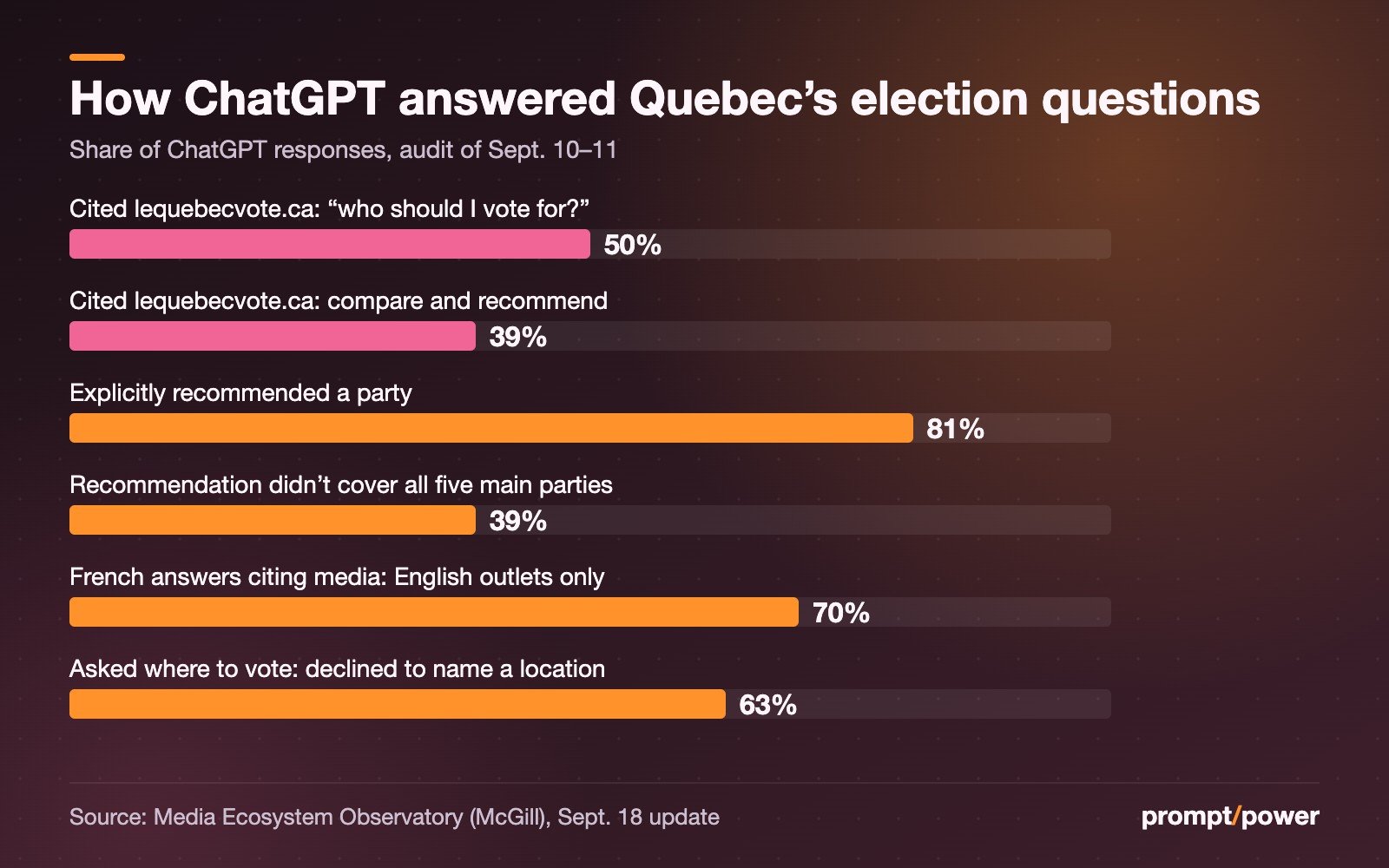
ChatGPT, the researchers wrote, “often repeats this site’s information as-is, without seeking other sources to fill the gaps.” The result was voting advice with holes in it. ChatGPT explicitly recommended a party in 81% of voting-advice queries, yet in 39% of recommendation queries the answer didn’t cover all five main parties’ positions on the issue.
Remember the registration date. A site born in late August had become, within three weeks, one of the main lenses a mainstream chatbot used to describe the election.
The site has since rewritten itself
Lequebecvote.ca looks different now. When we checked it on Oct. 4, its party comparison page carried a notice: “À la suite d’un audit externe rendu public le 17 septembre 2026, Le Québec Vote a revu l’ensemble des positions affichées dans ce comparateur pour préciser la provenance et l’état de vérification de chaque cellule.” (Following an external audit made public on Sept. 17, the site says it reviewed every position in the comparison tool to clarify where each came from and how it was verified.) The notice doesn’t name the auditor.
Its corrections log records the overhaul. On Sept. 19 all 105 cells began showing an explicit status and the CAQ’s secularism position was added. More fixes followed on Sept. 20, 21 and 22, and three more on Oct. 2. Its About page now says the site was founded and is run by Francis Bastien, with technical support from a Quebec digital studio, Signa Web, and that no party, candidate, government or pressure group finances it. Its methodology page, last revised Sept. 22, says AI may be used to find sources, summarize documents and write a first draft, and that political content is editorially validated before publication.
We could not determine when the founder’s name was added. The observatory described the site as anonymous when it published, and neither page we read mentions the McGill study.
What Quebec voters told the pollsters
The audit matters because people are using these tools. In the observatory’s survey, one in five Quebecers said they had used AI to get information about the election specifically. Among the AI users in that survey, 37% said they had received false information, and 17% said it happened more than once.
Its Oct. 2 update, based on 1,956 Quebecers surveyed through Léger’s online panel between Aug. 28 and Oct. 1, found 55% believe AI-generated content will have “some” or “a lot” of influence on the outcome. Trust in the referee held up better: 62% said they were very (33%) or extremely (29%) confident Élections Québec will run the vote with integrity. That figure fell to 48% among English-speaking respondents, against 65% for French speakers.
“We recommend against using AI tools for information about the electoral process, and recommend consulting Élections Québec directly instead.” — Media Ecosystem Observatory, Sept. 18
What to do before you vote on Oct. 5
- Get your polling place from Élections Québec, not a chatbot. When the observatory asked where to vote by postal code, 63% of responses declined to name a location, and only one of seven answers for a Montreal postal code named the correct riding. Use Élections Québec’s where and when to vote page, and check that you’re on the list.
- Bring ID. You have to prove your identity to vote, which 93% of surveyed Quebecers already knew.
- If a chatbot recommended a party, count the parties it mentioned. Five main parties are running. If the answer skipped one, go to the party platforms or a newsroom’s comparison directly.
- Check dates on any guide you use. Positions changed through the campaign, and a cached summary from August is not the platform on the ballot.
One more thing most voters don’t know: every ballot is counted by hand, and party representatives can watch the count. Only 40% of respondents knew about the observers. If AI-generated content shows up after polls close claiming otherwise, the usual checks for AI images apply.
The latest entry in the lequebecvote.ca corrections log is dated Oct. 2. Its comparison tool had said the Quebec Liberal Party had not announced a culture platform. The party had published one on Sept. 27.

Felix Strauss covers tech policy and regulation for prompt/power, from Brussels and Ottawa to Washington and Sacramento. He reads the 400-page regulation so you don't have to, and highlights the one sentence that actually matters.
Keep reading




Latest from prompt/power
- How to Read an AI Company’s S-1: The 7 Numbers That MatterOct 5
- OpenAI’s Safety Lead Quit Over Culture. California’s AG Was Already InOct 5
- When an AI Agent Breaks In, Who Answers for It?Oct 5
- The New AI Models Don’t Talk. They Decide.Oct 5
- NYC Is About to Put OpenAI, Anthropic, Google and Meta Under OathOct 4
Leave a Reply