
IWF Found More AI Child Abuse Images in Six Months Than in All of 2025
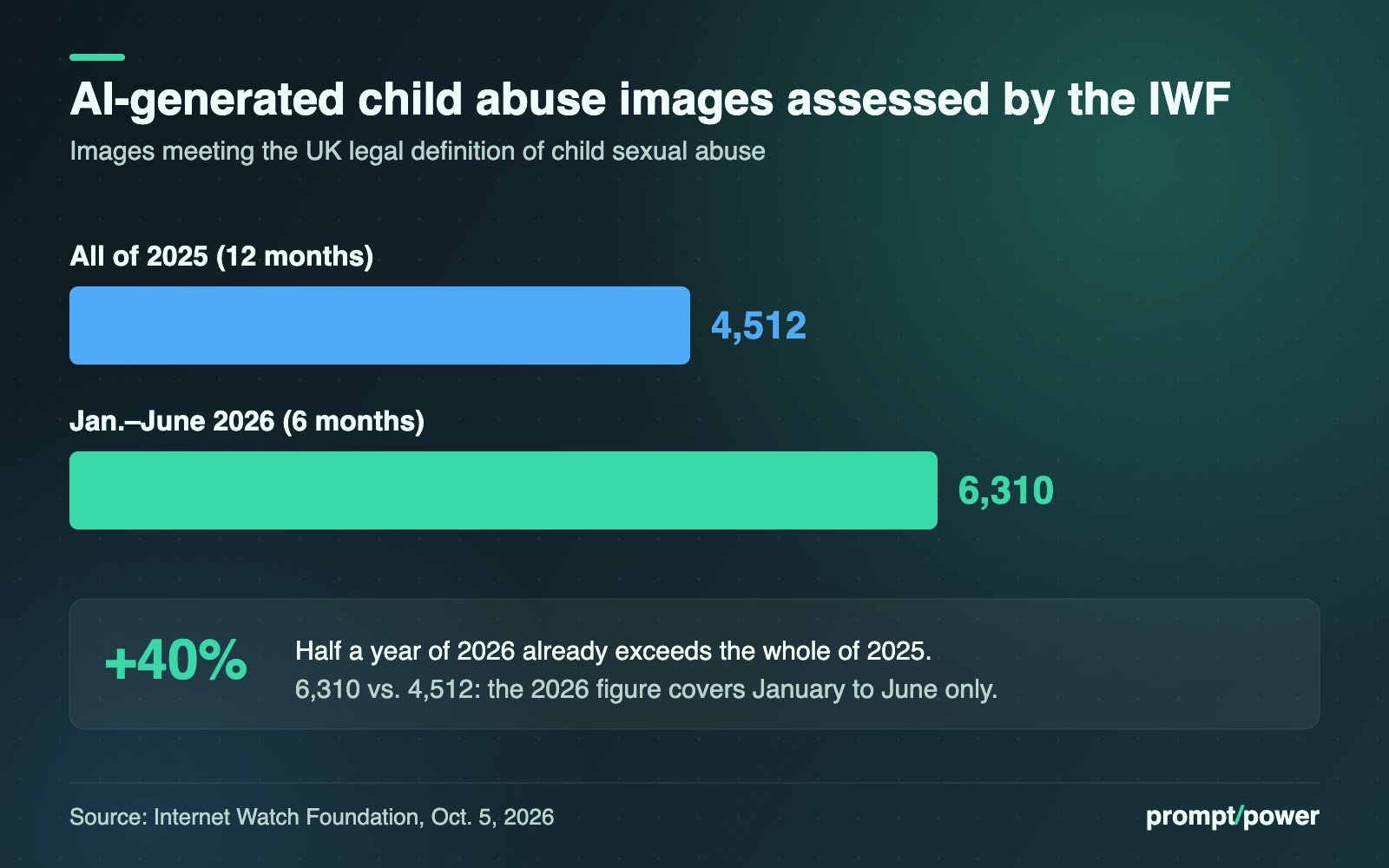
The Internet Watch Foundation (IWF), the UK charity that finds and removes child sexual abuse material online, assessed 6,310 AI-generated images that met the legal definition of child sexual abuse between January and June 2026. In the whole of 2025 it found 4,512. Six months of 2026 have already produced 40% more than the previous twelve, the IWF said in figures published on Oct. 5.

That comparison matters. The 40% is not a six-month growth rate; it sets half a year against a full one. If the second half of 2026 merely matches the first, the annual total would be close to triple last year’s.
“It is deeply concerning to see how quickly AI-generated child sexual abuse imagery continues to grow and spread online,” said Kerry Smith, the IWF’s chief executive, in the release.
What the IWF’s AI child abuse figures show
The charity broke the half-year total down in its release. Girls appeared in 98% of the images where sex was recorded. Children aged 7 to 13 accounted for 79% of the total, up from 70% in 2025.
UK courts sort indecent images of children into three legal categories, A to C, by severity. In the first half of 2026, 88% of the AI-generated images the IWF assessed were Category C, the least severe band, compared with 62% in 2025. In raw numbers, the IWF counted 350 Category A and 403 Category B images in the period. Every one of them is illegal to make, possess or share in the UK.
The rise is also reaching children directly. Report Remove, the service that lets under-18s in the UK ask for sexual images of themselves to be taken down, received 420 reports in 2026 from children saying such images had been faked or altered, against 397 in all of 2025, according to Result Sense’s summary of the Guardian’s report, which first carried the figures. “It is incumbent on tech companies to build tools which cannot be abused this way,” Hannah Swirsky, the IWF’s head of policy, told the Guardian, according to the same summary.
UK law already bans AI child abuse image generators
Britain has gone after the tools themselves. The Crime and Policing Act 2026 creates an offence covering the adaptation, possession, supply or offer to supply of models designed to generate child sexual abuse material, with a maximum sentence of five years in prison, according to the Home Office’s factsheet. It applies across England and Wales, Scotland and Northern Ireland. The same Act extends an existing offence covering so-called paedophile manuals to AI-generated material.
There is a carve-out for safety work. The Act gives the Secretary of State a power to let approved organisations hold such models for purposes such as testing what they can do. The government first announced that defence in November 2025, when Technology Secretary Liz Kendall said, as quoted by the IWF: “These new laws will ensure AI systems can be made safe at the source.”
One caveat: most of the Act’s provisions need commencement orders before they bite, the Online Safety Network notes, and the Home Office factsheet does not give a start date for the generator offence. Making, possessing or sharing the images themselves was already a crime under older laws.
What Ofcom requires of platforms
The Online Safety Act puts the burden on services rather than individuals. Since March 17, 2025, platforms in scope have had to act on illegal content, and Ofcom expects high-risk providers, including smaller file-hosting and storage services, to use hash-matching and URL detection to find known child sexual abuse material, the regulator said. Fines can reach £18m (about US$24m) or 10% of qualifying worldwide revenue, whichever is greater.
AI services are not exempt. In a November 2024 open letter, Ofcom said AI-generated images shared by users on a user-to-user service are “regulated in exactly the same way as human-generated content.”
The IWF’s release, though, was aimed at Brussels. It is pressing the EU to finish its proposed Child Sexual Abuse Regulation. “Europe cannot afford to delay,” Smith said.
A different fight in the US
Across the Atlantic, the legal battle runs the other way. On Oct. 2 the 8th U.S. Circuit Court of Appeals temporarily blocked a Minnesota law, in force since Aug. 1, that bars website operators and developers from letting users create realistic AI-generated intimate images of identifiable people without consent, Reuters reported via MPR News. Elon Musk’s xAI argues the law violates free-speech protections. Minnesota says it acted against what it called a “staggering amount (of) child sexual abuse material” produced by AI products, which xAI disputes, saying its tool has “rigorous protections.”
The scale problem is not only British. The US National Center for Missing & Exploited Children received more than 1.5 million CyberTipline reports with a generative AI connection in 2025, it said in March.
How to report AI child abuse images
- In the UK: report anonymously to the IWF at report.iwf.org.uk. Under-18s can use Report Remove through Childline.
- In Canada: report to Cybertip.ca, run by the Canadian Centre for Child Protection.
- In the US: report to NCMEC’s CyberTipline.
- Do not download, screenshot or forward the material, even to report it. Send the link instead. If a child is in immediate danger, call 999 in the UK or 911 in North America.
Parents looking at the AI apps their children use can start with our guide to the parental controls that exist. The IWF’s next count, for the second half of 2026, will show whether 6,310 was a peak or a midpoint.

Oman Hassan covers cybersecurity and privacy for prompt/power: breaches, exploits, surveillance and the policy that follows them. He assumes the password is "password" until proven otherwise.
Keep reading

How to Stop ChatGPT, Claude, Gemini and Meta AI From Training on Your Chats

New Mexico Wants Up to US$40B From Meta. Here’s How the Math Works

Google Paused Its Open-Source Bug Bounty Over a Flood of Bad AI Reports

Meta’s Muse Keeps a Page on Everyone You Know, Leaked Prompts Show
Latest from prompt/power
- Thomson Reuters Won the First AI Training Appeal. Footnote 7 Is the CatchOct 7
- The Family Safe Word: How to Beat AI Voice-Clone Emergency ScamsOct 7
- Reflection AI’s Beam, Explained: The 501B Open-Weight Model Aimed at ChinaOct 7
- Your SSN or SIN Leaked in a Breach? Do These 8 ThingsOct 7
- Apple’s Oct. 13 Event Rumour, Plus iPhone Duo Pre-Order Dates for CanadaOct 7
Leave a Reply