
Rogers Communications will report its third-quarter 2026 results before markets open on Friday, Oct. 23, with a conference call for analysts at 8 a.m. ET, according to the company’s teleconference notice. It will be the first quarterly report since Rogers quietly raised three of its four bring-your-own-phone plans by CA$5 a month for new customers. The number that will show whether that matters is mobile phone ARPU, the average monthly revenue Rogers makes per phone line. It has fallen year over year in each of the last four quarters Rogers has reported.
We built the record from Rogers’s own releases, then set it against the price changes. Here is what the company’s numbers say going in, and what to look for when the Q3 release lands on Rogers’s investor relations site.
Rogers, Bell and Telus plan prices: the CA$5 hike
None of the Big Three announced it. iPhone in Canada spotted the changes on Oct. 9: Rogers and Telus had each lifted three bring-your-own-phone (BYOP) tiers by CA$5 a month, following Bell, which raised its BYOP prices by CA$5 to CA$10 on Oct. 6. The top unlimited tier at all three stayed at CA$100.
| Rogers BYOP plan | Before | From Oct. 9 | In US$ (about) |
|---|---|---|---|
| 5G+ Lite, 60GB | CA$65 | CA$70 | US$50 |
| 5G+ Essentials, 100GB | CA$70 | CA$75 | US$53 |
| 5G+ Popular, unlimited | CA$85 | CA$90 | US$64 |
| 5G+ Ultimate, unlimited | CA$100 | CA$100 | US$71 |
Rogers’s prices are with its Auto-Pay discount. Telus’s matching tiers, 5G+ Select at 60GB, 5G+ Complete at 100GB and Complete Unlimited, moved from CA$65, CA$70 and CA$85 to CA$70, CA$75 and CA$90, with a CA$10 discount built in. Bell’s cheapest 60GB plan is now CA$70. US$ conversions use the Bank of Canada’s Oct. 19 rate of CA$1.4097.
The increases apply to the advertised rates for new sign-ups. Existing customers are not automatically moved, though a separate rate change on a current bill is always possible.
Look at the pattern rather than the dollars. The cheapest three tiers rose and the CA$100 tier did not, so the gap between a 60GB plan and full unlimited roaming narrowed from CA$35 to CA$30. That is a nudge upward, toward the plans Rogers most wants to sell.
Rogers ARPU has fallen for four straight quarters
Here is why Rogers would want that nudge. Its mobile phone ARPU has dropped year over year in every quarter for the past year, and Rogers has blamed the same cause each time.
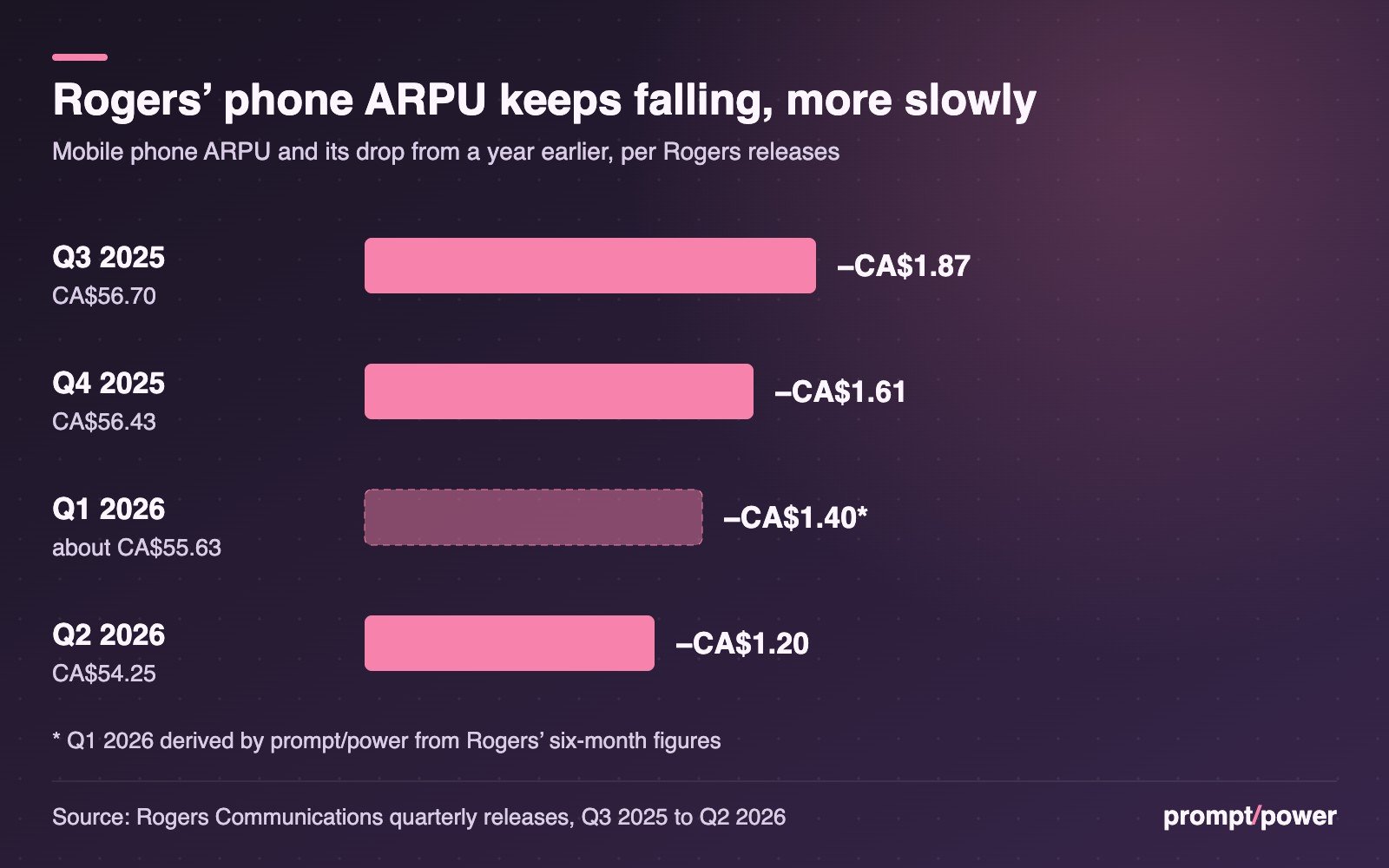
- Q3 2025: CA$56.70, down CA$1.87, per the Oct. 23, 2025 release, which cited “ongoing competitive intensity in a slowing market.”
- Q4 2025: CA$56.43, down CA$1.61, per the Jan. 29 release, with the same phrase.
- Q1 2026: about CA$55.63, down about CA$1.40. Our calculation from the six-month figures in the Q2 release.
- Q2 2026: CA$54.25, down CA$1.20 from CA$55.45, per the July 22 release, which pointed to “the cumulative impact of competitive intensity.”
Two things stand out. The declines are getting smaller, from CA$1.87 to CA$1.20. And the CA$5 hike only touches new BYOP sign-ups from Oct. 9, nine days into the fourth quarter. It cannot show up in Friday’s third-quarter ARPU at all. What Friday can show is whether the slide kept shrinking on its own before the prices went up.
One caution on comparing across years. The Q2 2026 release gives Q2 2025 ARPU as CA$55.45, lower than the CA$56-plus figures Rogers reported for each quarter of 2025’s second half. Read each quarter against the year-earlier number in the same release, as we have here, not against older releases.
The CA$5 hike started nine days into the fourth quarter. Friday’s ARPU can’t show it.
Rogers Q3 earnings: the numbers to watch
Three wireless lines in Friday’s release will say most of what matters for customers.
- Postpaid phone net additions. Rogers added 22,000 in the second quarter, down from 35,000 a year earlier, and 62,000 in Q3 2025. A third-quarter number well below 62,000 would extend a slowdown Rogers has tied partly to slowing population growth after changes to immigration policy.
- Postpaid churn. Monthly churn was 0.94% in Q2 2026, against 0.99% in Q3 2025. Our read: a period of low churn is the least risky time to raise prices for new customers.
- Wireless service revenue. It was CA$1.99 billion in Q2, flat from CA$2.00 billion a year earlier. Rogers’s total revenue rose 8% in the same quarter to CA$5.62 billion, so the growth is coming from somewhere other than phone plans.
Rogers also reaffirmed its 2026 outlook in July: total service revenue growth of 3% to 5% and adjusted EBITDA growth of 1% to 3%. Any change to that range on Friday would be the first sign that the competitive pressure Rogers keeps describing has eased, or worsened.
How it compares with the US
Americans have seen the same move made a different way. T-Mobile is raising bills by adding fees rather than touching plan prices, which we covered when its fee increase hit customers with a price lock. Canada’s carriers moved the sticker price for new customers instead. The cheapest Rogers BYOP plan is now about US$50 a month for 60GB, before taxes.
Bell’s own changes, including Virgin Plus and Public Mobile, are in our breakdown of Bell’s plan price changes. More consumer tech is on our consumer apps page.
What to do if you’re shopping for a plan
- Already on a plan? Your price did not change because of this. Check your latest bill for any separate rate notice.
- Signing up? The advertised Rogers and Telus prices assume an automatic-payment or built-in discount. Without it, you pay more.
- Want to compare? iPhone in Canada’s Oct. 9 check covered the main Rogers, Telus and Bell brands only. Rogers’s Fido and Chatr, and Bell’s and Telus’s discount brands, need checking separately.
Rogers’s mobile phone ARPU in the second quarter was CA$54.25. Its cheapest BYOP plan now costs CA$70. The release on Oct. 23 will show how much of the difference promotions are still giving away.

Alicia Loveday is a senior editor at prompt/power and a mom who works where fashion meets AI. She leads Tech & Your Money: what Canadians actually pay for phones, plans and gadgets, and the fine print that changes the bill. When the news needs her elsewhere, she goes. She believes every algorithm should come with a return policy.
Keep reading




Latest from prompt/power
- Quebecor’s offer for TELUS says nothing about TELUS’s AI factories. Here’s what’s at stakeNov 16
- Can an AI chatbot be your therapist? Where the rules stand in the U.S., Canada and beyondNov 16
- ChatGPT, Claude, Gemini and Copilot: what every AI plan costs in CanadaNov 16
- Nvidia’s first earnings without Jensen Huang: the numbers to watch on TuesdayNov 16
- SoftBank wrote off 39% of its AI power equipment spendingNov 16
Leave a Reply