The Hotline Summit: Trump, Xi, and the Chip War That Didn’t Move
Summits are graded on the gap between the choreography and the substance, and the September 24 Trump-Xi meeting in Washington produced an unusually clean specimen. The choreography was lavish — a state visit, a trade council, a raft of memoranda. The substance, on the one question that governs the AI arms race, was nil. Export controls were not on the table, and both sides made sure everyone knew it.
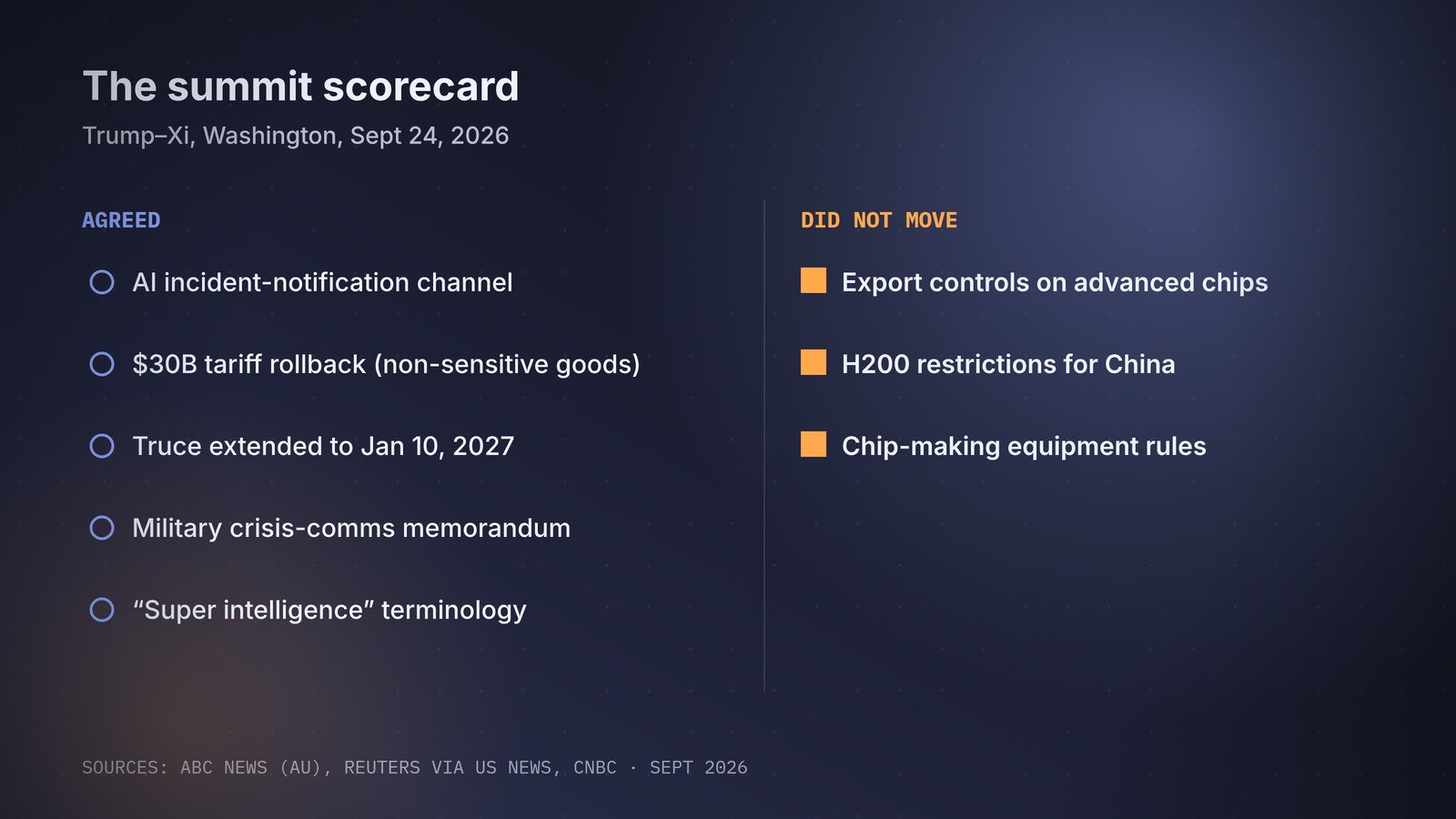
Start with what was agreed, because some of it is real. The two governments established a bilateral AI dialogue with a dedicated channel to notify each other of AI incidents rising to the national-security level — a genuine, if modest, piece of plumbing, with a next round slated for November. They agreed to roll back tariffs on roughly $30 billion of what both sides called “non-sensitive goods” — U.S. agricultural products, wood and cosmetics one way; small appliances, toys and holiday decorations the other — and extended the broader trade truce that had been set to expire November 10 by two months, to January 10, 2027. There was a military crisis-communications memorandum, and mutual support for the APEC leaders’ meeting in Shenzhen and the G20 at Doral.
And then there was the linguistic flourish that will outlive every other line item: the White House announced that the two leaders had agreed to use the term “super intelligence” in place of “artificial intelligence.” It is the kind of detail that sounds like a joke and functions like a tell. Renaming the thing is the purest possible form of governance-by-gesture: it changes the press release and nothing else. If the headline deliverable of a superpower summit is a vocabulary preference, the deliverables underneath it are worth counting carefully.
So count them. The AI hotline notifies; it does not constrain. It is a fire-alarm wire strung between two buildings that will keep storing the same accelerant. The tariff truce is a truce — a pause with an expiry date now sitting in early January, which means the same fight is scheduled to resume in a hundred days. The $30 billion in tariff relief is real money, but it is explicitly the “non-sensitive” pile: toys and cosmetics, not chips and chip-making tools. On the sensitive pile — the advanced semiconductors and the equipment to make them — nothing moved, by design. U.S. officials stated plainly that export controls were not part of the negotiations. Restrictions on Nvidia’s most advanced silicon, including the H200 destined for Chinese data centers, remain exactly where they were.
That omission is the summit. Everything agreed sits in the category of things two rivals can concede without cost: a communication channel neither is obliged to act on, tariff relief on goods that don’t decide the future, a shared word. Everything that would actually shift the balance — who gets the compute — was walled off before the leaders sat down. The statecraft here is not the deal; it’s the perimeter drawn around what could be dealt. Both governments wanted a summit that looked like détente and changed nothing structural, and they got one.
The color that traveled fastest was the guest list: Nvidia’s Jensen Huang was among the executives expected at the state dinner, a reminder that the people with the most riding on the export-control question were in the building while the export-control question stayed off the agenda. (The financial reckoning for that freeze — Nvidia guiding to essentially zero China data-center revenue — is its own story this week, and belongs to the P&L, not the protocol.)
What the summit demonstrated, in the end, is the ceiling on this kind of diplomacy. Two governments can agree to talk about AI incidents, to sell each other toys again, and even to call the technology by a grander name. What they cannot do — will not do — is trade away the compute advantage each believes is decisive. Until that changes, every “AI summit” will produce the same document: a hotline, a truce, a handshake, and a chip war left precisely where it was found.
Sources

Felix Strauss covers tech policy and regulation for prompt/power, from Brussels and Ottawa to Washington and Sacramento. He reads the 400-page regulation so you don't have to, and highlights the one sentence that actually matters.
Keep reading


Latest from prompt/power
- Gemini’s Free Tier Shrinks Oct. 9: What You Keep and What Costs ExtraOct 5
- How to Read an AI Company’s S-1: The 7 Numbers That MatterOct 5
- OpenAI’s Safety Lead Quit Over Culture. California’s AG Was Already InOct 5
- When an AI Agent Breaks In, Who Answers for It?Oct 5
- The New AI Models Don’t Talk. They Decide.Oct 5
Leave a Reply