
Meta will report its third-quarter 2026 results after the market closes on Wednesday, Oct. 21, with a conference call at 1:30 p.m. PT / 4:30 p.m. ET, according to the company’s investor relations announcement. The bar it has to clear is one Meta set itself. In its second-quarter release on July 29, the company guided to third-quarter revenue of US$61 billion to US$64 billion and full-year capital expenditures of US$130 billion to US$145 billion.
Those two ranges, plus a free cash flow figure that nearly vanished last quarter, are the numbers that will decide how Wednesday reads. Here is each benchmark, taken from Meta’s own filings, and the arithmetic behind it.
Meta Q3 2026 earnings date, time and webcast
The results land after the close on Oct. 21. The call starts at 4:30 p.m. ET, and Meta says the live webcast will be on its investor site, investor.atmeta.com.
The revenue range Meta set for itself
Meta’s outlook was specific: “We expect third quarter 2026 total revenue to be in the range of $61-64 billion.” It added that the guidance assumes foreign currency is “an approximately 1% headwind” to year-over-year growth.
Set that against a year ago. Meta’s third-quarter 2025 release reported revenue of US$51.24 billion. Our math: the low end of the new range is growth of about 19%, the midpoint about 22% and the top end about 25%.
Every one of those is slower than the second quarter, when revenue rose 28% to US$60.80 billion. The first quarter grew 33%, according to Meta’s April 29 release. So the guidance itself describes a company whose growth is cooling from a very hot first half, and the question on Wednesday is how far.
Meta also has a recent record of landing near the top of its own ranges. For the second quarter it guided to US$58 billion to US$61 billion and reported US$60.80 billion. A print near US$64 billion would repeat that pattern. One near US$61 billion would be inside guidance and still read as a miss to anyone who has watched those last two quarters.
The ad engine underneath
Two second-quarter metrics explain where the revenue comes from. Ad impressions rose 14% year over year and the average price per ad rose 12%. In the first quarter, impressions grew 19%, with the same 12% price gain. Impression growth slowing while pricing holds is the pattern to check first: it says advertisers are paying more for each slot as the supply of new slots grows less quickly. Family daily active people averaged 3.60 billion in June, up 3%.
Capex: about US$79B to US$94B left to spend in 2026
Meta has moved its 2026 capital spending range twice this year, and both times the floor went up.
| Guidance given | 2026 capex range (incl. finance lease principal) |
|---|---|
| Before April 29 | US$115B to US$135B |
| April 29 (Q1 results) | US$125B to US$145B |
| July 29 (Q2 results) | US$130B to US$145B |
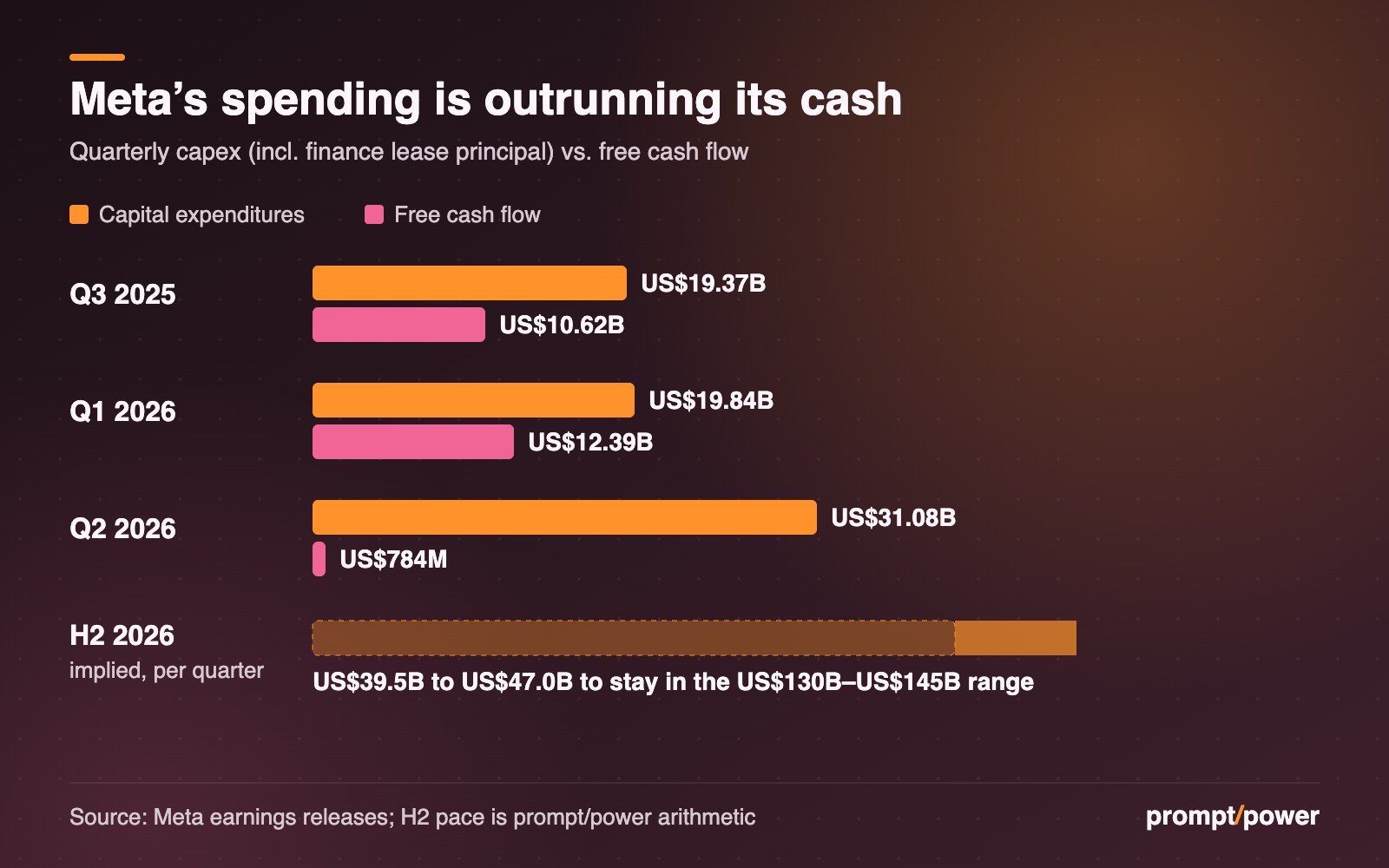
In July, the release said the range was “narrowed from our prior outlook of $125-145 billion.” Spending so far: US$19.84 billion in the first quarter and US$31.08 billion in the second, both including principal payments on finance leases. That is US$50.92 billion for the first half.
Subtract that from the guidance and Meta has committed itself to between about US$79 billion and US$94 billion in the second half. Split evenly, that is roughly US$40 billion to US$47 billion a quarter, against US$19.37 billion in the third quarter of 2025. Any third-quarter figure well below US$40 billion either loads the fourth quarter heavily or hints that the range is drifting down. A figure near US$47 billion points to the top of the range.
The bigger tell may be the 2027 language. A year ago, Meta’s third-quarter 2025 release warned that “capital expenditures dollar growth will be notably larger in 2026 than 2025.” Wednesday’s release is the natural place for an equivalent sentence about 2027.
Meta generated US$784 million in free cash flow in the second quarter. In the first quarter it was US$12.39 billion.
Free cash flow is the number to read first
That pull quote is not a typo. Meta’s free cash flow fell to US$784 million in the second quarter, from US$12.39 billion in the first quarter and US$10.62 billion in the third quarter of 2025. The company bought back no stock in the second quarter, against US$10.17 billion of buybacks a year earlier, while paying US$1.35 billion in dividends and dividend equivalents.
The balance sheet still has room. Meta ended June with US$90.26 billion in cash, cash equivalents and marketable securities, and US$83.66 billion of long-term debt. But if second-half capex really runs at US$40 billion-plus a quarter, free cash flow is likely to stay thin or turn negative unless operating cash flow rises with it. That is our read of the guidance, not a forecast Meta has made.
Meta’s AI push is also running into disputes outside the income statement. We have reported on how it classifies AI data centres for research tax credits, and on the new Oct. 30 business terms that let it crawl websites tied to business accounts.
Why the year-ago profit comparison will look strange
Headline earnings growth on Wednesday will probably be enormous, and mostly meaningless. Meta’s third-quarter 2025 net income was US$2.71 billion, or US$1.05 a diluted share, because the quarter absorbed a one-time, non-cash income tax charge of US$15.93 billion tied to the One Big Beautiful Bill Act. Excluding the charge, Meta said net income would have been US$18.64 billion.
Any year-over-year EPS comparison against US$1.05 will flatter the new quarter. The fairer test is operating income. In the second quarter it fell 8% to US$18.78 billion, and the operating margin dropped to 31% from 43% a year earlier, as costs and expenses jumped 55%.
Meta did promise one thing on profit: “We continue to expect to deliver operating income this year that is above 2025 operating income.” Its full-year expense range is US$165 billion to US$169 billion, with the low end raised in July to absorb US$2.4 billion of charges from legal proceedings. It also raised its expected tax rate for the rest of 2026 to 15% to 17%, from 13% to 16%.
Meta guidance scorecard for Oct. 21
| Benchmark | What Meta guided | What would stand out |
|---|---|---|
| Q3 revenue | US$61B to US$64B (about 19% to 25% growth) | Below US$61B, or a fourth-quarter range implying further slowing |
| 2026 capex | US$130B to US$145B; US$50.92B spent in H1 | A Q3 figure far from the US$40B to US$47B quarterly pace |
| 2026 total expenses | US$165B to US$169B | A raised top end |
| Tax rate, rest of 2026 | 15% to 17% | Another increase |
| 2026 operating income | Above 2025 | Any softening of that promise |
What to listen for on the call
- 2027 capex. Whether Meta repeats last year’s move and signals that dollar growth will rise again.
- Legal exposure. In July the CFO outlook flagged “a number of youth-related trials scheduled for this year in the U.S., which may ultimately result in a material loss.” Any update on those cases matters for the expense range.
- AI revenue beyond ads. Mark Zuckerberg said in July that AI is “opening the door to entirely new enterprise opportunities.” The company has started selling model access, as our look at Muse Wonder’s API pricing showed. Whether it breaks out any of that revenue is worth watching.
- Buybacks. A second straight quarter with none would confirm where the cash is going.
More earnings coverage is on our business and startups page.
A year ago, Meta’s third quarter produced US$10.62 billion in free cash flow on US$19.37 billion of capex. To hit the middle of this year’s range, it needs to spend more than twice that in each of the next two quarters.

Marcia Okonkwo covers the business of technology for prompt/power: venture capital, startups, IPOs and earnings. She treats a valuation as a mood rather than a number until the S-1 says otherwise.
Keep reading

Bumble Buyout: Ithaca Holdings Pays US$6.05 a Share, a 138% Premium

Amazon Eyes Decart for US$7B as Nvidia Weighs Buying Reflection AI

Cohere Opens an Ottawa Office as Its AI Agents Head to Navy Ships

Arena, the Leaderboard That Ranks AI Models, Is Now Worth US$3.1 Billion
Latest from prompt/power
- Anthropic’s 5% Pledge Is Worth About US$48B. Here’s the Fine PrintOct 21
- Commons AI Study Meets Parliament’s Interpreter Math: 44 Passes in 5 YearsOct 21
- CNN All Access Canada Price Is CA$7.99. Americans Pay About 23% MoreOct 20
- DeepSeek Federal Ban: DHS Order Also Covers Apps Built on Its ModelsOct 20
- Google Magic State Cultivation Explained: What Willow Fixed, What It Didn’tOct 20
Leave a Reply