The Memory ‘Shortage’ and the Theater of Margins
The cleanest way to understand the memory market right now is to hold two facts next to each other and resist the urge to pick a winner.
Fact one: On September 20, 2026, DigiTimes reported remarks from Acer chairman and chief executive Jason Chen that were, by the standards of hardware executives, unusually blunt. “It’s impossible for the shortage to last until 2030,” Chen said, according to reporting picked up by Tom’s Hardware and Notebookcheck on September 23. He argued that current supply of DDR4 and DDR5 is already ample, that genuine constraints are confined to high-end components, and — this is the load-bearing part — that memory makers have an incentive to keep repeating the 2030 timeline because it protects pricing. The outlets covering him paraphrased the accusation the same way: suppliers are overshooting their shortage estimates to defend the margins the AI cycle has delivered.
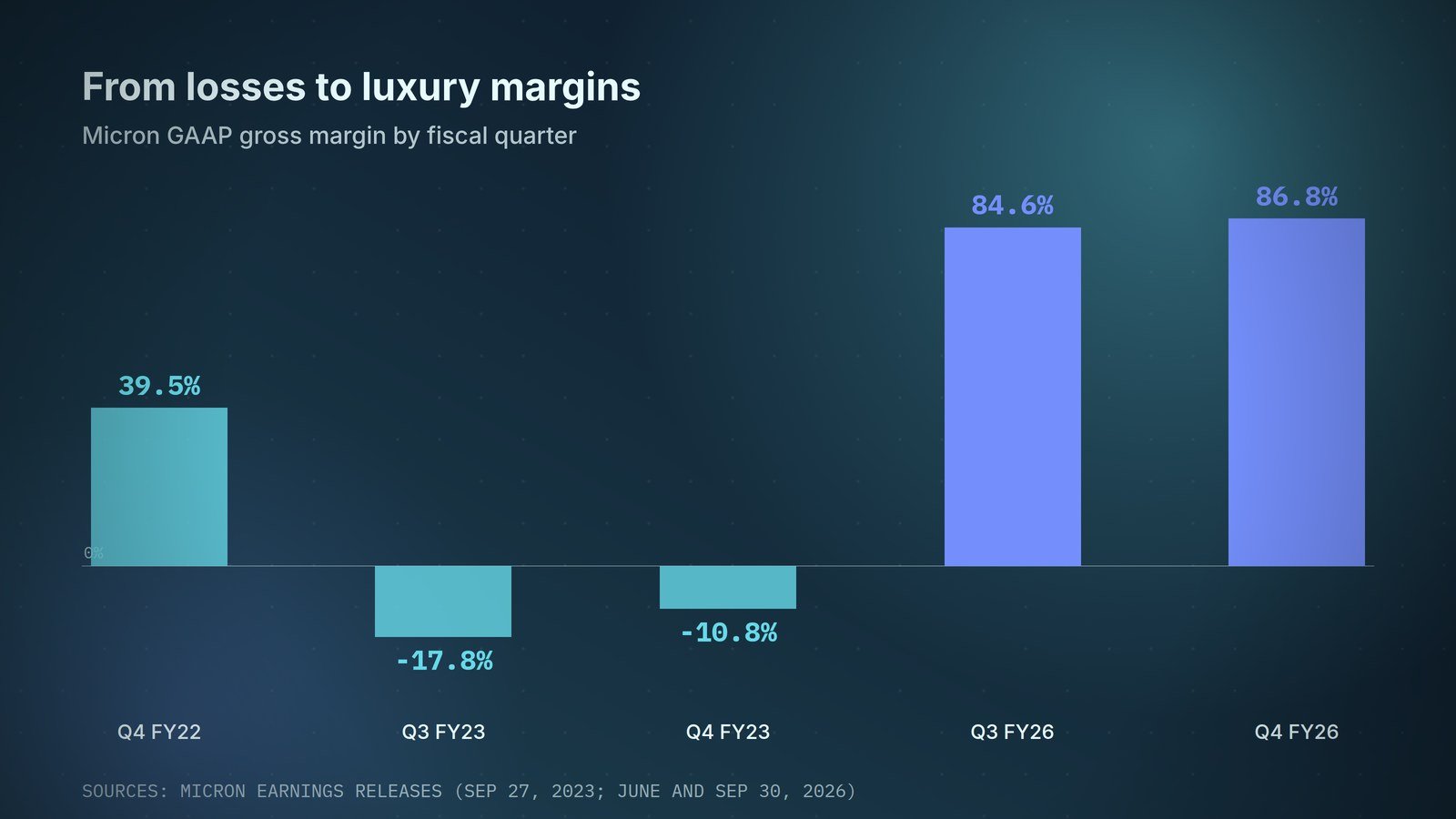
Fact two: memory suppliers are, in fact, printing money. On September 30, Micron reported its fiscal fourth quarter of 2026, ended September 3: record revenue of $54.23 billion, up from $11.32 billion a year earlier, at a GAAP gross margin of 86.8 percent. The quarter before had already set a record at 84.6 percent. For the current quarter Micron guided to about $61.5 billion in revenue, with gross margin near 86 percent. Reporting the fiscal-Q3 record in June, chief executive Sanjay Mehrotra said the company is “investing at record levels in technology, products and supply to address our customers’ rapidly growing demand.”
Why the margin number is the story
Set aside who is right about 2030 for a moment and look at that 86.8 percent gross margin, because it is the single figure that makes Chen’s accusation legible.
Memory is historically a brutal, cyclical commodity business. Just three years ago, in fiscal 2023, Micron’s GAAP gross margin for the full year was negative 9.1 percent, and the company lost $5.83 billion. An 87 percent gross margin is not a memory-industry number; it is a luxury-goods number. When a company that sells an interchangeable commodity is keeping 87 cents of every revenue dollar before operating costs, the polite word for it is scarcity pricing, and scarcity pricing depends entirely on the market believing the scarcity will persist.
That is the mechanism Chen is describing. He is not, in the coverage available, alleging a literal cartel or a fabricated inventory number. He is making a narrower and more defensible point about narrative: a supplier that tells the world prices “won’t come down until 2030” is doing something that happens to be very good for its own book, whether or not it is true. The forecast and the incentive are impossible to separate from the outside.
The capex side of the argument
Micron’s rebuttal, implicit in Mehrotra’s language, is that it is spending like a company that believes its own forecast. Record capital investment in new capacity is not what you do if you expect the shortage to evaporate; it is what you do if you think demand keeps climbing and you want to serve it. AI training and inference clusters genuinely do consume high-bandwidth memory at volumes that did not exist two years ago. The demand is not imaginary.
Chen’s counter to the counter is supply from a direction the incumbents would rather not discuss: China. He named CXMT specifically, arguing that cheaper Chinese DRAM coming online is the catalyst that breaks the pricing story. Acer has itself begun using CXMT chips in some products. Chen’s price forecast is concrete enough to be checked later: increases of 5 to 20 percent through the end of 2026, a plateau in early 2027, and declines after roughly mid-2027 — a timeline that ends years before the 2030 date he is disputing.
Why it matters
This is not really a fight about whether AI needs memory. It is a fight over who narrates the price. The supplier with an 87 percent margin and the OEM bracing for price increases of up to 20 percent have directly opposed interests in what you believe about 2030, and each is describing the world in the shape that suits its balance sheet. The useful posture for a buyer is to treat both the “shortage to 2030” line and the “prices crash in 2027” line as positions, not forecasts — and to watch Chinese capacity, because that is the variable that decides the argument regardless of who says what at a podium.
Sources
- Tom's Hardware, "Acer CEO says memory makers are hyping 2030 shortage fears to protect margins" (Sep 2026)
- Notebookcheck, "Acer CEO says memory makers are hyping the 2030 shortage to protect margins" (Sep 23, 2026)
- Micron fiscal-Q3 2026 results (StockTitan reproduction of Micron release)
- The Motley Fool, "Acer's CEO Has a Warning for Micron Technology Investors" (Sep 28, 2026)
- Micron, "Micron Technology, Inc. Reports Record Fiscal Fourth-Quarter and Full-Year 2026 Results"
- Micron fiscal Q4 2023 results (SEC filing, Sep 27, 2023)

Yuna Park covers mobile and gadgets for prompt/power: phones, accessories, consumer electronics and the supply chains behind them. Her favourite test for any new phone: would you notice if someone swapped it for last year's?
Keep reading



Latest from prompt/power
- Gemini’s Free Tier Shrinks Oct. 9: What You Keep and What Costs ExtraOct 5
- How to Read an AI Company’s S-1: The 7 Numbers That MatterOct 5
- OpenAI’s Safety Lead Quit Over Culture. California’s AG Was Already InOct 5
- When an AI Agent Breaks In, Who Answers for It?Oct 5
- The New AI Models Don’t Talk. They Decide.Oct 5
Leave a Reply