
Oura Pulled Its IPO. The S-1 Already Showed Who It Was For.
On September 29, hours before it was due to price, Oura postponed its initial public offering. The smart-ring maker had marketed 50 million shares at $40 to $44 apiece on Nasdaq under the ticker OURA, with trading set to begin the next day; at the top of the range, the deal would have raised $2.2 billion at a fully diluted valuation of $15.62 billion, according to Reuters, up from an $11 billion private mark last October. “We aim to deliver an extraordinary IPO for our employees and investors and we have the luxury of choosing our moment,” chief executive Tom Hale said. Oura was not alone: nuclear-services firm Holtec and Bamboo Insurance also delayed listings as a spike in bond yields and fears of further rate hikes cooled appetite for new issues.
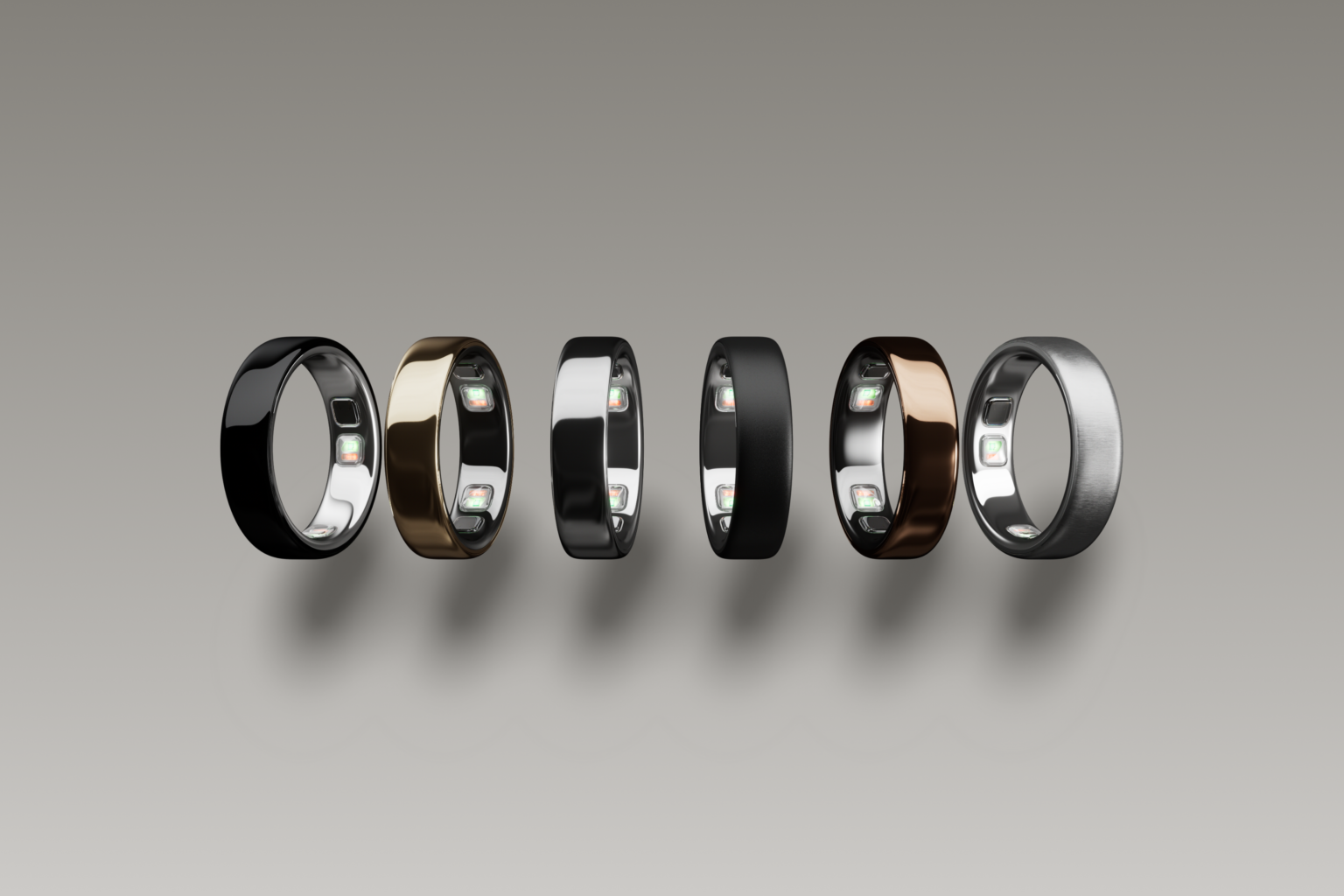
The luxury Hale describes is real, and the prospectus shows where it comes from. Open the S-1 and the growth story quietly rearranges itself into an exit, one the company itself barely needs.
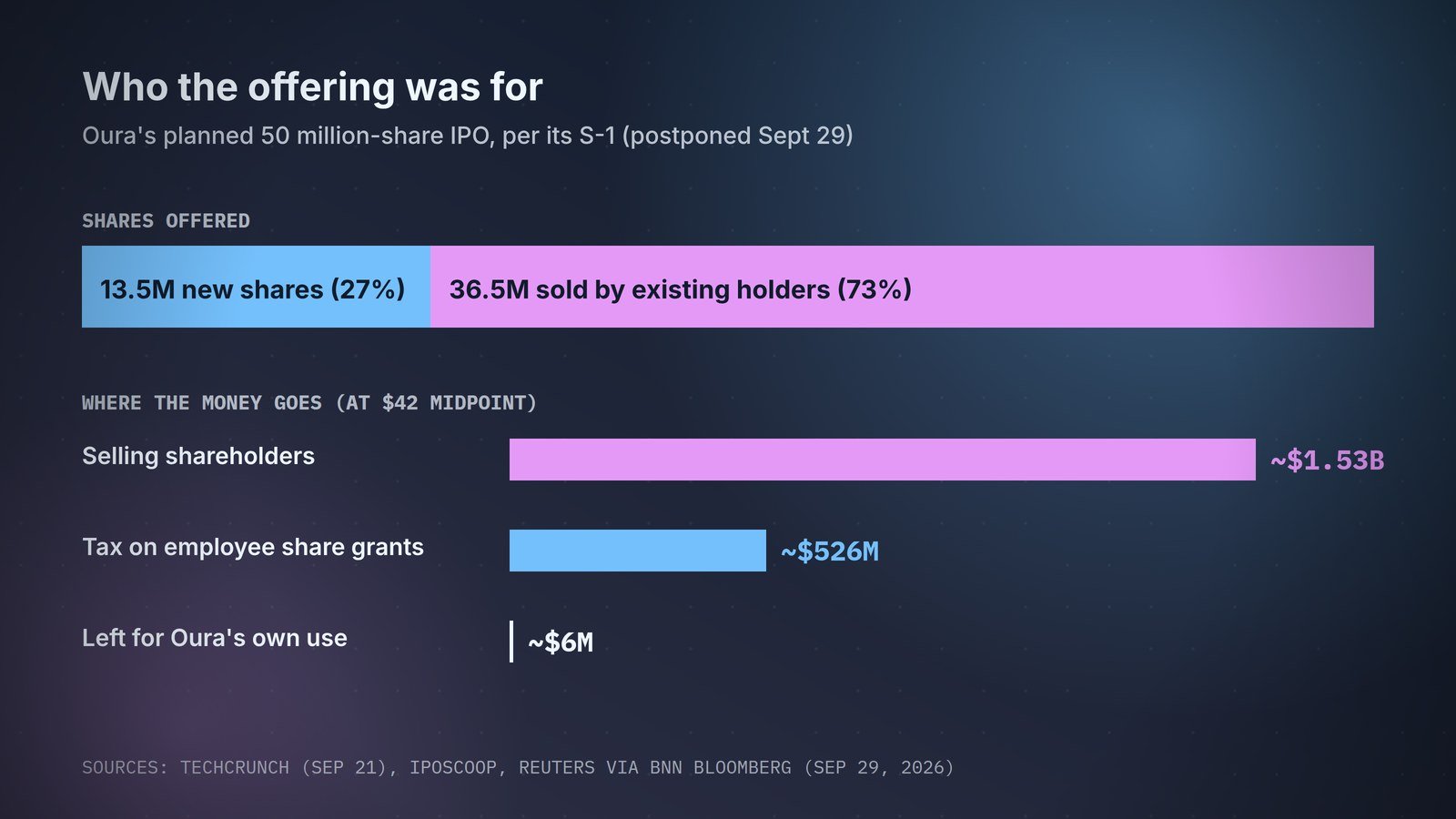
Of the 50 million shares on offer, only 13.5 million — about 27% — are primary shares, meaning newly issued stock whose proceeds actually flow to Oura. The other 36.5 million, roughly 73%, are secondary shares: existing stockholders selling into the offering and pocketing the money themselves. Per TechCrunch’s read of the filing, those selling shareholders stood to collect on the order of $1.5 billion, with early backer Forerunner Ventures accounting for close to 80% of the secondary sales. IPOScoop’s term sheet confirms the same 13.5-million/36.5-million split and spells out the mechanic bluntly: the company receives proceeds only from its own shares.
Where the company’s slice actually goes
Here is the part that should give retail buyers pause. Even the primary money mostly doesn’t fund the future. At the midpoint, Oura’s net proceeds land around $533 million — and the S-1, as parsed by TechCrunch, earmarks the overwhelming majority of that, roughly $526 million, to cover accumulated tax obligations on employee share grants. What is left over for actual corporate purposes — product, R&D, the next act beyond the ring — is a sliver, reported at about $6 million.
So the scoreboard, read honestly, is this: existing investors would take out around $1.5 billion, the tax man would take roughly half a billion, and the operating business would keep single-digit millions. For a company being valued in eleven figures, that is not a war chest. It is a receipt.
The pre-IPO paperwork tells the same story in a different key. Before filing, Oura spent about $1.09 billion over nine months buying back 27.9 million shares from seed-through-Series-C investors — roughly 17% of its preferred stock — handing early backers liquidity before the listing bell even rang. Forerunner, per the filing, sold 1.6 million Series B shares for $65 million in that buyback while keeping a stake above 5%. In other words, the insiders were already being cashed out on the way to the door; the IPO would have been the second serving.
Why it matters
None of this makes Oura a bad company. The fundamentals are, by wearables standards, unusually sturdy: TechCrunch’s read of the S-1 shows revenue of about $1.21 billion over the nine months ended June 30, split between roughly $974 million of hardware and $240 million of membership subscriptions carrying an 89% gross margin — the razor-and-blades model working as intended. IPOScoop cites trailing-twelve-month net income of $59 million on $1.43 billion of revenue. Oura reports about 5 million paying members and expects 5.7 million by the end of its fiscal year. One figure in the filing looks alarming and mostly is not: over the nine months, Oura shows a net loss attributable to stockholders of $924.3 million, against $60.8 million of net income before charges, a gap almost entirely created by the accounting treatment of the buyback. This is a real business with a genuinely profitable software layer, which is more than most consumer-hardware IPOs can say.
The point is about who the offering is for. A share sale that is three-quarters secondary, with the primary proceeds pre-committed to tax bills, is structured to reward the people who got in early, not to capitalize the years ahead. That is a legitimate thing for a mature, cash-generative company to do — Oura simply doesn’t need the growth capital. But it changes what a buyer would be purchasing. You would not be funding the next Oura product; you would be buying Forerunner’s seat as it stands up.
For a business whose entire premise is monetizing intimate health data — sleep, heart rate, temperature, readiness — that alignment question is not academic. When the deal comes back, the earliest and best-informed shareholders will again be the ones most eager to convert paper into cash. The question for anyone buying in then is the one the S-1 already raises: what do they know about the ceiling that you don’t?
Sources
- TechCrunch, "Oura's $2.2B IPO is mostly a payday for existing shareholders" (Sep 21, 2026)
- IPOScoop, "The IPO Buzz: Oura (OURA Proposed) Launches $2.1 Billion IPO"
- Yahoo Finance, "Oura publicly files for initial public offering, looks to raise $2.2 billion"
- Augment Market, "Oura's S-1 Reveals $1.09B in Buybacks"
- BNN Bloomberg / Reuters, "Oura becomes latest U.S. IPO hopeful to delay listing as market jitters deepen" (Sep 29, 2026)

Casie Stewart covers the creator economy, social platforms and wellness tech for prompt/power: who gets paid, who gets seen, and what the algorithm is really asking of the people who feed it. She has been publishing online since 2005, long before "creator" was a job title, and has spent most of that time on the other side of the platforms she now writes about. Based in Toronto. Her rule for any new app: if it promises to save you time, check how much of it you just spent reading the onboarding.
Keep reading



Latest from prompt/power
- Gemini’s Free Tier Shrinks Oct. 9: What You Keep and What Costs ExtraOct 5
- How to Read an AI Company’s S-1: The 7 Numbers That MatterOct 5
- OpenAI’s Safety Lead Quit Over Culture. California’s AG Was Already InOct 5
- When an AI Agent Breaks In, Who Answers for It?Oct 5
- The New AI Models Don’t Talk. They Decide.Oct 5
Leave a Reply