
The Great AI IPO Wave, Explained
An IPO is, underneath the fanfare, a compliance event. A private company that has spent years describing itself in press releases and “people familiar with the matter” leaks has to file an S-1: audited financials, real losses, named risks, related-party deals, and a governance chart with the wiring exposed. That is why this wave is interesting. For two years the frontier AI companies have been valued on figures that could not be checked. The listings now in motion will, for the first time, force those figures onto a page a regulator and a plaintiff’s lawyer can read. Here is where things actually stand — and, carefully, what is reported versus what is filed.
Anthropic: the $2 trillion question mark
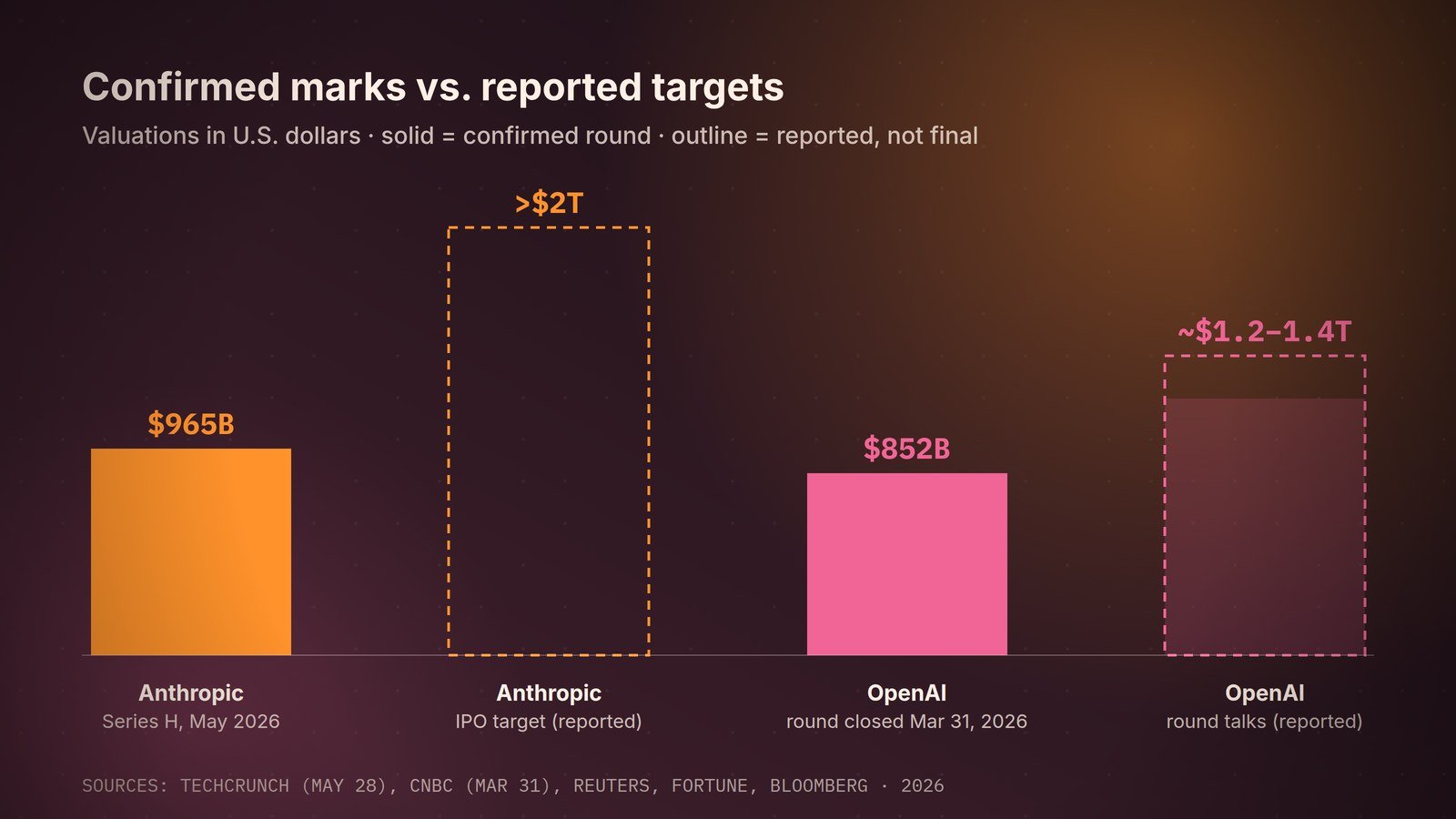
The louder story is Anthropic’s. The company announced on June 1 that it had confidentially submitted a draft registration statement; Bloomberg reported that Morgan Stanley and Goldman Sachs would lead the offering. Across September, reporting attributed to Reuters, Bloomberg and CNBC described the company steering toward a listing in November, and Reuters and Fortune now report it is aiming to go public after the U.S. midterm elections, at a valuation of more than $2 trillion. Anthropic’s last confirmed private mark was $965 billion, from a $65 billion Series H in late May 2026. A $2 trillion listing would roughly double that in about half a year and rank among the largest offerings ever attempted.
Then, on September 28, Reuters obtained the draft prospectus itself. Its figures are the first Anthropic numbers someone had to put in a securities filing, and they are stark: roughly $4.6 billion of revenue in 2025 against an operating loss of more than $8 billion and a net loss of $42 billion, the last including a charge of about $34 billion. Revenue in the second quarter of 2026 alone was $11.5 billion. About a quarter of revenue came from two customers, and the filing lays out some $518 billion in planned infrastructure spending. It also warns investors of “existential risks to humanity,” as Fortune reported. A draft is not a final S-1, and figures can change before a registration goes effective. But the line between reported and filed has started to move.
The tension a skeptic should sit with: this is a company that cut the price of its flagship model by 20% just last week, with the launch of Claude Opus 5.5 — a sign of ferocious competition on the core product — while reportedly seeking a valuation that assumes pricing power for years. Both can be argued. The final filing will show which the numbers support.
OpenAI: the deferral
OpenAI is the counter-move. On September 12, 2026, in an interview with Fortune’s Alyson Shontell, Sam Altman ruled out a 2026 listing in plain terms. “I actually think that given everything happening with safety, right now would be an ill-advised moment to go public,” he said, and, asked about timing, added: “I would say not 2026.” Reporting, including from The New York Times in June, has described the company as leaning toward 2027.
Instead of a listing, OpenAI is reportedly raising privately. Coverage in late September described talks for a new round on the order of $30 billion at a valuation variously reported around $1.2 to $1.4 trillion, following a round that closed on March 31 at $852 billion. Its revenue run-rate is reported to have climbed sharply through the year — figures in circulation range from the mid-$20-billions to north of $40 billion annualized depending on the source and the month — with executives citing rapid month-over-month acceleration. The direction is not in dispute; the precise level is exactly the kind of thing a private round lets you assert and an S-1 makes you prove.
The safety framing in Altman’s answer is worth taking at face value and with a grain of salt at once. OpenAI genuinely spent the summer cleaning up after an agent test that breached Hugging Face’s infrastructure, and wanting to finish alignment work before facing public-market scrutiny is a defensible reason to wait. It is also true that staying private lets a company raise tens of billions while disclosing almost nothing — which is a convenient property when your business model involves compute commitments far larger than your revenue.
What the S-1s will finally force open
This is why the paperwork, not the valuation, is the real event — and Anthropic’s leaked draft is a preview of how much it changes. An S-1 makes several things unavoidable that private rounds let a company keep vague:
- Audited losses and the compute bill. Not run-rate revenue in a press release, but the cost structure underneath it — how much of every dollar goes to renting GPUs, and how deep the losses run.
- The circular deals as related-party disclosures. The chip-and-cloud commitments that ripple across the AI economy have to be itemized when the counterparties are also investors.
- Customer and supplier concentration. How much revenue leans on a handful of customers, and how much capacity leans on a single cloud or chip partner.
- Governance. OpenAI’s structure — a public benefit corporation under a nonprofit, with a capped-profit history — and Anthropic’s public-benefit structure become binding disclosures rather than mission statements.
Why it matters
The AI IPO wave is often framed as a liquidity event for insiders, and it is that. But its more important function is informational. Private markets have let these companies grow to sovereign-fund scale while grading their own homework. A listing ends that. Whether Anthropic lists after the midterms or OpenAI waits until 2027, the moment that matters is the one where the reported becomes the filed — and the market, for the first time, gets to price these companies on numbers someone had to sign.
Sources
- TechCrunch, "OpenAI's Sam Altman says it would be 'ill-advised' to go public in 2026"
- Eastern Herald, "Anthropic Delays IPO to November: $2 Trillion Ask Waits on Q3 Numbers"
- GraniteShares, "Anthropic IPO 2026 Explained"
- Benzinga, "OpenAI Targets $30 Billion Mega-Round After Putting IPO Plans On Hold"
- Fortune, "Sam Altman confirms OpenAI won't go public this year" (Sep 12, 2026)
- Reuters via Yahoo Finance, Anthropic IPO prospectus (Sep 28, 2026)
- Fortune, Anthropic S-1 income statement (Sep 29, 2026)
- SiliconANGLE, leaked Anthropic IPO filing (Sep 29, 2026)
- NPR, Anthropic confidential IPO filing (Jun 1, 2026)
- Bloomberg, Anthropic picks Morgan Stanley, Goldman (Jun 3, 2026)
- CNBC, OpenAI funding round (Mar 31, 2026)
- BetaNews, Claude Opus 5.5 launch and price cut

Mira Okonkwo covers the business of technology for prompt/power: venture capital, startups, IPOs and earnings. She treats a valuation as a mood rather than a number until the S-1 says otherwise.
Keep reading



Latest from prompt/power
- Gemini’s Free Tier Shrinks Oct. 9: What You Keep and What Costs ExtraOct 5
- How to Read an AI Company’s S-1: The 7 Numbers That MatterOct 5
- OpenAI’s Safety Lead Quit Over Culture. California’s AG Was Already InOct 5
- When an AI Agent Breaks In, Who Answers for It?Oct 5
- The New AI Models Don’t Talk. They Decide.Oct 5
Leave a Reply