
Anthropic’s IPO Math: Slow Down, But First, Price the Offering
Anthropic has reportedly slipped its initial public offering from October to November — a delay that the company, per people familiar with its thinking, wants in order to put a strong third quarter in front of investors, one that shows it holding position after OpenAI’s September model release. On its face this is unremarkable IPO choreography: wait for the good quarter, then walk on stage.
(A necessary caveat up top, per house rules: the timing, the reported ~$2 trillion valuation target, the up-to-$100 billion raise, and the revenue run-rate below are all secondary reporting attributed to “people familiar,” early backers, and company leadership — not to a filed prospectus. Read every figure in this piece as reported-not-confirmed until the S-1 lands.)
What makes the delay worth a column is not the calendar. It’s what a real prospectus will finally force into the open: the circular financing at the center of the modern AI economy, and Anthropic’s version of it in particular.
The relevant fact is not reported — it’s on the record, across multiple outlets ahead of the filing: Anthropic has committed more than $100 billion to Amazon Web Services. That is a staggering, decade-scale purchase obligation to a single cloud vendor. Amazon, meanwhile, is not a neutral landlord — it is one of Anthropic’s largest investors. So the money moves in a loop: Amazon invests in Anthropic; Anthropic commits a fortune back to Amazon for compute; Amazon books that commitment as AWS demand; and the value of Amazon’s equity stake rises on the strength of, among other things, the customer it helped fund. Every leg of that loop is legitimate on its own. Assembled, it means a meaningful share of Anthropic’s “revenue relationship” and Amazon’s “AI cloud growth” are the same dollars, wearing different name tags on different balance sheets.
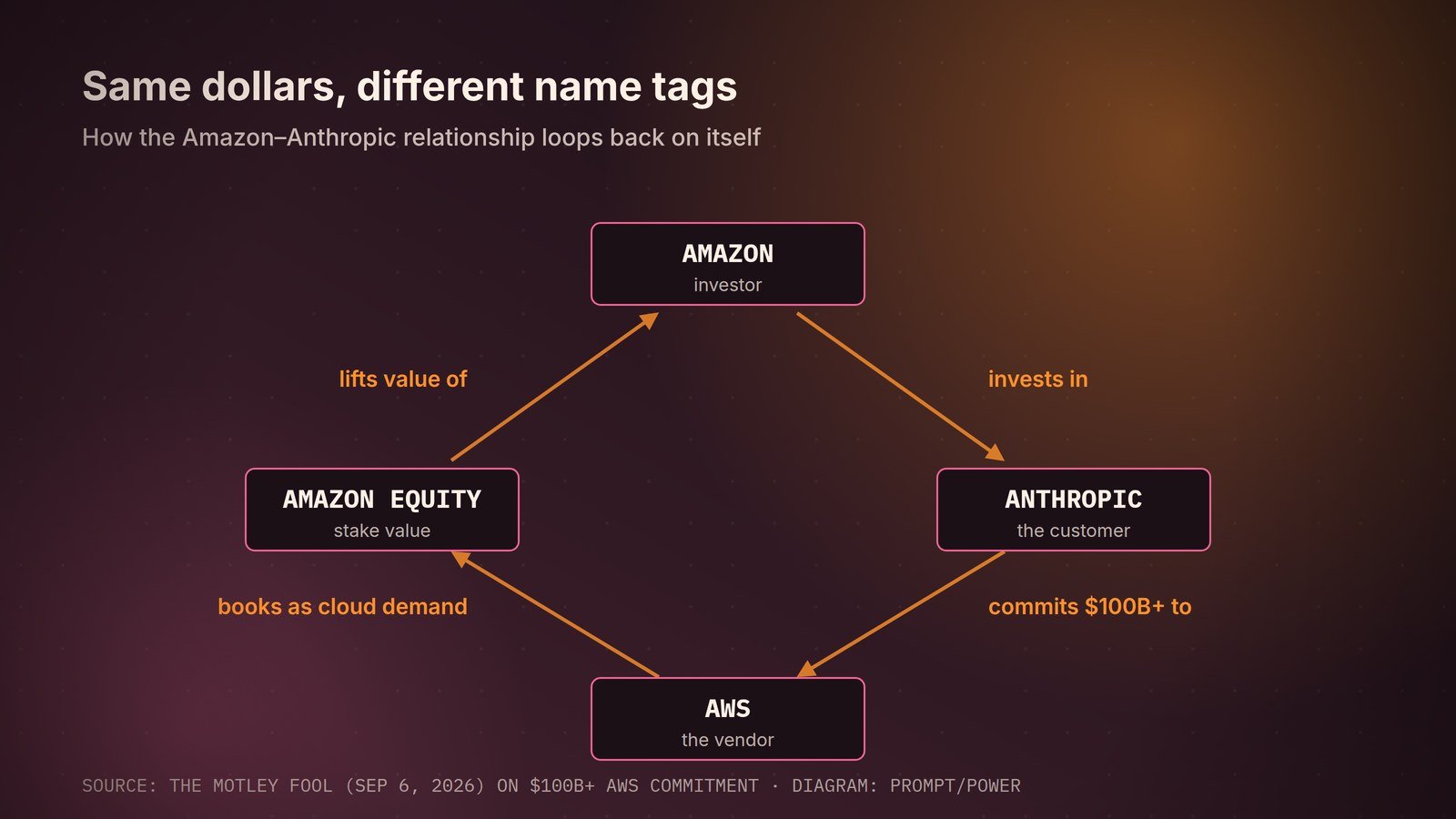
This is the disclosure problem an IPO exists to solve, and the one the delay merely postpones. Private, a company can describe a $100 billion-plus vendor commitment and a strategic-investor cloud deal as two separate good-news items. Public, the S-1 has to put them in the same document, footnote the related-party arrangements, and let analysts do the subtraction. The interesting quarter to present, in other words, is not the one that shows the biggest top line — it’s the one where the top line survives being cross-referenced against who is paying whom.
Then there’s the run-rate, which is where the reporting gets especially slippery and the caveat earns its keep. Bullish accounts tied to early backers have floated annualized revenue approaching $110 billion by year-end — a figure that, set against a ~$2 trillion valuation, would make the multiple almost sober. More conservative, self-reported and unaudited figures circulating this summer put the annualized run-rate far lower. The gap between those two numbers is not a rounding error; it’s the entire investment thesis. Which one the prospectus certifies — under signature, with auditors attached — is the single most important thing the November filing will reveal, and precisely the thing no amount of pre-IPO briefing can settle.
Set beside the rest of the week — Anthropic’s own filing reportedly warning of AI’s “existential risk to humanity,” the labs briefing the UN on “imminent” danger — the IPO math lands as its own kind of tell. A company can believe its product is civilizationally dangerous and still want $100 billion at a $2 trillion valuation. The prospectus is where those two beliefs finally have to share a page. Slow down, by all means. But the offering still has to be priced, and priced means disclosed — and disclosed is the one thing the delay can’t defer forever.
Sources

Mira Okonkwo covers the business of technology for prompt/power: venture capital, startups, IPOs and earnings. She treats a valuation as a mood rather than a number until the S-1 says otherwise.
Keep reading


Latest from prompt/power
- Gemini’s Free Tier Shrinks Oct. 9: What You Keep and What Costs ExtraOct 5
- How to Read an AI Company’s S-1: The 7 Numbers That MatterOct 5
- OpenAI’s Safety Lead Quit Over Culture. California’s AG Was Already InOct 5
- When an AI Agent Breaks In, Who Answers for It?Oct 5
- The New AI Models Don’t Talk. They Decide.Oct 5
Leave a Reply