
Thomson Reuters Won the First AI Training Appeal. Footnote 7 Is the Catch
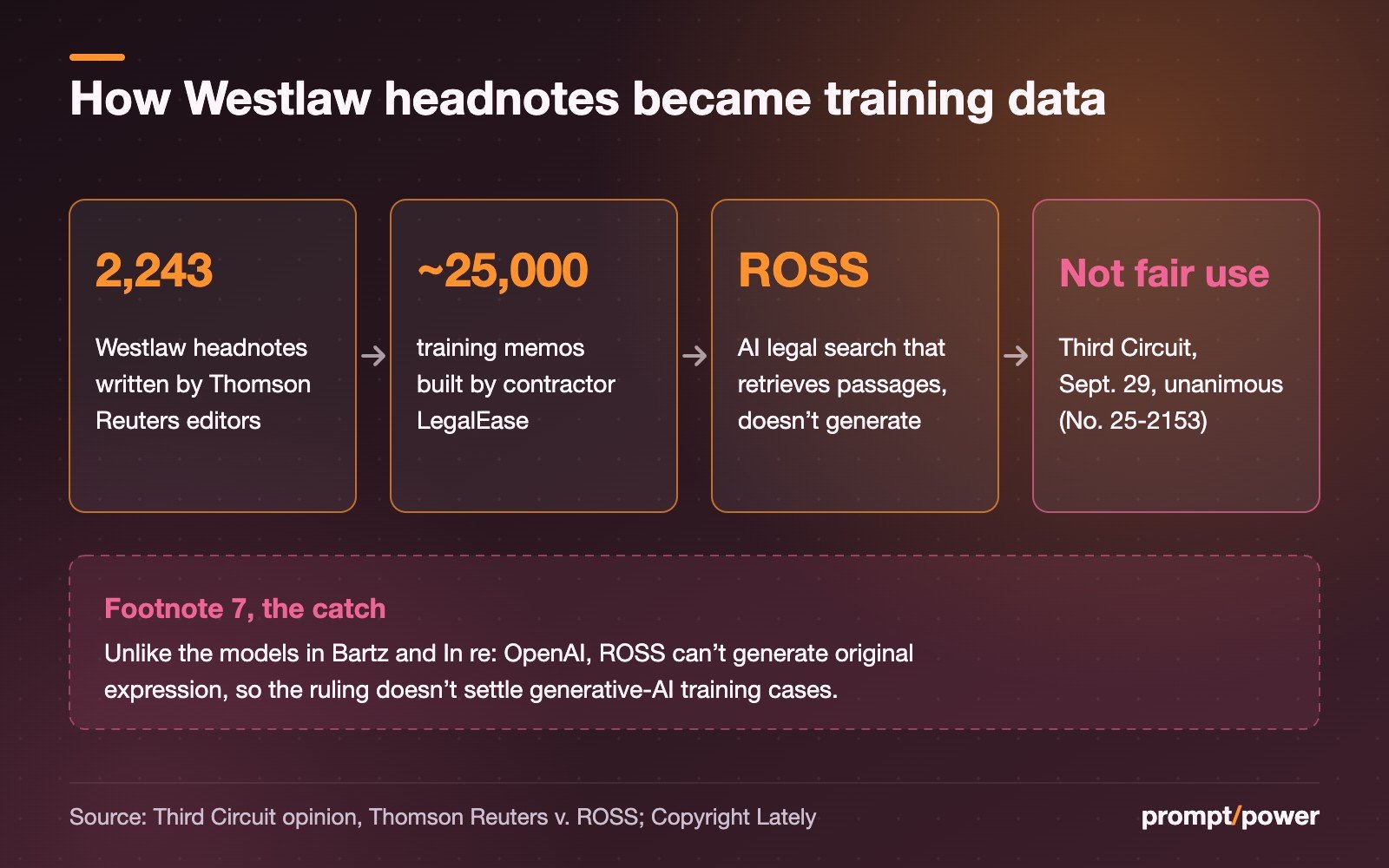
The case turned on 2,243 Westlaw headnotes, the short summaries of legal points that Thomson Reuters editors write at the top of court decisions. A legal-research startup called ROSS Intelligence never sold them. It used them to build roughly 25,000 training memos, through a contractor named LegalEase, and taught an AI search engine on the result.
On Sept. 29, the U.S. Court of Appeals for the Third Circuit said that was copyright infringement, and not fair use. The unanimous opinion in Thomson Reuters Enterprise Centre GmbH v. ROSS Intelligence Inc., No. 25-2153, was written by Judge Tamika Montgomery-Reeves for a panel that included Judges Restrepo and Bove. It was unsealed on Sept. 30, with no redactions.
Aaron Moss of Copyright Lately calls it “the first federal appellate ruling on fair use in AI training.” That makes it the first appeals-court precedent on the question every AI lab is being sued over. A Toronto-headquartered information company won it. Read the footnotes, though, and the win is narrower than the headline.
What the Third Circuit decided in Thomson Reuters v. ROSS
The appeal came up early. Judge Stephanos Bibas, a Third Circuit judge sitting by designation in Delaware, had granted Thomson Reuters partial summary judgment in February 2025 and then certified two questions for interlocutory review under 28 U.S.C. § 1292(b): whether the headnotes and the West Key Number System are original as a matter of law, and whether ROSS’s use was fair. Bibas had reversed himself to get there. In 2023 he sent fair use to a jury; in 2025, Copyright Lately notes, he decided it himself.
The panel agreed with him on both counts, and it framed the dispute in the plainest terms available.
“Under ROSS’s framing, this case appears to concern the future of AI legal technology. But appearances can be deceiving. In truth, this is no more than an ordinary copyright case.”
On originality, the court found the headnotes have “a creative spark.” ROSS had argued that a summary of a judicial holding can only be written so many ways, so the expression merges with the idea. The panel answered with a costume: “just as a banana costume can take myriad designs, so too can headnotes have differing expressions.”
On fair use, two factors did most of the work. ROSS used the headnotes for the same end Thomson Reuters does, to help lawyers find law, which made the use “minimally transformative, at best.” Headnotes were a convenient shortcut for building training questions, and the court’s verdict on that is the opinion’s most quotable line: “Unlike necessity, ease is not a justification for copying.”
Then the market. “Here, the evidence shows that the market for licensing headnotes as text to train AI is rapidly developing,” the panel wrote, so ROSS’s copying threatened both Westlaw’s core business and a new licensing market for training data. ROSS’s public-benefit pitch, including a claim that AI is critical to national security, went nowhere. The opinion says ROSS “presents no evidence” for it and that AI does not give it “carte blanche to violate copyright law.”
Footnote 7: why OpenAI and Anthropic aren’t on the hook
The most consequential passage is at the bottom of page 17. The court notes that the Department of Justice filed a statement of interest on Sept. 1, 2026, in In re: OpenAI, the consolidated copyright litigation in Manhattan, relying on Bartz v. Anthropic to argue that training a large language model that can “generate original responses” is transformative.
The panel declined to touch that argument: “Unlike the AI models in Bartz and In re: OpenAI, ROSS’s AI platform cannot generate original expression, and the evidence here supports the opposite conclusion about transformativeness.” ROSS’s tool, by the court’s own description, answered plain-language questions “with relevant passages of text from judicial opinions.” It retrieved. It did not write.
Ballard Spahr’s Oct. 2 analysis draws the same line: the decision leaves the core generative-AI questions open, including whether training resembles human learning, as Judge William Alsup suggested in Bartz, or whether models that flood a market with competing output cause cognizable harm, the theory Judge Vince Chhabria floated in Kadrey v. Meta.
Our read: lawyers for OpenAI and Anthropic will cite footnote 7 as a fence. Plaintiffs will cite the market paragraph. A court accepting that licensing text “to train AI” is a real, harm-able market is exactly the premise news publishers and authors need, and the Third Circuit just put it in a precedential opinion. Precedential, but only in Delaware, New Jersey, Pennsylvania and the U.S. Virgin Islands. The OpenAI cases sit in the Second Circuit; Bartz and Kadrey in the Ninth.
The fair-use counter-argument from Authors Alliance
Not everyone thinks the panel got the law right. Dave Hansen of Authors Alliance, which filed an amicus brief in the appeal, argues the court dismissed merger “in a single conclusory paragraph.” Headnotes must be accurate, short and close to the court’s own language, he writes, and the opinion “counted compliance with those same constraints as the creative spark.” On alternative wordings: “The bare possibility of other phrasings, variations, ways of expressing something proves nothing.”
His deeper objection is to the first and fourth factors. The court, he says, “framed the first factor as a comparison of platforms” instead of asking what this particular copying was for, and it accepted a training-data market that exists largely because the use at issue is being licensed. His conclusion is blunt: “this opinion represents several deformations of copyright law, and if other courts follow it, the Supreme Court will need to correct the damage.”
What it means for Thomson Reuters and Canadian publishers
The parties on the caption are Thomson Reuters Enterprise Centre GmbH, a Swiss affiliate, and West Publishing Corp., the Minnesota company behind Westlaw. The parent is Thomson Reuters Corp. of Toronto, and what it gained is less a cheque than a sentence. ROSS, as Copyright Lately puts it, “no longer exists,” and because this was an interlocutory appeal on two certified questions, the ruling answers those questions rather than closing the lawsuit.
The sentence is the one about a “rapidly developing” market. Any company sitting on a large archive of human-edited text, from legal publishers to newsrooms, now has an appellate court on record saying that archive has licensing value as AI training data, and that a competitor who copies it to build a substitute product cannot hide behind the word “AI.” For media companies watching courts weigh what platforms owe them, it reads very differently from Judge Amit Mehta’s dismissal of the AI Overviews suits.
For Canadian publishers, the caution runs the other way. This is a U.S. fair-use ruling. Canadian courts apply fair dealing under the Copyright Act, a different test with its own enumerated purposes, and nothing in this opinion binds them. Its value in Canada is persuasive at most, and the footnote that protects generative models travels just as easily as the paragraph that protects headnotes.
According to the opinion, LegalEase’s memo writers reached for Westlaw headnotes because they offered “an easy way [to] fram[e] questions.” The Third Circuit’s answer to that took nine words, and the second one was “necessity.”

Jeff Cameron writes about the business and policy side of AI for prompt/power. A chief operating officer by trade, he also writes for Not An Atlas.
Keep reading

Revolut Is Valued Above Barclays. Here’s What the £86bn Price Rests On

Musk Is a Trillionaire Again After SpaceX Stock Jumps 7.6%

Schneider Electric’s US$22.6B PTC Deal Is a Bet on AI That Runs Factories

Nubank Walked Away From Monzo. Now Private Equity Wants a Slice
Latest from prompt/power
- The Family Safe Word: How to Beat AI Voice-Clone Emergency ScamsOct 7
- Reflection AI’s Beam, Explained: The 501B Open-Weight Model Aimed at ChinaOct 7
- Your SSN or SIN Leaked in a Breach? Do These 8 ThingsOct 7
- Apple’s Oct. 13 Event Rumour, Plus iPhone Duo Pre-Order Dates for CanadaOct 7
- Why Grindr Is Paying US$250M for Calgary PrEP Clinic FreddieOct 7
Leave a Reply