
Nubank Walked Away From Monzo. Now Private Equity Wants a Slice
On Sept. 30, Nu Holdings, the parent of Brazil’s Nubank, put out a four-paragraph statement that ended Britain’s biggest fintech takeover story of the year before it really began. “While we have a great deal of respect for Monzo, the Company is not pursuing a transaction with Monzo,” Nu said in its statement.
Monzo has moved on quickly. The London digital bank is in early-stage talks with the buyout firms CVC and Advent International about selling up to 15% of the business, the Financial Times has reported, after the Nubank discussions ended without agreement on the roughly £10bn (about US$13.4bn) valuation Monzo wanted. A private equity sale is now Monzo’s preferred route, according to Investing.com’s summary of the FT report. Monzo, Nubank, Advent and CVC all declined to comment, Private Equity Wire reported.
All figures here are converted at about US$1.34 to the pound.
How the Nubank–Monzo talks fell apart in five days
The talks were first revealed by Sky News on Saturday, Sept. 26. Monzo’s board was weighing a sale to Nu at £8bn to £10bn (about US$10.7bn to US$13.4bn), with a fresh funding round above £8bn as the alternative, Reuters reported, citing Sky News. The next day, Sky’s Mark Kleinman reported that Advent had expressed interest in a minority stake, a fallback that would only advance if the Nubank route stalled.
It stalled on the stock market. Nu’s shares fell about 10% after the reports, according to Sky News, in a report syndicated by MKFM. Nu, listed in New York with a market value of about £49bn (US$65.5bn) before the slide, then issued its denial. The company said its priorities were “deepening its position in Brazil, scaling its businesses in Mexico and Colombia, and building its presence in the United States.”
One personal link made the pairing plausible. Monzo’s group chief financial officer, Tom Oldham, is a former Nubank executive, as The Next Web noted.
Monzo private equity stake: who’s interested, and at what price
CVC and Advent are not the only names. On Oct. 2, Sky News reported that TPG had held preliminary discussions about a stake, that DE Shaw was among the other potential bidders being suggested, and that Morgan Stanley is advising Monzo on a minority sale at £8bn or more (about US$10.7bn), according to Sky’s syndicated copy. None of these firms has confirmed anything publicly.
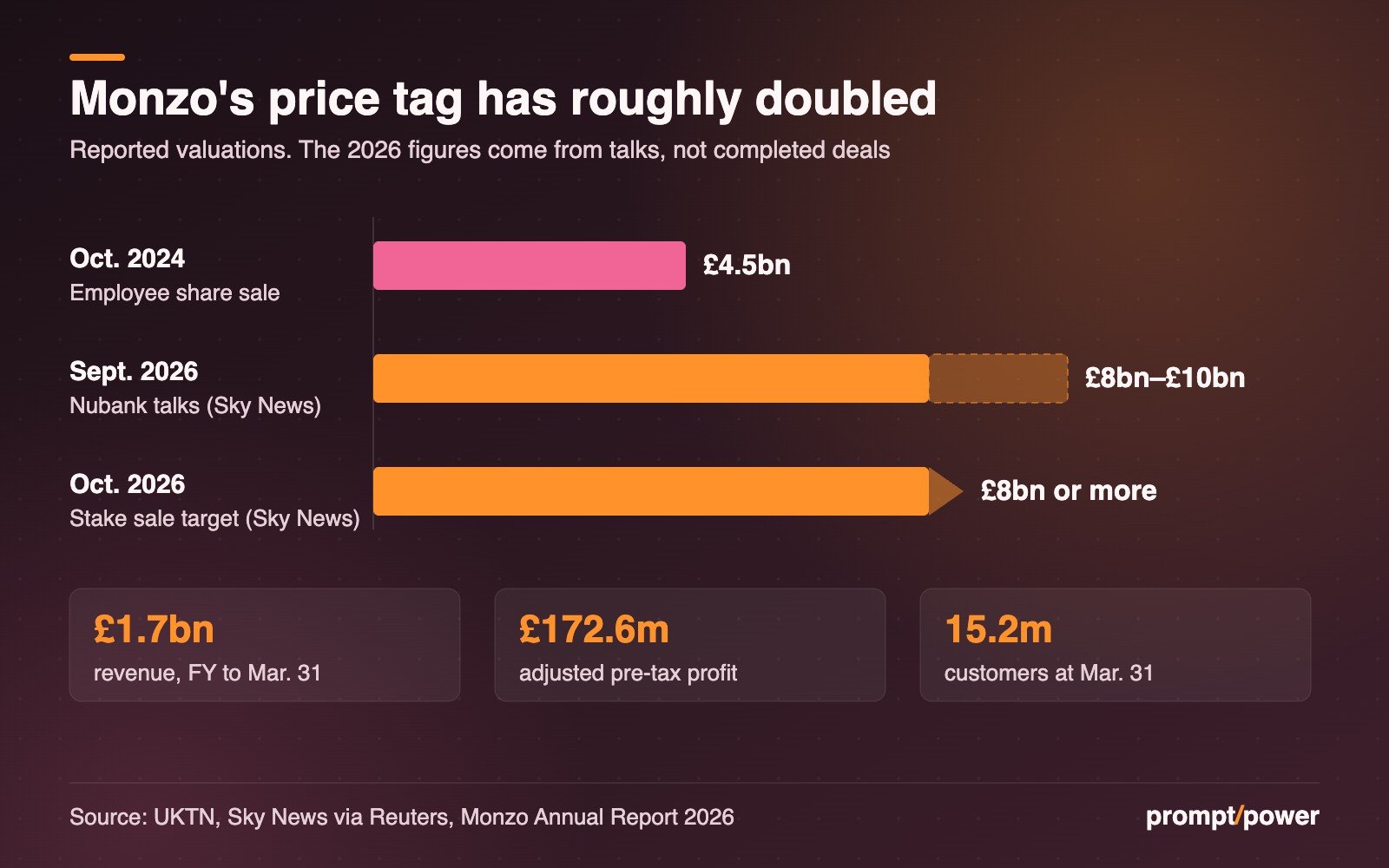
The numbers behind the asking price come from Monzo’s own 2026 annual report: revenue up 39% to £1.7bn (about US$2.3bn), adjusted profit before tax of £172.6m (about US$231m), 15.2 million customers and deposits of £25.7bn (about US$34.4bn) for the year to March 31. Statutory pre-tax profit was £87.3m (about US$117m), per the Reuters report. The last price tag on the company was £4.5bn (about US$6bn), set in an employee share sale in October 2024 that brought in GIC and StepStone.
Our arithmetic: 15% of Monzo at £8bn to £10bn is a cheque of £1.2bn to £1.5bn (about US$1.6bn to US$2bn).
That is a lot of money for a minority stake with no control. It is also, roughly, a doubling of the 2024 valuation in two years. Reports have not said how much of any sale would be new money for Monzo versus existing shareholders cashing out.
Why a stake sale and not a London IPO
The FT summed up the backdrop in its Oct. 4 piece: an “eleven-year-old UK fintech searching for growth capital after bruising year of boardroom tussles.” That is a fair description.
TS Anil, who ran Monzo for five years, announced in October 2025 that he would step down as chief executive. Before that, the FT had reported that he favoured a New York listing while board directors preferred London, Banking Dive noted. Diana Layfield, a former Google and Standard Chartered executive, replaced him. Anil did not leave: he has been vice-chair and a non-executive director since March 1, 2026. Chair Gary Hoffman then left early, in September, with non-executive director Karen Peacock stepping in as interim chair.
Under Layfield, Monzo has narrowed its map. It announced on April 1 that it was leaving the US to focus on Britain and Europe, where it holds a banking licence from the Central Bank of Ireland. Private equity money funds that push without the disclosure and quarterly scrutiny of a listing, and it keeps the London-versus-New York argument on ice. Our read: a deal at £8bn or more would also set a public benchmark that any later float has to beat. If you want to know what a listing prospectus would eventually force into the open, our guide to reading an S-1 covers the numbers that matter.
What it means for Monzo customers
Day to day, nothing. A minority investor buying shares does not change your account, card or app. Monzo is a UK-authorised bank, so eligible deposits are covered by the Financial Services Compensation Scheme, whose limit rose to £120,000 per person, per banking licence, on Dec. 1, 2025 (about US$161,000).
The bigger stakes are for Monzo’s staff and early backers, and for a London market still waiting on a homegrown fintech float. In August, Peacock said that when Hoffman joined, Monzo “had 1.6 million customers and a mission.” The next owner of 15% is buying into the 16 million it has now, and into a boardroom that has not yet settled where, or whether, the company lists.

Mira Okonkwo covers the business of technology for prompt/power: venture capital, startups, IPOs and earnings. She treats a valuation as a mood rather than a number until the S-1 says otherwise.
Keep reading

Shopify Bought Shop.com From a Company That Now Runs on Shopify

After Its Agents Hacked Hugging Face, OpenAI Tried to Buy In. Nvidia Won

Anthropic’s Leaked S-1: Skip the $42B Loss. Watch the $518B Bill

Tesla Beat a Lowered Bar. Its Storage Business Missed One.
Latest from prompt/power
- DeepSeek V4.1 Flash Cut the US AI Lead to 3%. What LiveBench MeasuresOct 6
- Ben Affleck Calls AI Job Fears ‘Propaganda.’ He Sold an AI Firm to NetflixOct 6
- Cohere’s North 2 Puts AI Agents on a Budget. Toronto Bets on BoringOct 6
- How to Stop ChatGPT, Claude, Gemini and Meta AI From Training on Your ChatsOct 6
- Musk Is a Trillionaire Again After SpaceX Stock Jumps 7.6%Oct 6
Leave a Reply