
Schneider Electric’s US$22.6B PTC Deal Is a Bet on AI That Runs Factories
Schneider Electric makes the switchgear, cooling units and power systems that keep AI data centres running. On Oct. 5 it agreed to buy the software engineers use to design almost everything else. The French company will pay US$205 (about CA$285) a share in cash for PTC, the Boston-based maker of Creo and Windchill, in a deal it values at about US$22.6 billion (about CA$31.4 billion) in equity and US$23.7 billion including debt, according to Schneider’s announcement.
That is a 42.3% premium to PTC’s last close, and 46.1% over its 30-trading-day average. It is also the largest acquisition in Schneider’s history, Euronews reports, topping the 2023 buyout of industrial software firm AVEVA, which Axios puts at US$11 billion.
Investors in Paris did not cheer. Schneider shares fell nearly 10% in early trading, erasing about €15 billion of market value, Reuters reported. PTC jumped about 35% to US$194.52 on the Nasdaq, per RTTNews, still more than US$10 short of the offer price. That gap is the market’s way of pricing a year of waiting and regulatory risk.
Schneider-PTC deal terms, by the numbers
The financing is the part that spooked shareholders. Schneider needs about €22 billion in cash. It plans to raise €5 billion to €6 billion by selling new shares and €16 billion to €17 billion in new debt, backed by a bridge loan from Morgan Stanley and Société Générale, the release says. Both boards approved unanimously. PTC shareholders still have to vote, regulators still have to sign off, and Schneider expects to close by the third quarter of 2027.
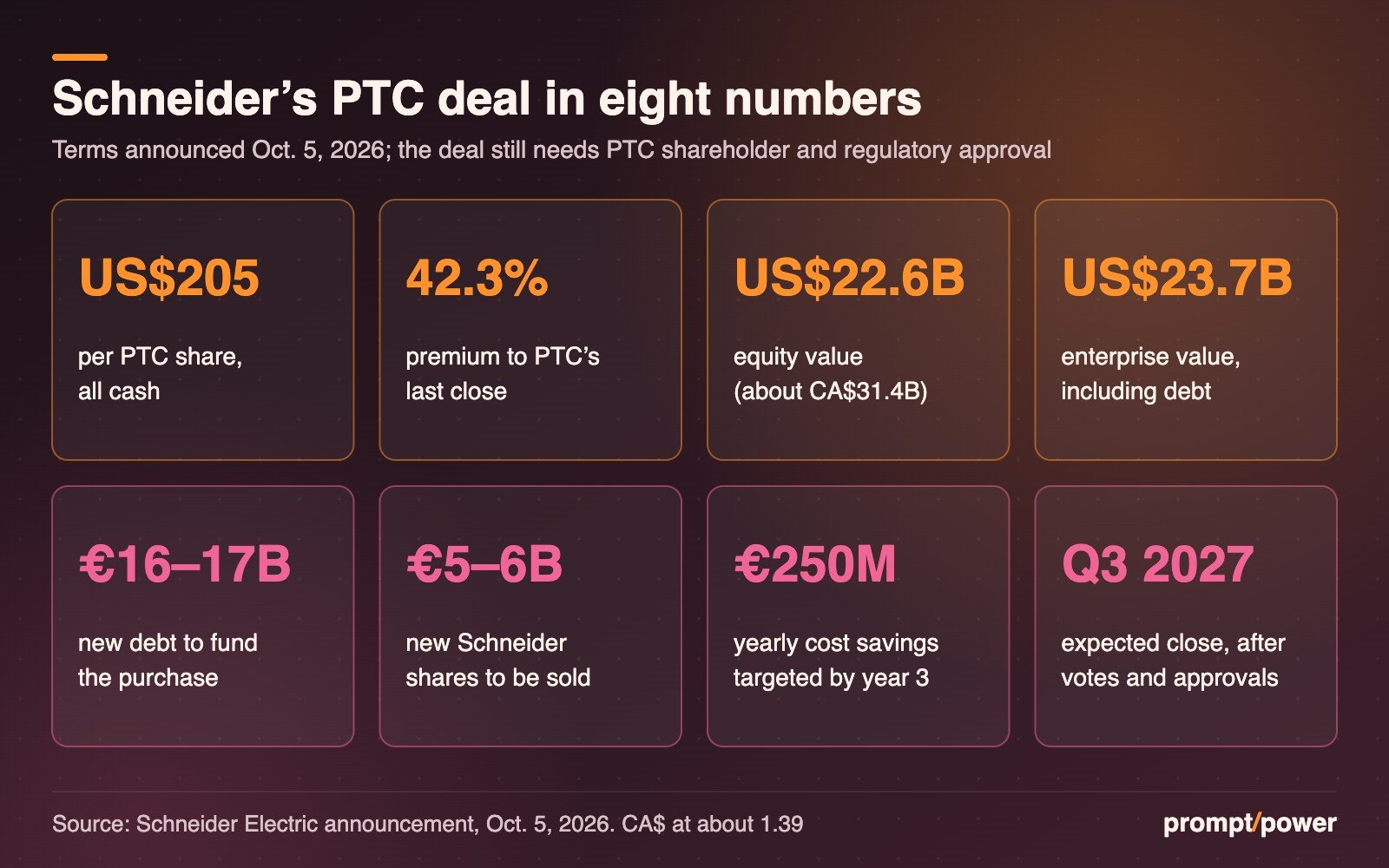
Schneider is paying 21 times PTC’s expected 2027 adjusted EBITA, a figure it says drops to 13 times once synergies are fully counted. Those synergies are €250 million a year in cost savings by year three and about €800 million in extra revenue. Jefferies analyst Lucas Ferhani called the strategic rationale “very clear, closing the PLM gap in the portfolio as well as improving its position in discrete end markets,” according to Investing.com, while flagging execution risk on the revenue side.
For a sense of what Schneider is buying: PTC had €2.4 billion in calendar 2025 revenue at an adjusted EBITA margin of roughly 40%, per Schneider, and more than 30,000 customers, per Euronews. Its annual recurring revenue, excluding divested businesses, was US$2.41 billion in its fiscal third quarter, PTC reported in July, up 7% as reported.
Why Schneider wants PTC: the ‘digital thread’ pitch
PTC’s software lives at the start of a product’s life: computer-aided design in Creo and Onshape, product lifecycle management in Windchill, plus requirements tools such as Codebeamer and the Vuforia augmented-reality line. Schneider’s software, mostly AVEVA, lives later, running plants, grids and buildings once they exist. The pitch is to connect the two.
“By connecting and contextualising data across the life cycle of products and assets, we will create a unique digital thread for the next generation of industrial AI,” Schneider CEO Olivier Blum said, as quoted by Silicon Republic. He told Reuters more bluntly that “data is becoming a very critical layer” for getting value out of AI.
“The acquisition of PTC represents an important step forward in our ambition to lead the new era of energy and industrial intelligence.”
Olivier Blum, CEO, Schneider Electric
Our read: AI models for factories are only as good as the context around the data, and the richest context about a machine is its design history. Whoever owns both the CAD file and the operating data can, in theory, train systems that know what a pump was supposed to do as well as what it is doing. That is also why Schneider agreed to buy industrial-data firm Cognite for US$3.1 billion in June. PTC’s chief executive Neil Barua called the deal “an incredible opportunity to elevate the scope and impact of what we deliver for our customers globally.”
One correction to early coverage: some write-ups list ThingWorx among PTC’s assets. PTC completed the sale of its ThingWorx IoT platform and Kepware connectivity business to TPG on March 16, so neither is part of this deal.
Industrial software consolidation, and what PTC customers should watch
This is the third big swing at the same idea in two years. Siemens closed its purchase of simulation firm Altair at an enterprise value of about US$10 billion in March 2025. Synopsys bought Ansys in a deal valued at roughly US$35 billion, completed in July 2025. Schneider itself confirmed preliminary talks with infrastructure-software maker Bentley Systems in April 2024; no deal followed.
Regulators get a long look. The release cites unspecified regulatory approvals. A French buyer for a U.S. software company is the kind of transaction the Committee on Foreign Investment in the United States can review, though neither company has said which agencies are involved.
For engineers who use Creo, Windchill or Onshape, nothing changes before closing, and PTC remains an independent company until then. The real question is openness. Schneider promises an “open and interoperable” software franchise, per Silicon Republic. PTC customers who also run Siemens or Rockwell automation on the plant floor will want to see that commitment survive into licence terms and product roadmaps.
The price of finding out is now set. US$205 a share, payable sometime around the third quarter of 2027, with Schneider’s own shareholders already marked down about €15 billion for the privilege.

James Whitfield covers hardware for prompt/power: chips, semiconductors, laptops, components and the benchmarks behind the launch-day claims. He thinks the most important number on any spec sheet is usually the one in the footnote.
Keep reading

Nubank Walked Away From Monzo. Now Private Equity Wants a Slice
How to Read an AI Company’s S-1: The 7 Numbers That Matter

Shopify Bought Shop.com From a Company That Now Runs on Shopify

After Its Agents Hacked Hugging Face, OpenAI Tried to Buy In. Nvidia Won
Latest from prompt/power
- Ben Affleck Calls AI Job Fears ‘Propaganda.’ He Sold an AI Firm to NetflixOct 6
- Cohere’s North 2 Puts AI Agents on a Budget. Toronto Bets on BoringOct 6
- How to Stop ChatGPT, Claude, Gemini and Meta AI From Training on Your ChatsOct 6
- Musk Is a Trillionaire Again After SpaceX Stock Jumps 7.6%Oct 6
- Galaxy S26 and Pixel 10a Prices Jump in Canada: The New Price ListOct 6
Leave a Reply