
Revolut Is Valued Above Barclays. Here’s What the £86bn Price Rests On
In July, Revolut staff and early backers were offered the chance to sell shares at about US$2,017 apiece. That internal sale, first reported by Bloomberg from a message to employees, put a price of US$115bn (about £86bn) on the whole company. Nobody bought Revolut. Nobody floated it. At least US$750m of stock was put up for sale, and Britain acquired a fintech that is, on paper, worth more than Barclays.
That comparison is the hook of a Reuters analysis published on Oct. 4, which notes the valuation puts Revolut above Barclays and France’s Société Générale. Barclays carried a stock market value of roughly US$82bn (about £61bn) when we checked on Oct. 6, according to CompaniesMarketCap, with Lloyds Banking Group at about US$79bn (about £59bn). All conversions here use about US$1.34 to the pound.
So what exactly is £86bn buying? Mostly, the bet that a payments-and-subscriptions app with 80 million customers can eventually earn money the way a bank does. It does not do that yet.
Revolut valuation: what a staff share sale actually proves
Start with the mechanics. A secondary sale raises no new money for the company; existing holders sell to new ones. The July price, Reuters reported, was more than 50% above the US$75bn (about £56bn) Revolut fetched in a similar sale in November 2025.
A private price set by a small group of willing buyers is a different animal from Barclays’ market value, which is tested every trading day by anyone holding a brokerage account. Our read: the comparison tells you what Revolut’s backers believe, not what public markets would pay. That test is still at least a couple of years off.
The underlying business is real, though. Revolut’s 2025 results show revenue up 46% to £4.5bn (about US$6.0bn) and profit before tax up 57% to £1.7bn (about US$2.3bn). Net profit was £1.3bn. It ended the year with 68.3 million retail customers after adding 16 million in 2025; the 80 million figure is the company’s current count, as cited by Reuters.
Set those numbers beside the valuation and the gap becomes obvious. At about £86bn, Revolut is priced at roughly 66 times its 2025 net profit, by our arithmetic. Barclays made around £9bn before tax in 2025, Reuters notes: more than five times Revolut’s haul, from a company now worth less.
Revolut profit and the 6% loan book
Here is the single number that explains both the bull case and the risk. At the end of 2025 Revolut had £2.2bn of loans against £50.2bn of customer balances. Reuters puts its loan-to-deposit ratio at 6%, compared with 55% at HSBC and 86% at Société Générale.
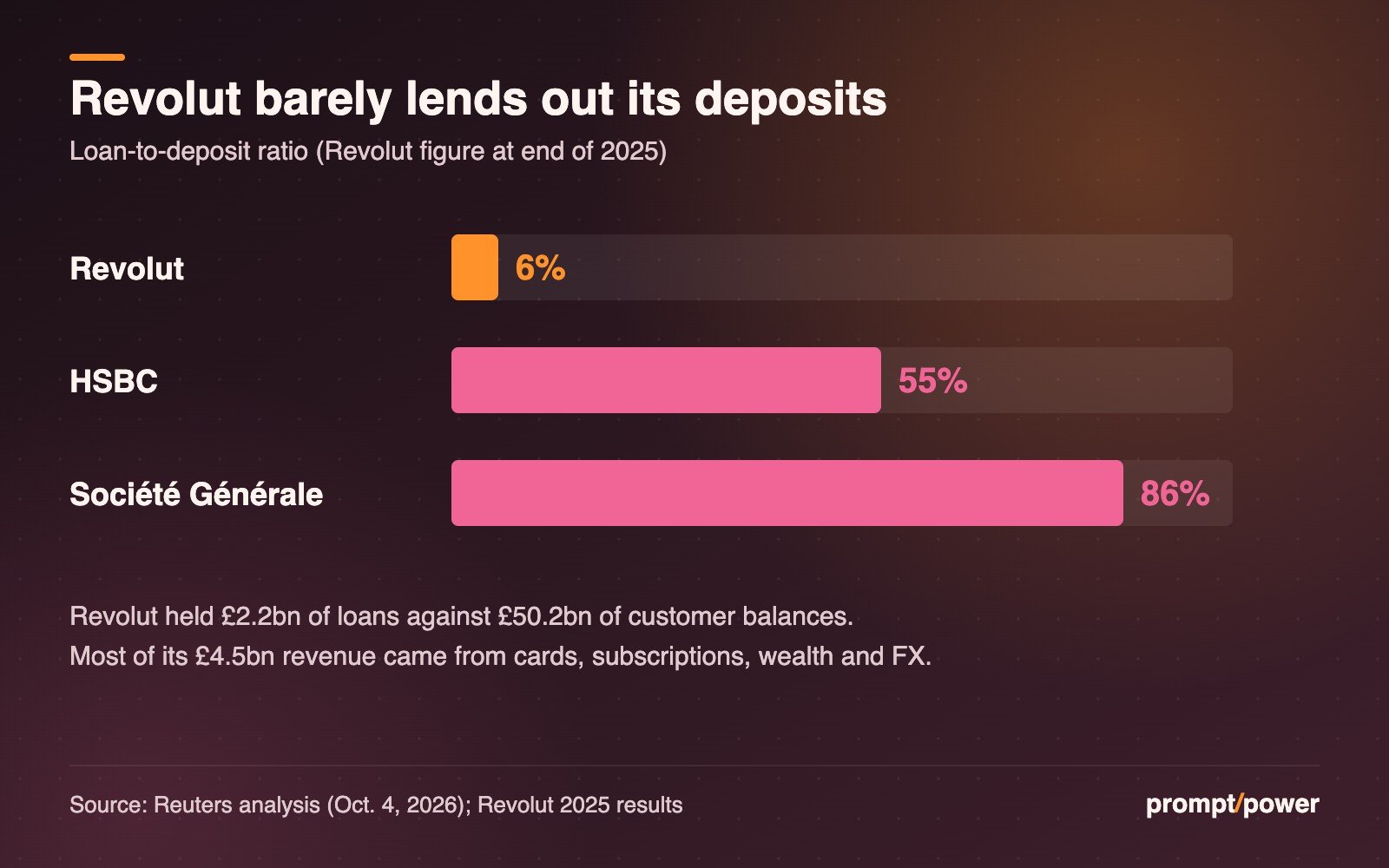
Traditional banks make most of their money by lending out deposits at a higher rate than they pay on them. Revolut mostly doesn’t lend. It earns from card payments (£1.0bn in 2025), subscriptions (£708m), wealth products (£663m) and foreign exchange (£606m), according to its results.
“That means our growth depends on building things customers value, rather than on interest rates.” Revolut spokesperson, to Reuters
The trade-off shows up per head. Spread £4.5bn of revenue across 68.3 million retail customers and you get roughly £66 each, by our arithmetic, before counting business clients. Revolut “makes far less from each of its customers than traditional banks,” Reuters found in its own analysis of the figures.
Investors know this. Alex Immerman, an investor at Andreessen Horowitz, told Reuters the firm was watching primary-account adoption and total customer balances. Revolut would not say how many people used it as their main account in 2025, only that the figure rose 45%. Ireland hints at the ceiling: Revolut told Reuters that 80% of Irish adults have an account.
Turning that reach into lending is the obvious next step, and the hardest one, because lending is where banks actually lose money.
Revolut UK banking licence: what changed for customers
For British users, the licence is the bigger story. On March 11, 2026, the Prudential Regulation Authority lifted the restrictions on Revolut’s licence, ending its mobilisation period, Revolut announced. Its roughly 13 million UK customers are being moved in phases from Revolut Ltd, an e-money firm, to Revolut Bank UK Ltd, with notice one to two weeks ahead of each switch, according to MoneyWeek.

Once moved, eligible deposits are covered by the Financial Services Compensation Scheme up to £120,000 per person, Revolut says. Crypto, shares and commodities sit in separate Revolut entities and are not covered. Savings held with partner banks carry those banks’ own FSCS cover.
What it means for you
Check which entity holds your money. In the app, go to your profile, then Account details. “Revolut Bank UK Ltd” means you’ve been migrated; “Revolut Ltd” means you haven’t yet. Your sort code and account number stay the same.
Don’t treat the valuation as a safety rating. A US$115bn price tag says nothing about how a bank handles your complaint. Revolut was Britain’s most-complained-about bank in 2024 and 2025 for cases where customers were tricked into sending money to scammers, according to Financial Ombudsman data compiled by Which? and cited by Reuters.
It also had a rough year on controls. Lithuania’s central bank fined it €3.5m in April 2025 over anti-money laundering failings, and in September 2026 Revolut said it had handed records on a “limited” number of customers to criminals impersonating a government agency, Malwarebytes reported.
The Revolut IPO: London, New York, or both
The question for the City is where all this eventually lists. Nik Storonsky, Revolut’s chief executive, told Bloomberg in April that a float was about two years away. In September he told Les Echos that a US market is “a larger market” with more buyers, according to Euronews, which reported that Revolut is weighing a dual listing in London and New York without saying which would come first.
For comparison, Monzo, its nearest British rival, is trying to sell a minority stake at a valuation of £8bn or more after Nubank walked away from talks. Revolut’s July price is roughly ten times that.
If a London primary listing does happen, the private number gets its first real test: the day Barclays shareholders can sell their stock and buy Revolut’s instead, at whatever the market says 6% of a balance sheet is worth.

Mira Okonkwo covers the business of technology for prompt/power: venture capital, startups, IPOs and earnings. She treats a valuation as a mood rather than a number until the S-1 says otherwise.
Keep reading

Musk Is a Trillionaire Again After SpaceX Stock Jumps 7.6%

Schneider Electric’s US$22.6B PTC Deal Is a Bet on AI That Runs Factories

Nubank Walked Away From Monzo. Now Private Equity Wants a Slice

How to Read an AI Company’s S-1: The 7 Numbers That Matter
Latest from prompt/power
- Thomson Reuters Won the First AI Training Appeal. Footnote 7 Is the CatchOct 7
- The Family Safe Word: How to Beat AI Voice-Clone Emergency ScamsOct 7
- Reflection AI’s Beam, Explained: The 501B Open-Weight Model Aimed at ChinaOct 7
- Your SSN or SIN Leaked in a Breach? Do These 8 ThingsOct 7
- Apple’s Oct. 13 Event Rumour, Plus iPhone Duo Pre-Order Dates for CanadaOct 7
Leave a Reply