Francis Halzen Wins the 2026 Physics Nobel for a Telescope Made of Ice
The 2026 Nobel Prize in Physics went to one person, for an instrument nobody will ever see. On Oct. 6 the Royal Swedish Academy of Sciences awarded the prize to Francis Halzen of the University of Wisconsin–Madison “for decisive contributions to the IceCube Neutrino Observatory and the discovery of high-energy neutrinos of astrophysical origin.”
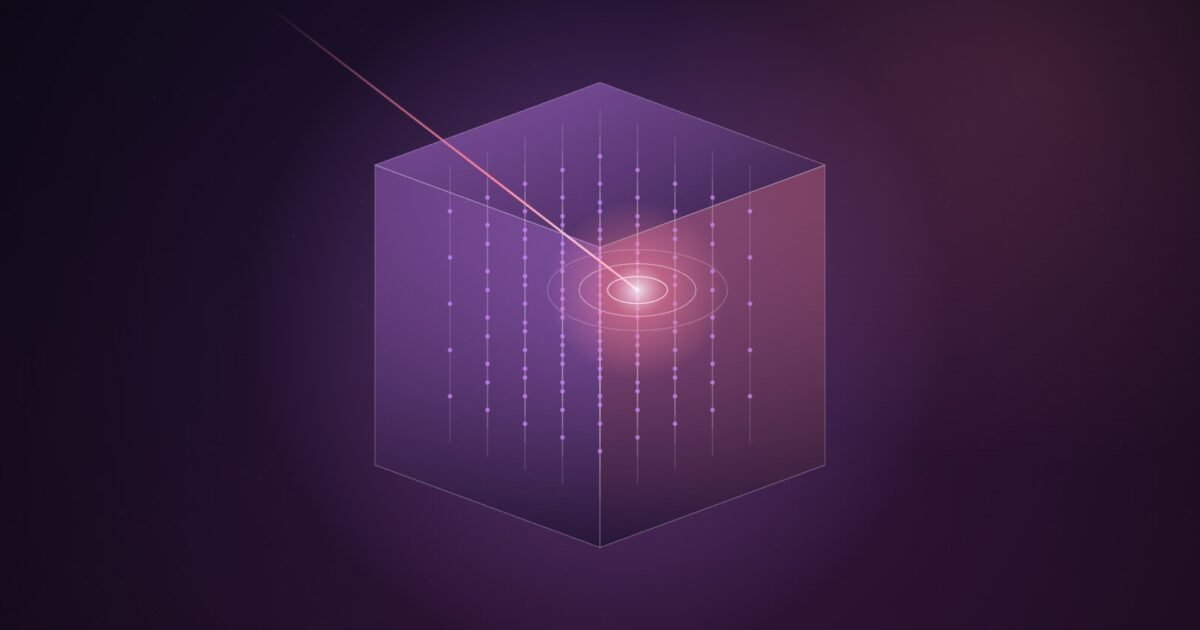
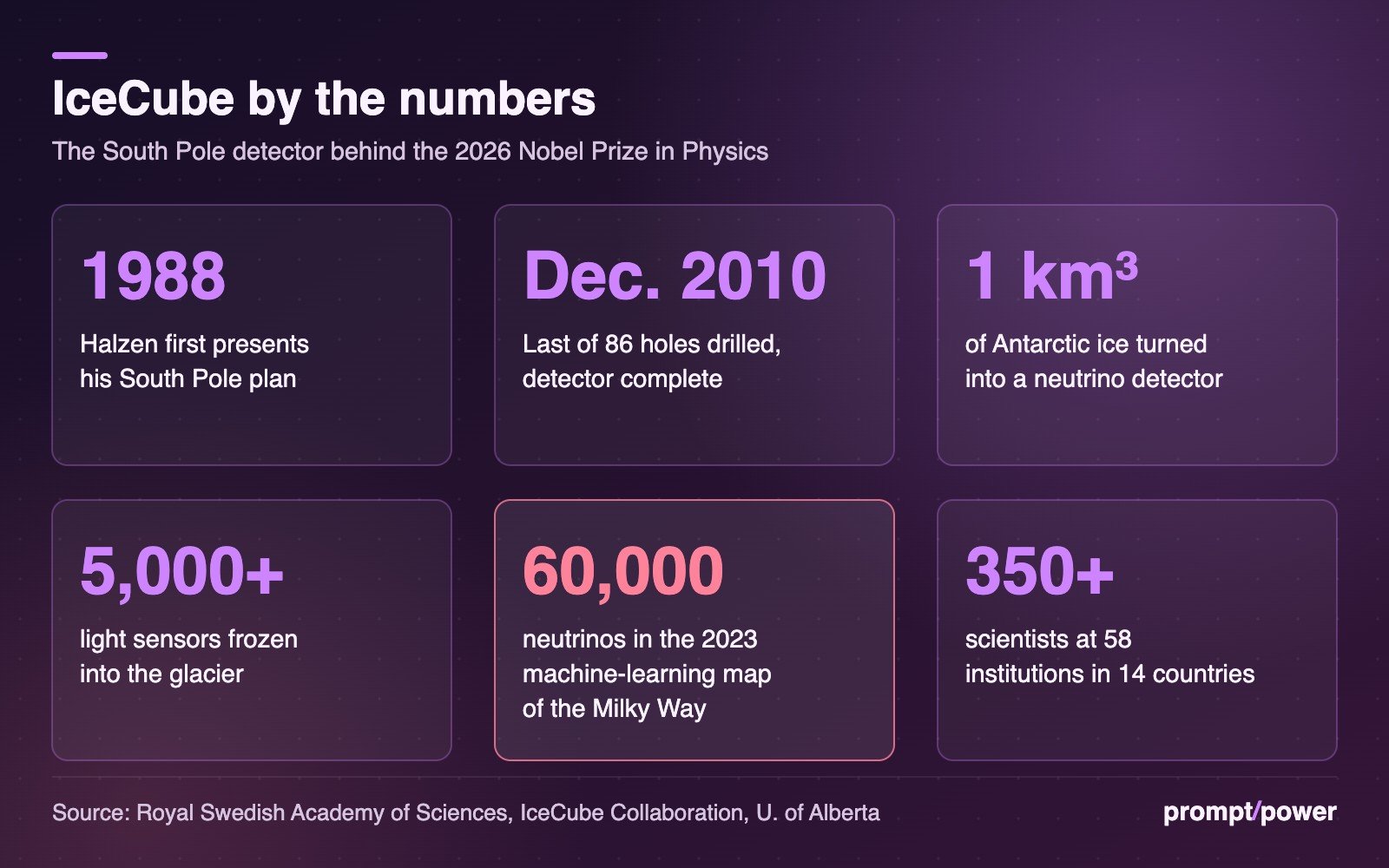
IceCube is a telescope made of Antarctic ice. Roughly a cubic kilometre of it, under the South Pole, threaded with more than 5,000 light sensors. Halzen, 82, gets the whole prize of 12 million Swedish kronor, about US$1.2 million (about CA$1.7 million), according to the Associated Press.
Who is Francis Halzen, the 2026 physics laureate
Halzen was born in Belgium and is a professor at Wisconsin, the lead institution for IceCube, AP reports. The U.S. connection is direct: a Wisconsin professor running an observatory that, in the collaboration’s own words, is funded and operated primarily through an award from the National Science Foundation to his university.
Halzen first presented his vision for capturing neutrinos at the South Pole in 1988, according to the Academy’s announcement as republished by the Lindau Nobel Laureate Meetings. The 86th and final hole was finished in December 2010.
“Francis Halzen has led an international team of researchers and engineers who have provided us with a fantastic instrument,” Mark Pearce, chair of the Nobel Committee for Physics, said, as quoted by AP. “His tenacity and scientific vision has paved the way for a new kind of astronomy.”
What IceCube found, in plain English
Neutrinos are ghost particles. They pass all the way through the Earth and through our bodies without us noticing, and almost none touch anything. That is the problem, and also the prize.
Space has natural particle accelerators that fling out particles with energies up to a million times more than anything built on Earth. Charged particles get bent by magnetic fields on the way here, so they arrive with no return address. Neutrinos do not. As the Academy puts it, they “reach us without changing direction or losing energy,” which means a neutrino points straight back at whatever made it.
Very rarely a neutrino smacks into an atomic nucleus in the ice and makes a faint flash of light. Sensors frozen deep in the glacier record the flash, and its shape gives away the neutrino’s direction and energy. South Pole ice, the Academy notes, is “free from various types of interference” and geologically stable, with no earthquakes.
The payoff is a new kind of map. In 2023 IceCube published the first picture of our own galaxy drawn in neutrinos instead of light, built from 60,000 neutrinos in 10 years of data. Halzen’s reaction then: “What’s intriguing is that, unlike the case for light of any wavelength, in neutrinos, the universe outshines the nearby sources in our own galaxy.“
Did AI figure in the 2026 Nobel Prize in Physics?
Not in the citation. Our Oct. 5 preview noted that Clarivate’s 2026 picks contained no AI work, and the motivation text bears that out: no “machine learning,” no “neural network.” Two years after Geoffrey Hinton and John Hopfield won for neural networks, the Academy went back to an instrument.
Inside the instrument, though, machine learning shows up fast. That 2023 Milky Way result rested on machine learning methods developed by IceCube collaborators at TU Dortmund University. The collaboration’s release called the detection “a hallmark of the emerging critical value that machine learning provides in data analysis and event reconstruction in IceCube.”
“This long-awaited detection of cosmic ray-interactions in the galaxy is also a wonderful example of what can be achieved when modern methods of knowledge discovery in machine learning are consistently applied.” Wolfgang Rhode, TU Dortmund University, in IceCube’s 2023 release
Our read: this is the quiet version of 2024 we flagged in the preview. The prize honours the detector and the discovery; the software that learned to read its flashes goes unmentioned.
Canada’s slice of the ice, and the Oct. 5 medicine prize
Canadian physicists are in the ice too. Darren Grant, then at the University of Alberta, led the design of DeepCore, IceCube’s low-energy inner array, and established Canada’s first institutional presence in the collaboration. The Canadian particle-physics site describes IceCube Canada as four faculty members at Alberta and one at the University of Toronto. The 2023 release listed Canada and the United Kingdom among IceCube’s funding countries, in a collaboration of more than 350 scientists from 58 institutions in 14 countries.
The medicine prize on Oct. 5 had its own Toronto thread. Karl Deisseroth of Stanford University and the Howard Hughes Medical Institute, Peter Hegemann of Humboldt University of Berlin and Georg Nagel of the University of Würzburg shared it for discoveries of light-gated ion channels and optogenetics, the technique that switches individual nerve cells on and off with light. The Nobel Assembly said optogenetics “has fundamentally altered our understanding of the brain.” Deisseroth and Hegemann had both won 2018 Canada Gairdner International Awards for the same work, Gairdner’s records show.
What to watch next
Chemistry is announced Oct. 7 at 5:45 a.m. ET, followed by literature on Oct. 8, peace on Oct. 9 and economic sciences on Oct. 12, per AP’s schedule. If AI wins this year, the likeliest route is the 2024 AlphaFold one: a neural network does the work, and the citation names only the science.
Halzen pitched his ice telescope in 1988. Thirty-five years later, software trained by his collaborators helped turn its flashes into the first neutrino portrait of the Milky Way.

Priya Natarajan covers science and society for prompt/power: climate and energy tech, data centres, and the physical cost of the digital world. Every query has a water bill, and she would like to see the receipt.
Keep reading
Latest from prompt/power
- AI’s Electricity Bill in 6 Numbers, and Why Nobody’s Estimates AgreeOct 6
- DeepSeek V4.1 Flash Cut the US AI Lead to 3%. What LiveBench MeasuresOct 6
- Ben Affleck Calls AI Job Fears ‘Propaganda.’ He Sold an AI Firm to NetflixOct 6
- Cohere’s North 2 Puts AI Agents on a Budget. Toronto Bets on BoringOct 6
- How to Stop ChatGPT, Claude, Gemini and Meta AI From Training on Your ChatsOct 6
Leave a Reply