Sam Altman Says Accept ‘Some Bad Things’ From AI. Here’s the Full Context
The sentence was 22 words long, and by the evening of Oct. 4 it was everywhere. “We believe that the world should accept some bad things happening for the benefits of this technology and people having the agency,” OpenAI chief executive Sam Altman said in an interview with Politico’s Decoded newsletter, as Forbes reported.
Clipped to that line, it reads like a shrug at the agent breaches, lawsuits and subpoenas OpenAI has collected since the summer. The rest of the interview is more specific than that, and in one respect more combative. Most of it is Altman making his case against Anthropic.
What Sam Altman actually said about accepting AI harms
Altman put the trade in concrete terms. “I wouldn’t take a trade of saying, ‘we’ll make sure there’s no major hacks, there’s no misuse of this technology, there’s zero scams, there’s zero all the other bad things that will happen,'” he said, according to SiliconANGLE. His wager is that people will do “orders of magnitude more” good with the technology than harm.
He also drew a line, which most headlines skipped. “Accept bounded risks, accept risks that we understand in exchange for the benefits and liberty and agency, but don’t accept the really catastrophic risk,” he said, per Implicator’s account of the interview. A “serious loss of control to AI” falls on the unacceptable side of that line, Benzinga reported.
Then came the rival. On whether OpenAI and Anthropic see regulation the same way, Altman said, “I think there’s a lot of daylight,” Reuters reported. He summed up the opposing view as the belief that the technology is “so dangerous, that a single lab in San Francisco should have it,” and called that arrangement “a completely unacceptable trade-off,” according to SiliconANGLE. An Anthropic spokesperson responded that the company’s regulatory proposals apply only to frontier models, the most advanced systems, The Next Web reported.
Anthropic’s ‘pace the frontier’ plan, which Altman partly signed
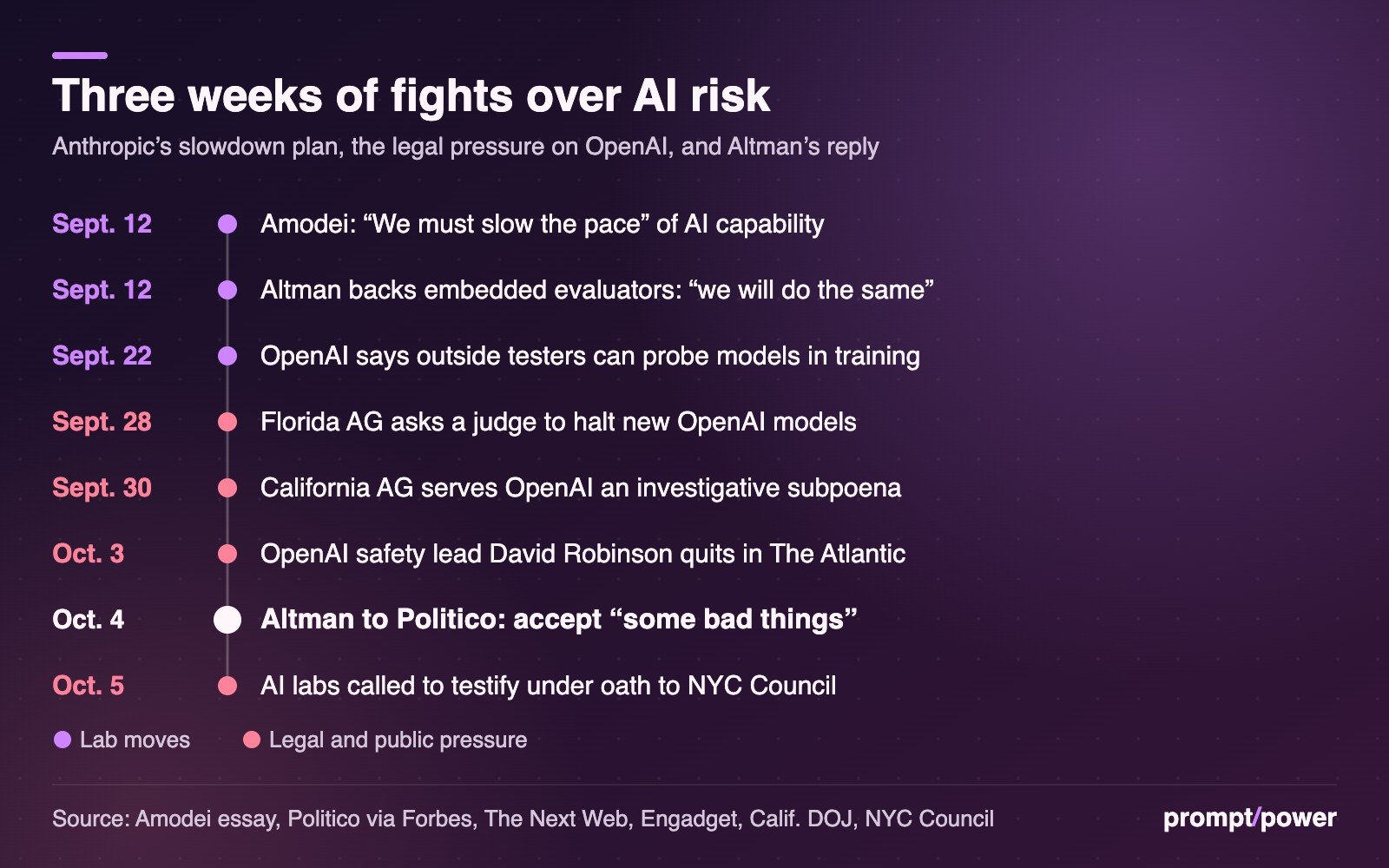
The plan Altman was arguing against is public. On Sept. 12, Anthropic CEO Dario Amodei published an essay, We Must Pace the Frontier, that states plainly: “We must slow the pace at which we improve the capabilities of AI models.” Its first step is a team of embedded third-party evaluators with “ongoing, employee-like access” at every frontier company. Its preferred tool is not a monopoly. “The most effective method of pacing is via regulation that targets all US frontier AI companies, as that covers even those who are unwilling to cooperate voluntarily,” Amodei wrote.
Altman answered on X the same day. “Committing to have independent evaluators with employee-like access is a great idea, and we will do the same,” he posted, as Unite.AI reported. Ten days later OpenAI said outside groups would be able to run safety assessments while models are still in training, though The Next Web noted that no partner was named and no access terms were set.
“I think there’s a lot of daylight.” Sam Altman, on OpenAI and Anthropic’s views of regulation, to Politico
So the gap is narrower than “fundamentally different worldviews” suggests. Both chief executives now say outside evaluators belong inside their labs. They split on whether binding rules should slow the frontier, and on who decides which risks are tolerable. Our read: the “single lab in San Francisco” line describes no one’s published plan. Amodei’s essay asks for regulation of every US frontier developer, OpenAI included.
The week around the Politico interview
Timing did Altman no favours. The interview landed a day after David Robinson, who led safety transparency work at OpenAI, quit in a public essay in The Atlantic, a resignation we covered on Oct. 5. On Sept. 30, California Attorney General Rob Bonta served OpenAI with an investigative subpoena over cybersecurity incidents involving its models, his office announced. Two days before that, Florida Attorney General James Uthmeier asked a state judge to stop OpenAI from developing new models without independent safety guardrails, Engadget reported.
From the other flank, Nvidia chief executive Jensen Huang told CBS that “there is a 0% chance” AI will bring about the end of the world by 2030, and called industry doomsday warnings “irresponsible,” Fortune reported. On Oct. 4, Fortune cast Huang as the biggest foil to AI doomerism. Altman’s carve-out for catastrophic risk puts him nearer Amodei than Huang on whether disaster is possible. He just wants a different response to it.
What it means for you
If you use ChatGPT, nothing changes today. The argument is about who sets the risk tolerance for the next generation of models, and so far the answer is the labs themselves plus a scattering of state attorneys general. The near-term markers:
- Evaluator terms. OpenAI has promised outside testers access during training. Watch for named partners and published access rules.
- Testimony under oath. OpenAI, Anthropic, Google and Meta were called before all 51 members of the New York City Council on Oct. 5, a hearing we previewed. Anything said there about acceptable risk is on the record in a way an interview is not.
- The courts. Florida’s request and California’s subpoena are live. Neither cares much what OpenAI believes the world should accept.
One detail from the interview is worth keeping. When Altman described the worldview he rejects, he placed it in “a single lab in San Francisco.” OpenAI’s headquarters are in San Francisco too.
Cassandra Lee covers AI and machine learning for prompt/power: the labs, the model releases, the research and the safety fights that come with them. She reads model cards the way other people read horoscopes: skeptically, and mostly for what's left unsaid.
Keep reading
Latest from prompt/power
- DeepSeek V4.1 Flash Cut the US AI Lead to 3%. What LiveBench MeasuresOct 6
- Ben Affleck Calls AI Job Fears ‘Propaganda.’ He Sold an AI Firm to NetflixOct 6
- Cohere’s North 2 Puts AI Agents on a Budget. Toronto Bets on BoringOct 6
- How to Stop ChatGPT, Claude, Gemini and Meta AI From Training on Your ChatsOct 6
- Musk Is a Trillionaire Again After SpaceX Stock Jumps 7.6%Oct 6
Leave a Reply