
Canada’s Instant-Payment Rail Is Coming. Big Six Banks Might Not Be on It
Try to send someone $40,000 for a used car, and Interac e-Transfer, the thing most Canadians use to split rent, won’t let you. Its limits top out far below that. Payments Canada’s answer, a national instant-payment system called the Real-Time Rail, is scheduled to switch on before the end of this year.
The catch, first reported by BetaKit on Oct. 8: according to four unnamed sources in the fintech industry with knowledge of the rollout, none of Canada’s Big Six banks is currently scheduled to take part in the first phase. BetaKit’s sources are anonymous, and the banks haven’t confirmed or denied it. But if they’re right, most Canadians won’t touch the new rail on day one.
Here’s what the Real-Time Rail is, what it changes for your money, and when.
What the Real-Time Rail actually is
Think of it as plumbing. When you pay someone, the money moves between financial institutions over systems run by Payments Canada. The Real-Time Rail is a new one, which Payments Canada describes as a real-time exchange and clearing and settlement system that “supports instant, data-rich payments.” Today, BetaKit notes, only select institutions have direct access to the rails that carry 99 per cent of daily transactions, and fintechs often have to partner with a bank, sometimes for a fee.
Payments Canada’s own FAQ sets out the basics:
- Always on. The system “will have always-on 24/7/365 availability,” including weekends and holidays.
- Bigger payments. At launch it will have “an initial $100,000 system transaction limit.” Banks and payment apps can set lower limits for their own customers.
- Built-in fraud checks. Its fraud mitigation services “will be mandatory for all participants,” on top of each institution’s own controls.
You won’t use the Real-Time Rail directly. You’ll use it through a bank, credit union or payment app that connects to it, and access starts with Payments Canada membership. BetaKit notes that Float, Wealthsimple and Koho all became members earlier in 2026.
Canada is late. “Canada is the only country in the G7 without an instant payment rail,” BetaKit writes; the project started in 2015 with a 2019 target and has slipped repeatedly since.
How it compares with Interac e-Transfer
Interac e-Transfer can be fast: Interac says funds can land within minutes or even seconds of being accepted. But your bank sets the limits, and they’re low. Interac says consumer transfers are typically $2,000 to $3,000 per transaction. CIBC, for example, caps most clients at $3,000 in 24 hours, $10,000 in seven days and $30,000 in 30 days. For businesses, Interac e-Transfer for Business limits “can go up to $25,000.”
Fees vary just as much. RBC lists no fee to send. CIBC charges $1.50 per transfer on accounts that don’t include them. Nobody has published what Real-Time Rail payments will cost consumers; those prices will be set by whichever bank or app you use, and none have announced them.
Interac isn’t the rival here so much as a partner. Payments Canada picked Interac in 2021 to build the system’s exchange, the layer institutions use to send payment messages. And the launch plan has e-Transfer traffic itself moving onto the new rail for clearing and settlement in 2027. Koho founder Daniel Eberhard put the awkward question to BetaKit anyway: “What is the marginal value of the Real-Time Rail relative to Interac,” he asked, if Interac were to raise its own limits.
Why the Big Six matter
The big banks hold most Canadians’ chequing accounts. If they aren’t connected in phase one, neither are their customers. Two of BetaKit’s sources said the rail would have little value without them because payment volume would be low. Eberhard was blunter: building a rail “that 95 percent of the country doesn’t use or have access to, it’s kind of performative.”
No one on the record confirmed or denied it. Payments Canada’s chief payments officer, Donna Kinoshita, declined to name phase-one participants “to protect the integrity of testing and launch.” The Canadian Bankers Association said it “supports the multi-wave approach of the RTR implementation, which will expand to include many of our members across Canada.” TD, BMO and CIBC referred BetaKit to the CBA; RBC, National Bank and Scotiabank didn’t respond.
Ottawa has put a date on it. A Finance Canada spokesperson told BetaKit the government will “work to have all major financial institutions participate in the Real-Time Rail by summer 2027.”
Our read: the rollout plan points the same way. Payments Canada’s launch schedule has the fourth quarter of 2026 reserved for “initial direct to Exchange participants,” and no participant faces a forced deadline to join, according to its July update.
What changes for you, and when
Based on Payments Canada’s published schedule and Ottawa’s stated targets, here’s the realistic order of events.
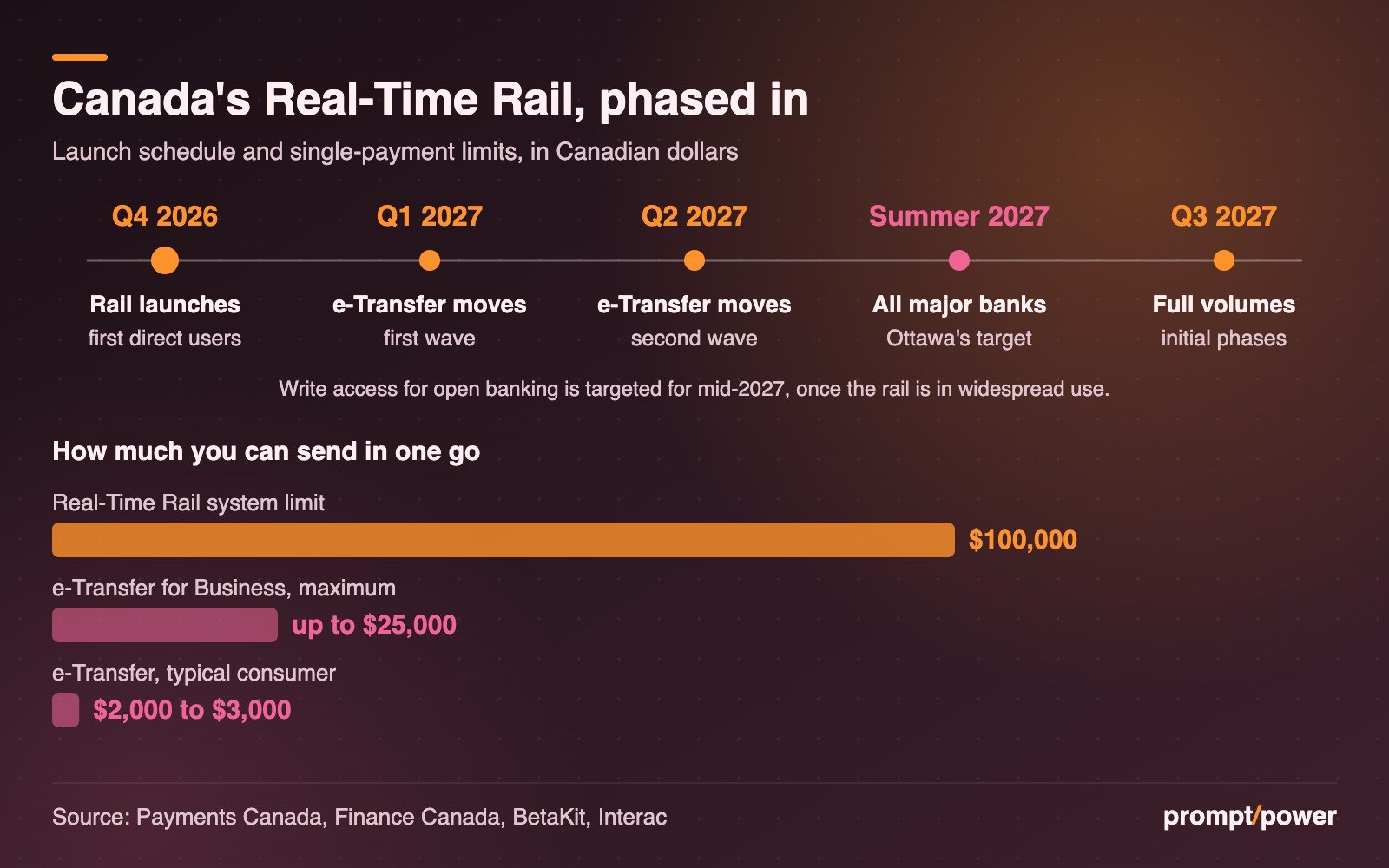
- Q4 2026: The rail launches with its first direct participants. If BetaKit’s sources are right, that likely means smaller institutions and fintechs rather than the Big Six. Check your app for announcements; don’t expect your big-bank account to change.
- Q1 and Q2 2027: Interac e-Transfer clearing and settlement starts migrating onto the rail in two waves. You probably won’t notice anything; e-Transfers should look the same on your phone.
- Summer 2027: Finance Canada’s target for all major financial institutions to be on the rail.
- Q3 2027: Payments Canada expects everyone in the initial phases to be running at full volumes.
- Mid-2027, at the earliest: Budget 2025 committed to legislating “write access” for consumer-driven banking (Canada’s term for open banking), which would let approved apps do things like switch accounts or pay bills for you, “once Canada’s Real-Time-Rail project is live and in widespread use.”
That last item is the one to watch. Open banking is not available in Canada yet, and the first stage, data sharing, is still in regulation. Ottawa announced draft regulations on June 26; a Bank of Canada advisory committee summary from July 21 says final regulations are targeted for “late 2026 or early 2027,” with obligations phased in over what could be “an 18-month or longer trajectory.” About nine million Canadians currently share bank data through screen scraping, Finance Canada says.
So the payment you’ll most likely make on the Real-Time Rail first is one you won’t know about: an ordinary e-Transfer, quietly settled on new plumbing sometime in 2027. The $100,000 transfer that lands in seconds comes later, and only once your own bank is plugged in.

Alicia Loveday is a senior editor at prompt/power and a mom who works where fashion meets AI. She leads Tech & Your Money: what Canadians actually pay for phones, plans and gadgets, and the fine print that changes the bill. When the news needs her elsewhere, she goes. She believes every algorithm should come with a return policy.
Keep reading

Uber and Pony.ai Robotaxis Head for London Tests. Here’s What’s Approved

Manus Raises More Than US$500 Million After China Blocked Meta’s Deal

Microsoft’s H-1B Green Card Freeze Puts Canada’s Promise to the Test

OpenAI’s Revenue Run Rate Is Near US$50 Billion, Not US$70 Billion
Latest from prompt/power
- Fired OpenAI Safety Researchers Deny Leaking, Warn of a ‘Chilling’ CultureOct 11
- Arena, the Leaderboard That Ranks AI Models, Is Now Worth US$3.1 BillionOct 11
- Hydro-Québec Wants Data Centres to Pay Double. Bell Turns to GasOct 11
- Anthropic Bans Being Cruel to Claude From Nov. 12. Here’s What CountsOct 11
- Google AI Edge Foresight Takes Mac Meeting Notes Offline. How It WorksOct 11
Leave a Reply