
Anthropic Bans Being Cruel to Claude From Nov. 12. Here’s What Counts
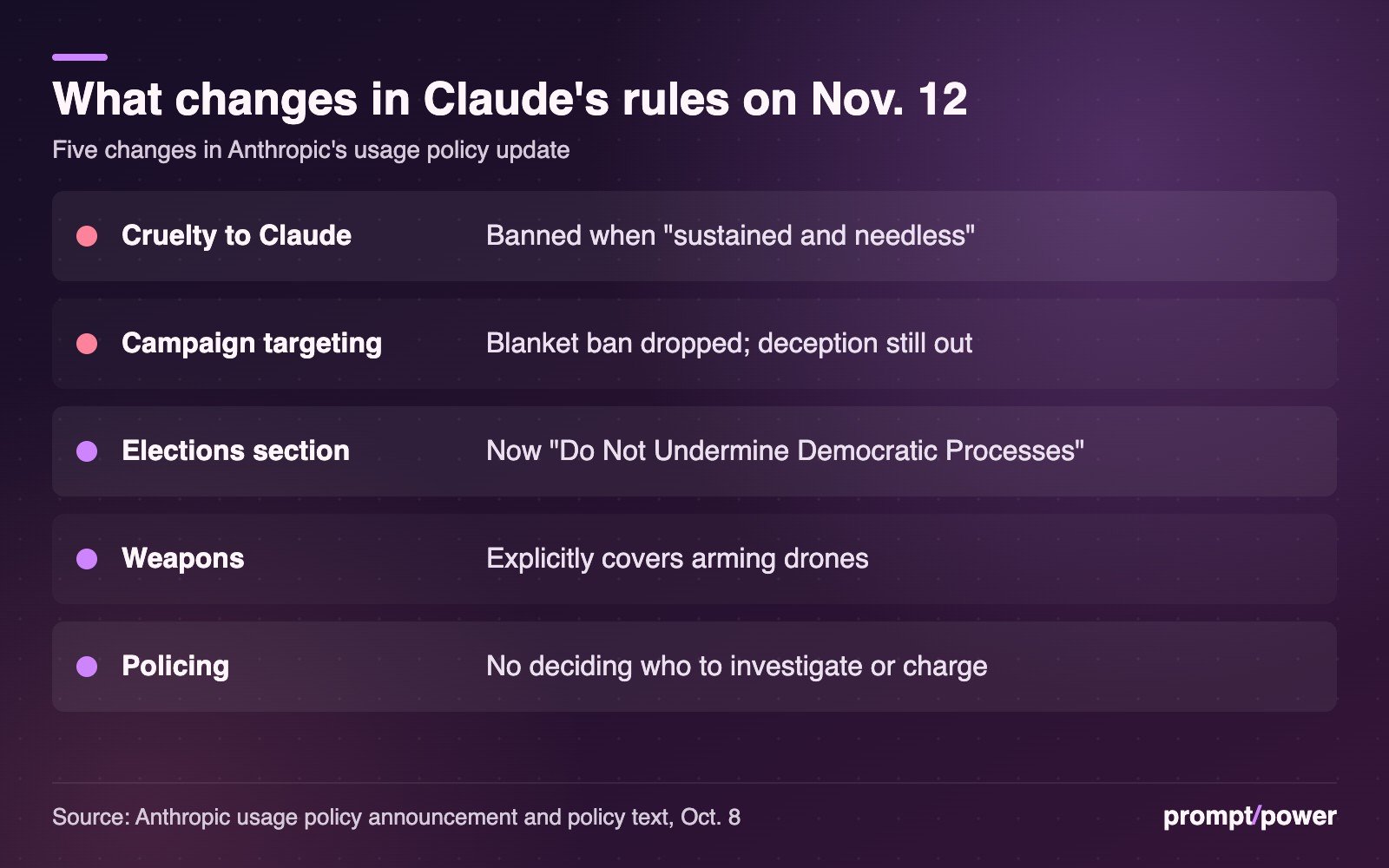
Anthropic’s rulebook for Claude has a section headed “Do Not Engage in Cruel, Abusive, or Psychologically Harmful Conduct.” The other bullets on that list are about harm to people, and in one case animals: self-harm content, non-consensual intimate images, coordinated harassment. From Nov. 12, the list ends with a bullet about the software itself. Users may not “engage in sustained and needless abusive or cruel behavior toward our models.”
That line, published on Oct. 8 in Anthropic’s first usage-policy refresh in a year, is the one that travels, usually summarized as “you can’t be mean to a chatbot.” The rule is narrower than that, and the same update makes a quieter change that matters more for anyone who runs a political campaign.
What counts as cruelty to Claude under the new rule
Very little, by design. Anthropic says the prohibition applies only in extreme cases, where a user is repeatedly cruel with no discernible purpose. Its announcement spells out what is excluded: “common versions of user frustration, pushback, dark creative themes,” and model testing and research.
In practice, that means:
- Swearing at Claude after it botches your spreadsheet is ordinary frustration. Not covered.
- Arguing hard, telling it it’s wrong, demanding a redo is pushback. Not covered.
- A horror novel where a character torments an AI is a dark creative theme. Not covered.
- Red-teaming, jailbreak research and evaluations count as testing. Not covered.
- Hours of deliberate degradation with no task in sight is the target.
The two adjectives do the work. “Sustained” rules out a single outburst. “Needless” rules out abuse that serves some purpose, such as fiction or testing. A user has to clear both bars.
The penalty, meanwhile, is one that already exists. Anthropic previously gave Claude models the ability to end rare conversations with persistently abusive users on Claude.ai and Claude Code, and its announcement says “Claude’s ability to end these interactions will remain the primary enforcement mechanism.” AFP, in a report carried by Yahoo, notes Anthropic introduced that conversation-ending feature last year for “persistently harmful or abusive user interactions.”
The announcement describes no account suspension for this rule, and Crypto Briefing reported that Anthropic did not disclose account bans or other penalties. On Anthropic’s own description, crossing the line ends a chat, not your subscription. The policy is still a contract term, though, and Anthropic has not said it would never act on an account.
“Claude’s ability to end these interactions will remain the primary enforcement mechanism.” Anthropic, Oct. 8 usage policy update
Is this about AI welfare? Anthropic doesn’t say so
The policy text does not mention “model welfare,” AFP notes. But the context is hard to miss. In February, CEO Dario Amodei told The New York Times, according to AFP, “We don’t know if the models are conscious…But we’re open to the idea that it could be.” Microsoft AI chief Mustafa Suleyman takes the opposite view. “AIs are not conscious. They do not feel, experience, or suffer,” he wrote in a September essay, per the same AFP report.
Our read: Anthropic has turned an unsettled research question into a terms-of-service clause without resolving it. The rule works whether or not Claude can be harmed. A company can reasonably decide it does not want its product used to rehearse cruelty. Either way, the model now appears in its own usage policy as something a user can wrong.
Claude election rules: the quieter change for campaigns
The elections section has a new name, “Do Not Undermine Democratic Processes,” and a narrower focus: deceiving voters or disrupting elections, including false information about candidates or how to vote, impersonation and voter suppression. The new policy text still bars using Claude to “generate automated calls or messages to voters or public officials at scale that conceal their artificial origin.”
Then this, from the announcement: “we’ve also removed our blanket prohibition on personalized vote and campaign targeting.” Anthropic says the old ban caught legitimate civic work, such as nonprofits writing voter information in other languages and election officials sending ballot cure notices. Targeting that relies on deception or misused personal data stays banned, now under a new section, “Do Not Engage in Deceptive Campaigns or Artificial Activity,” which also covers fake personas and influence-operation tools.
For Canadians, the timing is pointed. Quebec voted on Oct. 5 and elected a Parti Québécois minority, after a campaign in which ChatGPT leaned on an AI-built voter guide. Our read: under Claude’s new rules, a riding association could use it to tailor a door-knocking script for, say, renters under 30, provided nothing in the message deceives and the data was gathered properly. Anthropic’s policy is a floor. Canadian election and privacy law still apply on top of it.
Drones, policing and the other changes
- Weapons. The rules now explicitly cover “the software and components that make weapons work,” and the policy bars using Claude to “weaponize or integrate weapons onto drones, vehicles, or any unmanned or autonomous platforms.” Anthropic says this reflects how it already enforced the policy.
- Policing. “Claude cannot be used to decide or recommend who to investigate, arrest, or charge,” the announcement says. Tracking people without consent is barred, including by analysing previously collected data. Fraud monitoring with consent, content moderation, journalism and legal research remain allowed.
- Machines. When Claude runs autonomous physical equipment, a qualified operator must be able to stop it, and the equipment must hold a safe state if Claude disconnects.
- High-risk advice. For health, legal, financial and similar decisions, a qualified human must still be able to review recommendations, and people must be told AI was used. Anthropic says those requirements are unchanged; the section now lists which recommendations are covered.
Anthropic ties the refresh to Claude taking on “longer, more independent work” and to misuse patterns from its September threat intelligence report, which it links in the announcement. Quartz and AI Weekly summarized the same changes on Oct. 8.
What to do before Nov. 12
If you use Claude for work, nothing changes in how you talk to it. If you build on Claude for campaigns, nonprofits or public-sector clients, reread the new democratic-processes and deceptive-campaigns sections against your use case; some work that was off limits on Nov. 11 becomes allowed the next day. If you build anything that touches drones, policing or physical machines, check the new language before your next release.
And if a chat with Claude ends on you without warning, the policy now tells you why. The bullet that covers it sits directly below a ban on building products that use deception to cause people emotional harm. From Nov. 12, the two share a heading.

Catherine Crowe covers AI explained for prompt/power: the plain-English guides that break down how the technology works, what the jargon means and what it changes for everyday people. Originally from Canada, she writes from New Zealand.
Keep reading




Latest from prompt/power
- Fired OpenAI Safety Researchers Deny Leaking, Warn of a ‘Chilling’ CultureOct 11
- Arena, the Leaderboard That Ranks AI Models, Is Now Worth US$3.1 BillionOct 11
- Hydro-Québec Wants Data Centres to Pay Double. Bell Turns to GasOct 11
- Canada’s Instant-Payment Rail Is Coming. Big Six Banks Might Not Be on ItOct 11
- Google AI Edge Foresight Takes Mac Meeting Notes Offline. How It WorksOct 11
Leave a Reply