
Arena, the Leaderboard That Ranks AI Models, Is Now Worth US$3.1 Billion
When Meta launched Llama 4 in April 2025, its announcement leaned on a number from LMArena: an Elo score of 1417, good for second place on the crowdsourced leaderboard. The model that earned it was not the one developers could download. A Meta spokesperson told The Register it was “a chat optimized version we experimented with that also performs well on LMArena,” and the leaderboard’s operators said Meta “should have made it clearer that Llama-4-Maverick-03-26-Experimental was a customized model.”
Eighteen months later, the company that runs that leaderboard is worth US$3.1 billion (about CA$4.3 billion).
Arena, which dropped the “LM” from its name in January, announced on Oct. 8 a US$200 million (CA$278 million) Series B at that valuation. As TechCrunch’s Julie Bort reported, the price has nearly doubled since the start of the year. The money is a bet that the free scoreboard the AI industry quotes in its launch posts can also be a business that sells to the industry it scores.
Arena’s US$3.1 billion round and who invested
Lightspeed Venture Partners and Khosla Ventures co-led the round, according to Arena’s announcement. New backers Salesforce Ventures, 01 Advisors, Dell Technologies Capital and Endeavor Catalyst joined existing investors including Andreessen Horowitz, Felicis, AMP PBC, QuantumLight and The House Fund, Pulse 2.0 reported.
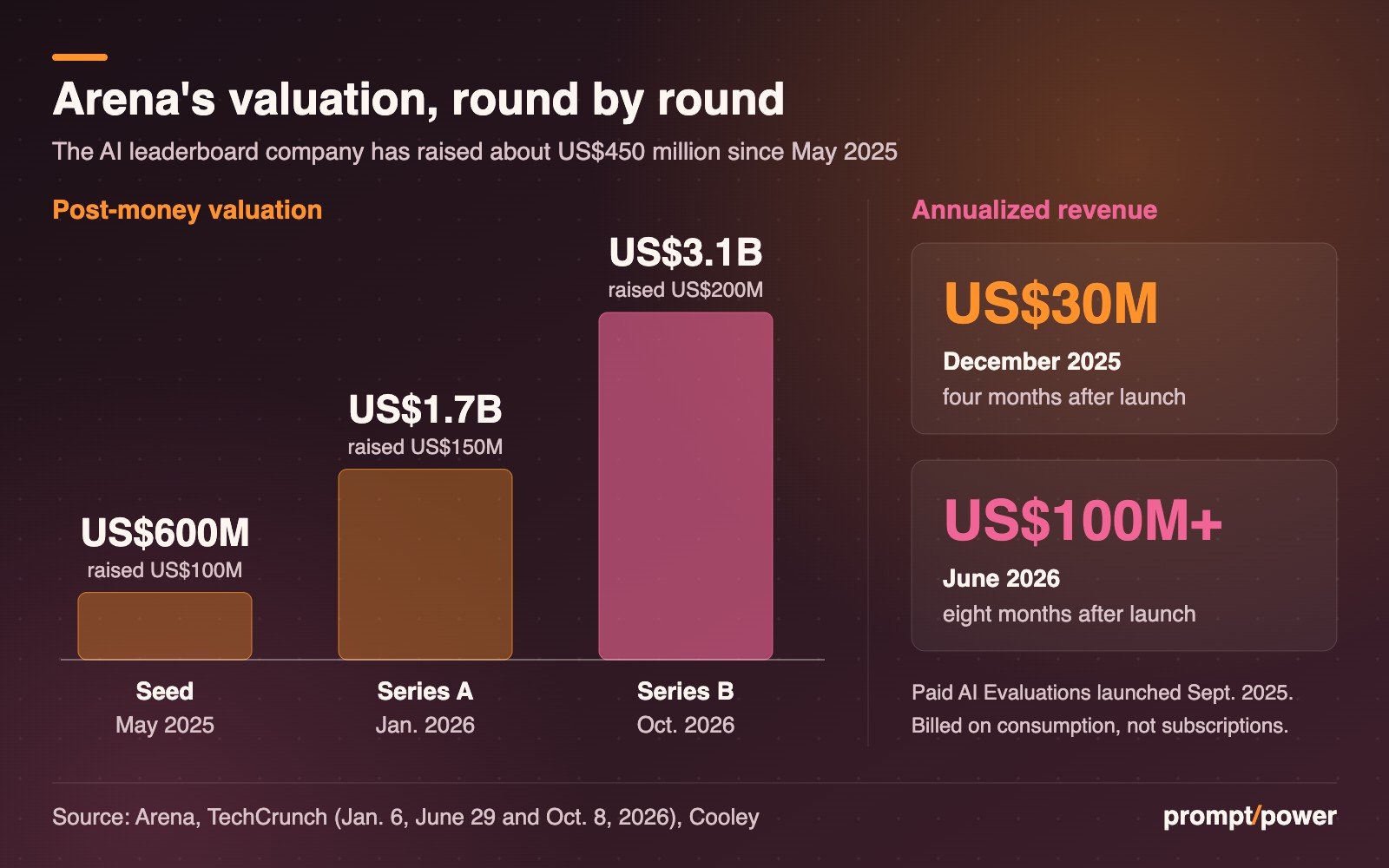
The climb has been steep. Arena raised a US$100 million (CA$139 million) seed round at a US$600 million valuation in May 2025, then a US$150 million Series A at a US$1.7 billion post-money valuation on Jan. 6, 2026, led by Felicis and UC Investments, the University of California’s fund, TechCrunch reported at the time. Law firm Cooley lists the same terms. That puts total funding at about US$450 million (CA$626 million) in 17 months, and the valuation up about 82 per cent in a little over nine months.
Revenue moved faster. Arena’s annualized “consumption rate,” its term for run-rate revenue, was US$30 million in December 2025, according to TechCrunch. By June it had reached US$100 million, TechCrunch’s Marina Temkin reported, and Arena now says it has “exceeded $100M in annualized revenue.” Chief executive Anastasios Angelopoulos told Temkin that customers pay for “consumption,” so the figure is not recurring revenue in the subscription sense.
How a free leaderboard turned into a business
The public site works the way it has since 2023, when it began as Chatbot Arena, a UC Berkeley research project built by Angelopoulos and Wei-Lin Chiang. You type a prompt, two anonymous models answer, and you pick the better one. Arena says that has added up to 350 million sessions, 62 million votes and tens of millions of monthly visitors from more than 150 countries.
The money comes from AI Evaluations, launched in September 2025, which sells performance analytics drawn from those community votes. In January, TechCrunch described the buyers as “enterprises, model labs, and developers.” Neither Arena nor the coverage we read names a single paying customer. Angelopoulos told TechCrunch that Arena competes “for the same dollar” as Mercor, Surge and Scale AI, the data-labelling firms that help model makers with post-training.
That comparison is revealing. Mercor and Scale do not publish the industry’s most-cited public ranking. Arena does, and according to TechCrunch, part of what draws its volunteer voters is early access to new and sometimes unreleased models. Pre-release testing keeps the crowd coming back, and it is also the practice critics have attacked hardest.
The Leaderboard Illusion and Arena’s reply
In April 2025, researchers led by Cohere Labs, with co-authors from Princeton, Stanford, the University of Waterloo, MIT, the Allen Institute for AI and the University of Washington, published The Leaderboard Illusion. They argued that undisclosed private testing let a few large providers try many variants and publish only the best. “At an extreme, we identify 27 private LLM variants tested by Meta in the lead-up to the Llama-4 release,” they wrote.
The paper also estimated that Google and OpenAI “have received an estimated 19.2% and 20.4% of all data on the arena, respectively,” while “a combined 83 open-weight models have only received an estimated 29.7% of the total data.” Votes are training signal, so more of them is an advantage. And “out of 243 public models, 205 have been silently deprecated,” the authors found.
Cohere sells models that compete on the same leaderboard; its Command A ranked 19th at the time, BetaKit noted. “This was an uncomfortable paper to write,” Sara Hooker, head of Cohere Labs at the time and a co-author, told BetaKit.
Arena rejected the framing. In a May 9, 2025 response, it said “any model provider can submit as many public and private variants as they would like, as long as we have capacity for it,” and that “it has always been our policy to only publish the results for publicly available models.” It said the writeup “contains several incorrect claims.”
Both things can be true. A rule open to every lab still favours the labs with the most variants and the biggest release budgets.
A referee with investors in the game
The Series B announcement pitches Arena as something bigger than a scoreboard. “The world needs a neutral third party to measure how safe and aligned AI actually is once it’s in the hands of real people,” the company wrote. “Arena is stepping into that role today.”
Its new Alignment Index tracks three failures in agent sessions: unauthorized action, false attribution of statements to the user, and “deceptive completion,” claiming a task is done when it is not. First results cover more than 20 frontier models. OpenAI’s GPT-6.1 Sol sits first, The Next Web reported, and TechCrunch says OpenAI models hold the top spots. The Next Web’s verdict was blunt: “Arena’s index is also a grader.”
Our analysis: neutrality is now the product, and the announcement says nothing about how Arena keeps it. One of its two new lead investors, Lightspeed, also led Anthropic’s US$3.5 billion Series E in March 2025, a round in which Salesforce Ventures took part, according to law firm Orrick. That is not evidence of bias, and venture overlap is normal in a small industry. It is a reason for disclosure. Arena could publish how much of its revenue comes from labs whose models it ranks, and how many private variants each provider tests before launch. It has published neither.
Meta’s 1417 ended up in a launch post before anyone asked where it came from. The next number labs will want to quote is a rank for not lying about finishing their work.

Mira Okonkwo covers the business of technology for prompt/power: venture capital, startups, IPOs and earnings. She treats a valuation as a mood rather than a number until the S-1 says otherwise.
Keep reading

Uber and Pony.ai Robotaxis Head for London Tests. Here’s What’s Approved

Manus Raises More Than US$500 Million After China Blocked Meta’s Deal

Microsoft’s H-1B Green Card Freeze Puts Canada’s Promise to the Test

OpenAI’s Revenue Run Rate Is Near US$50 Billion, Not US$70 Billion
Latest from prompt/power
- Cohere Opens an Ottawa Office as Its AI Agents Head to Navy ShipsOct 11
- Beijing Warns Officials Off ‘Blind Investment’ in AI and High TechOct 11
- TSMC Q3 Revenue Beat Its Forecast: What to Watch in ASML and TSMC EarningsOct 11
- China Gave AI Influencer Yuri an Official ID. What It Unlocks for CreatorsOct 11
- Double Counter Discord Breach: What to Do If Your IP Address LeakedOct 11
Leave a Reply