Every civilian agency of the US government is now under orders to strip out DeepSeek, the Chinese AI lab, and anything built with its models. The Department of Homeland Security published the order in the Federal Register on Oct. 20, 2026 (document 2026-21447). It bars Hangzhou DeepSeek and its affiliates from federal civilian procurement and requires removal of DeepSeek products already in place. The catch for the wider tech industry sits in one clause: agencies must also remove “third-party products and services developed using DeepSeek implementations.” The order was signed in June. What it says about the open-weight copies of DeepSeek that anyone can download is, as far as the public text shows, nothing.
We read the notice and the public-inspection PDF filed on Oct. 19. Here is what the order covers, where it goes quiet, and how it compares with the narrower step Canada took in 2025.
What the DHS DeepSeek order says
The notice has two operative parts. The first excludes “information technology products and services developed by Hangzhou DeepSeek,” a group that extends to “affiliated entities as defined in applicable regulations,” from federal civilian agency procurements. The definition it points to sits in the Federal Acquisition Regulation at 48 CFR 2.101, so a DeepSeek affiliate trading under another name is meant to be caught too.
The second part is the one that will generate compliance work. It orders “removal of all DeepSeek and DeepSeek-affiliate products” from civilian agency IT, along with “third-party products and services developed using DeepSeek implementations.”
The legal tool is the Federal Acquisition Supply Chain Security Act of 2018 (41 U.S.C. 1321–1328) and its rules at 41 CFR 201-1. DHS says the Secretary acted after reviewing a recommendation from the Federal Acquisition Security Council “and affiliated evidence.” Neither the recommendation nor the evidence is published. The notice was signed by James H. Percival II, DHS general counsel, and questions go to a FASCSA order implementation team inside the Cybersecurity and Infrastructure Security Agency (CISA).
The title limits the order to the federal civilian executive branch, so military systems are outside it.
Signed in June, published in October
Here is the strange part. The signed order isn’t in the Federal Register as searchable text; it is reproduced as page images in an appendix, and the notice points readers to a copy in regulations.gov docket DHS-2026-0628. CyberScoop, which reviewed the attached letter, reported that it was signed by Homeland Security Secretary Markwayne Mullin and dated June 26. FedScoop reported the same date. Both outlets read that as a ban that has been in force for months before the public could see it.
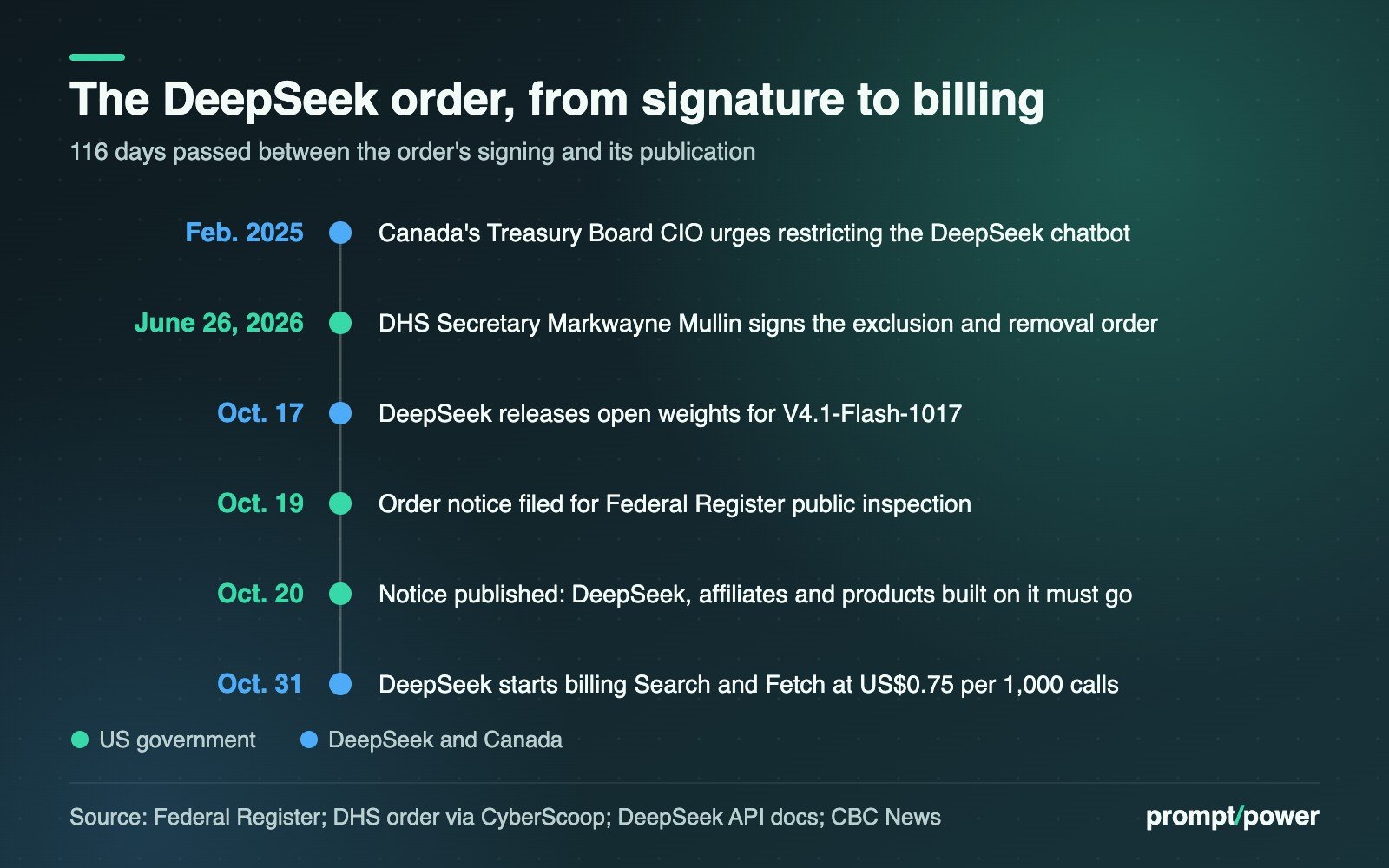
Mullin’s letter, as quoted by CyberScoop, says DeepSeek’s models present “multiple threat vectors” to agency systems. The reasons it gives: data stored on servers in China, where national security laws let the government demand data from domestic companies; DeepSeek-hosted models collecting personal information; and prompts and responses that “may result in the transfer of sensitive data.” Combined with public data, Mullin wrote, that information “could produce actionable intelligence on U.S. persons and/or government programs.”
DeepSeek-derived information “could produce actionable intelligence on U.S. persons and/or government programs,” Secretary Mullin wrote, according to CyberScoop.
He also conceded, per the same report, that some of the privacy and mass-collection risks could apply to other AI models, Chinese and American. DeepSeek is the only company named.
The gaps: open weights, cloud copies and waivers
Every risk Mullin lists runs through DeepSeek’s own servers. Prompts travel to China; data is stored in China. That is a description of the DeepSeek app and API.
It is not a description of DeepSeek’s open-weight models. Those are files. A developer can download them from Hugging Face, run them on a laptop or in a US data center, and never send a byte to Hangzhou. Our guide to running open-weight models locally covers how ordinary that has become.
The order’s language reaches those copies anyway, at least on its face. “Third-party products and services developed using DeepSeek implementations” plausibly covers a US startup’s coding assistant fine-tuned from DeepSeek weights, or a cloud service hosting the model on American soil. The public text we read does not define “implementations,” does not mention open weights, locally run models or cloud-hosted copies, and sets no removal deadline. Agencies are left to decide whether a model file is a “product.”
Exceptions exist but are tight. According to CyberScoop, agencies must request one 60 days in advance and show a “compelling justification,” such as being unable to perform a mission-critical function. In the meantime they are “encouraged” to monitor traffic, step up logging and watch for data exfiltration.
Our read: the “implementations” clause is the order’s real reach. A ban on the chatbot alone would barely register; agencies were already blocking DeepSeek at their own discretion, which the Commerce Department confirmed to FedScoop in 2025, CyberScoop notes. A ban on everything derived from DeepSeek’s weights forces federal vendors to audit model lineage, something few contracts ask for today.
Same week, DeepSeek shipped new open weights
DeepSeek did not slow down. On Oct. 17 it released DeepSeek-V4.1-Flash-1017 as an “open-source release,” with weights on Hugging Face and ModelScope, and said it is live on its website, app and API. The company claims “stronger benchmark performance, faster task completion, and shorter outputs than the previous version.” We covered how its predecessor narrowed the US lead on LiveBench.
The same post starts charging for two tools. Search and Fetch calls, currently free for API users when run through server-side tools in DeepSeek Harness, Claude Code and Codex, will cost US$0.75 (about CA$1.06) per 1,000 calls for each endpoint. “Billing starts Oct 31, 2026, at 16:00 UTC,” the company says.
That second detail matters for the order. A paid web-search tool means DeepSeek’s hosted service is fetching pages and returning them through its own infrastructure, which is exactly the data flow Mullin’s letter describes. The downloadable weights do none of that.
Beijing objected. Chinese state broadcaster CGTN reported on Oct. 20 that China “slams” the ban.
Canada restricted a chatbot, not a supply chain
Canada moved first and moved smaller. In a memo to departments in February 2025, Treasury Board Secretariat chief information officer Dominic Rochon wrote that “it is recommended that departments and agencies restrict the use of the DeepSeek chatbot on government devices,” CBC News reported. Shared Services Canada had already applied the block to the mobile devices it manages; BNN Bloomberg carried the story on Feb. 7, 2025.
That is a device rule aimed at a chatbot, framed as a recommendation. It says nothing about procurement or derived products. The US order is binding, covers buying as well as using, and follows the model’s code into other companies’ software. For a Canadian AI company selling to Washington, the US rule is the one that bites.
More background on the security fights around Chinese AI lives in our privacy and security coverage, including how DeepSeek and Huawei are building around Nvidia’s software.
What the DeepSeek ban means for you
- Consumers: nothing changes. The order covers federal civilian IT and procurement, not personal phones or private companies.
- Federal contractors and SaaS vendors: find out whether any model in your product descends from DeepSeek weights, including fine-tunes and distilled models. “Developed using DeepSeek implementations” is the phrase your agency customer will ask about.
- Developers on DeepSeek’s API: budget for Search and Fetch. From Oct. 31 at 16:00 UTC, each costs US$0.75 per 1,000 calls.
- Agency IT staff: questions go to CISA’s FASCSA order implementation team, listed in the notice. An exception request needs 60 days’ lead time.
Mullin’s signature was 116 days old by the time the public could read the order. Three days before it appeared, DeepSeek put a new set of weights on Hugging Face, where any federal contractor can still download them.

James Whitfield covers hardware for prompt/power: chips, semiconductors, laptops, components and the benchmarks behind the launch-day claims. He thinks the most important number on any spec sheet is usually the one in the footnote.
Keep reading
Ofcom Fines Tismi £437,500 for Leaving 366,000 Numbers Open to Scammers
October 2026 Patch Tuesday: Record 1,400+ Fixes and What to Patch First
Ledger Wallet Implant: What to Do If You Bought From a Reseller
Stop & Shop, Giant, Food Lion Sites Down in Ahold Delhaize Cyber Incident
Latest from prompt/power
- Apple ‘Pro and Tell’ Oct. 28: What’s Confirmed and What’s Only RumouredOct 22
- Tesla Q3 Earnings: SpaceX Out-Earned It Nearly 4 to 1 as Merger Talks BeginOct 22
- Meta Q3 Earnings: A US$64.6B Beat, US$34.9B of Capex and Negative Cash FlowOct 22
- PHP2Shell: Ottawa Pulled Websites Offline. Here’s What to Patch NowOct 22
- Microsoft’s Reported Loughton Exit Leaves 92% of a UK GPU Pledge AdriftOct 22
Leave a Reply