Tesla Q3 Earnings: SpaceX Out-Earned It Nearly 4 to 1 as Merger Talks Begin

Tesla reported third-quarter 2026 results after the market closed on Oct. 21: revenue roughly flat at US$28.05 billion, GAAP operating income of US$718 million and GAAP net income of US$787 million, or 22 cents a diluted share. One day earlier, SpaceX reported US$2.79 billion in operating income on US$14.58 billion of revenue, nearly four times Tesla’s operating profit on about half the sales. That gap is now a governance question. Both companies’ boards have formed special committees of independent directors to look at a merger, and no terms have been agreed.
We read both companies’ Q3 documents side by side: Tesla’s Q3 2026 Update, released at 4:06 p.m. ET, and SpaceX’s earnings release filed with the US Securities and Exchange Commission. Tesla also filed the results with the SEC at 4:41 p.m. ET. Its written update does not mention the merger talks at all, and on the evening call Tesla refused to discuss them.
Tesla Q3 2026 earnings: the numbers that matter
Tesla’s update calls quarterly revenue “roughly flat” year on year at US$28.0 billion. Operating cash flow was US$6.3 billion, free cash flow US$1.5 billion, and quarter-end cash, cash equivalents and short-term investments US$45.4 billion. Energy storage deployments were 13.7 GWh, up 10% from a year earlier, matching what Tesla reported on Oct. 2 alongside 486,532 deliveries and 464,391 vehicles produced.
Profit is where the year-on-year story turns. Electrek’s read of the update puts operating income down 56% and GAAP net income down 43%, with operating margin at 2.6% against 5.8% a year earlier. Non-GAAP earnings were 48 cents a share, against a consensus of about 45 cents, by Electrek’s count. Gross margin improved to 19.6% from 18.0%. Operating expenses did the damage: research and development rose 69% to US$2.76 billion, which Electrek ties to spending on AI, Optimus and Cybercab. Regulatory credit revenue, once a cushion, fell 73% to US$113 million.
Energy, the business that missed in our Oct. 2 deliveries analysis, brought in US$2.88 billion in revenue, down 16%, though its gross margin rose to 33%, per Electrek. Tesla’s update blames the car side on supply, not demand. Electrek quotes it saying “battery availability continued to be the limiting factor in increasing auto volumes in the quarter,” with “the largest backlog for our passenger vehicles in four years.” The outlook section says Tesla is “focused on maximum capacity utilization at our factories” and expects hardware profits “to be accompanied by an acceleration of SI, software and fleet-based profits.”
One more line ties the two companies together already. Tesla’s GAAP profit included a US$142 million unrealized loss on its SpaceX equity stake, Electrek reports. Tesla is already a SpaceX shareholder.
What Tesla said on the Q3 earnings call
Investor relations head Travis Axelrod opened by saying Tesla “will not be addressing any questions today on a potential merger with SpaceX,” according to Investing.com’s transcript of the call. Musk added: “I think I said everything that should be said yesterday, tap dancing through a minefield there.”
The bigger news on the call was spending. Chief financial officer Vaibhav Taneja said Tesla is “revising our CapEx guidance to be approximately” US$20 billion for 2026. That is down from more than US$25 billion previously, StockTwits reported. It will be funded mainly from operating cash flow, Taneja said, backed by up to US$30 billion of undrawn borrowing capacity.
On products, the biggest milestones now sit in 2027. AI director Ashok Elluswamy said robotaxi service would launch in Dallas “next month” and that “somewhere around Q2 next year” Tesla could switch on unsupervised driving in the first customer cars. Executive Lars Moravy said Tesla is trying to get Cybercabs to customers by the end of 2026. Musk said Optimus deliveries are “likely to be towards the end of next year,” and that reaching 20,000 robots a week would take “at least a year, maybe a little longer.”
Shares rose about 2% after the report, then reversed to trade roughly 4% lower by about 8 p.m. ET, StockTwits reported.
Tesla vs SpaceX Q3: the numbers side by side
| Q3 2026 | Tesla | SpaceX |
|---|---|---|
| Revenue | US$28.05B (roughly flat) | US$14.58B (up 161%) |
| Biggest growth line | Services and other, US$4.61B (up 33%)* | Super Intelligence, US$7.56B (52% of revenue) |
| Operating income | US$718M | US$2.79B |
| Net income | US$787M | US$4.40B |
| Capital spending | US$4.73B* | US$19.59B |
| Cash and short-term investments | US$45.4B | US$89.9B (US$51.3B cash plus US$38.6B securities) |
*As reported by Electrek from Tesla’s update. SpaceX figures from its SEC filing; the cash total is our sum.
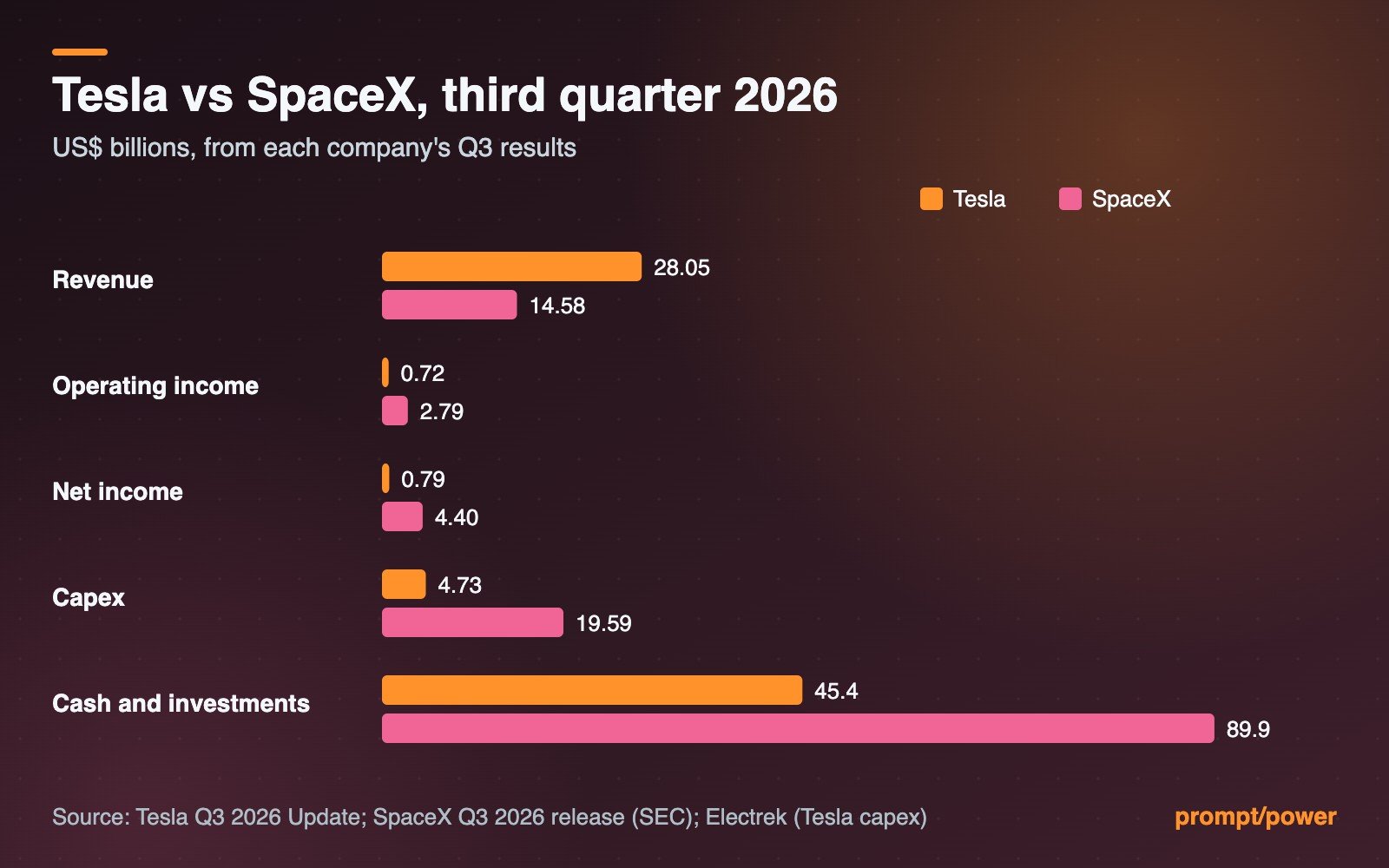
SpaceX’s release describes its Super Intelligence unit as “the operating and reportable segment previously reported as Artificial Intelligence (AI).” It brought in US$7.56 billion, of which US$7.02 billion came from SI solutions and infrastructure and US$538 million from advertising. Starlink added US$5.25 billion; launch, US$1.77 billion.
The capex line is the one to stare at. SpaceX spent US$19.59 billion in the quarter and US$48.07 billion over nine months, against US$13.10 billion of operating cash flow over the same nine months. SpaceX does not report free cash flow. Our arithmetic puts the nine-month gap near US$35 billion, which is why the company has been raising tens of billions in debt for Nvidia chips. Tesla, by contrast, generated cash this quarter and has just cut its full-year capex plan to about US$20 billion, less than SpaceX spent in the third quarter alone. In a merger, Tesla’s balance sheet would meet SpaceX’s spending.
Who decides a Tesla SpaceX merger
Musk raised the committees himself on SpaceX’s Oct. 20 call. “Because I’m a conflicted party, I can’t actually be in the discussions of the special committees,” he said, according to TechCrunch, calling it “an odd kabuki dance where two groups of people are talking, and I can’t be in the conversation.” He said assuming a merger is certain was “overstating it,” while adding: “I do think there’s a lot of merit to combining the companies.”
Tesla’s Oct. 19 proxy statement names seven independent directors, TechCrunch reported: chair Robyn Denholm, Ira Ehrenpreis, JB Straubel, Joe Gebbia, Jack Hartung, James Murdoch and Kathleen Wilson-Thompson. Elon Musk and his brother Kimbal Musk are not independent. Neither company has said who sits on its committee.
Here is the detail that will draw scrutiny. Ehrenpreis is also an independent director at SpaceX, where he chairs the compensation and nominating committee, per TechCrunch. One person counted as independent on both sides of a deal is not automatically disqualified. It does mean that if he sits on either committee, the other side of the table includes a fellow board member.
“At the end of the day, the shareholders have to be supportive of this.” Elon Musk on SpaceX’s Q3 call, via TechCrunch
The vote is where the companies differ most. At Tesla, a merger would need approval from 50% of all shareholders, not just those who vote, as Musk noted on the call, TechCrunch reported. At SpaceX, Musk holds more than 50% of the voting power. Our read: the Tesla vote, not SpaceX’s, is the real gate. Under a majority-of-all-shares bar, every share that stays home counts the same as a no.
What to watch next
- Committee membership. Whether Tesla names its committee members and advisers, and whether Ehrenpreis is among them.
- A valuation. No terms exist. Any exchange ratio will be judged against the two Q3 profit lines above.
- Tesla’s 10-Q. The quarterly filing should carry the SpaceX stake’s value and any related-party disclosures.
Musk’s own wealth already swings with SpaceX’s stock, as we covered in the Morgan Stanley note. Our guide to reading an AI company’s filings explains how to check the next documents yourself, and the business desk will follow the committees.
For now, one number frames the talks. SpaceX’s Super Intelligence segment alone brought in US$7.56 billion in the quarter, more than Tesla’s energy and services businesses combined.

Jeff Cameron writes about the business and policy side of AI for prompt/power. A chief operating officer by trade, he also writes for Not An Atlas.
Keep reading

Meta Q3 Earnings Oct. 21: The Capex, Ads and Cash Numbers to Watch

Anthropic’s 5% Pledge Is Worth About US$48B. Here’s the Fine Print

Bumble Buyout: Ithaca Holdings Pays US$6.05 a Share, a 138% Premium

Amazon Eyes Decart for US$7B as Nvidia Weighs Buying Reflection AI
Latest from prompt/power
- Apple ‘Pro and Tell’ Oct. 28: What’s Confirmed and What’s Only RumouredOct 22
- Meta Q3 Earnings: A US$64.6B Beat, US$34.9B of Capex and Negative Cash FlowOct 22
- PHP2Shell: Ottawa Pulled Websites Offline. Here’s What to Patch NowOct 22
- Ofcom Fines Tismi £437,500 for Leaving 366,000 Numbers Open to ScammersOct 22
- Microsoft’s Reported Loughton Exit Leaves 92% of a UK GPU Pledge AdriftOct 22
Leave a Reply