
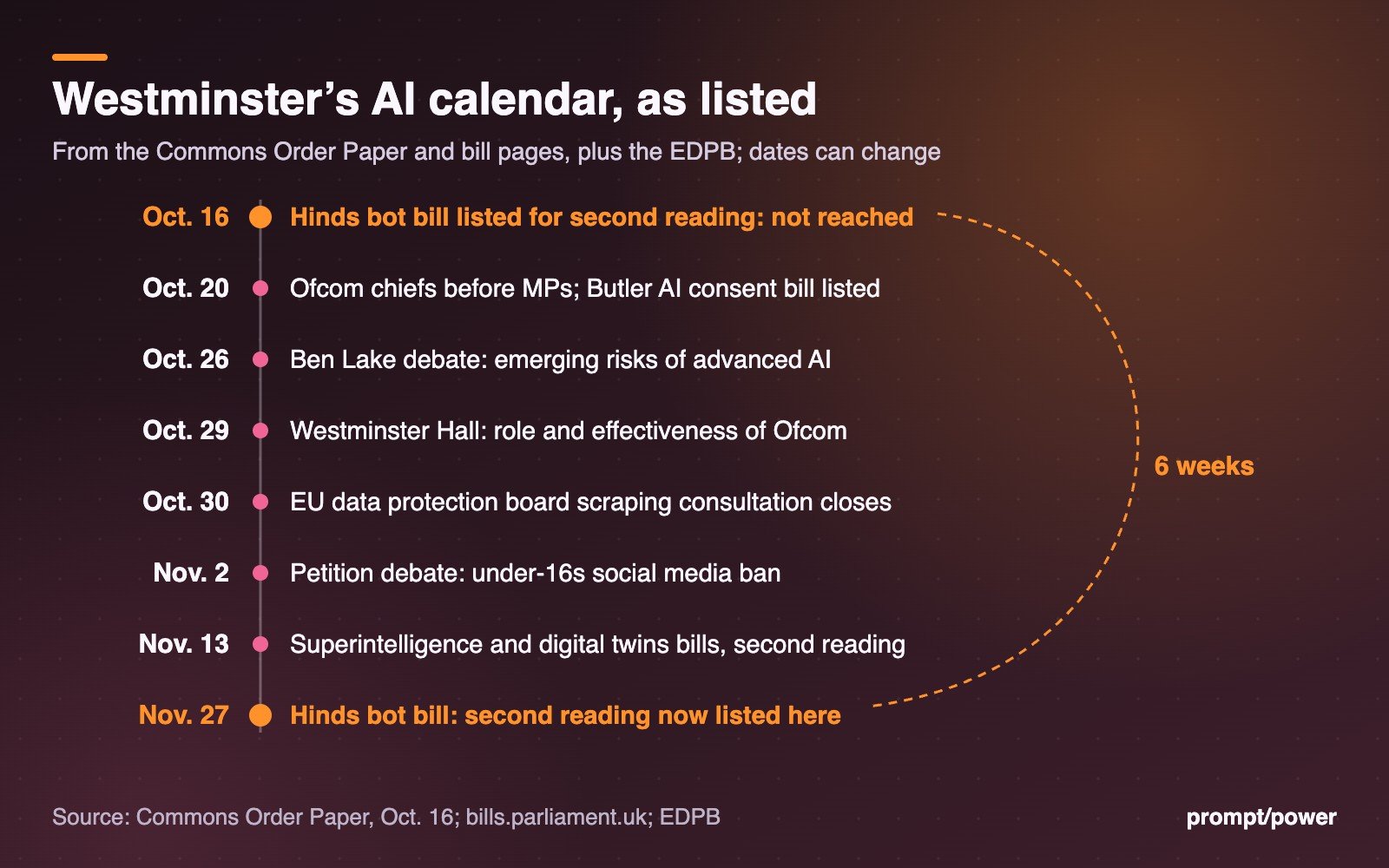
Damian Hinds’s bill to make AI crawlers identify themselves to the websites they scrape was listed for second reading in the House of Commons on Friday, Oct. 16. It wasn’t reached. The bill’s stage page on the Parliament website now shows a single second-reading sitting, on Friday, Nov. 27, and even then it can’t go to committee without a money resolution from the government. Meanwhile, the Commons has an unusually dense run of AI business booked: a backbench debate on the risks of advanced AI on Oct. 26, a Westminster Hall debate on Ofcom on Oct. 29, and second readings for an artificial superintelligence bill and a “digital twins” data bill on Nov. 13.
We built the timeline below from the Commons Order Paper for Oct. 16, whose future-business section lists these items, and from the Automated Online Software (Access and Transparency) Bill page. Both are living documents. The Hansard Society, in its Oct. 11 Parliament Matters bulletin, warns that business can change at short notice and the Order Paper should be checked on the day. Treat every future date here as “as listed”.
The UK AI and Ofcom timeline, Oct. 16 to Nov. 27
- Fri Oct. 16: Hinds’s bot bill listed for second reading. Hinds was thirteenth in the ballot, and the Hansard Society called it the least certain of the three ballot bills listed that day to be reached. It wasn’t debated; the stage page lists no Oct. 16 sitting.
- Tue Oct. 20, 10am: Ofcom chair Sir Ian Cheshire and chief executive Dame Melanie Dawes before the Commons Digital, Culture, Media and Sport Committee, according to Broadband TV News. The same day, Dawn Butler was listed to present an Artificial Intelligence (Consent and Misuse) Bill.
- Mon Oct. 26: Ben Lake’s backbench debate, on the motion “That this House has considered the emerging risks of advanced AI.”
- Thu Oct. 29, 3pm, Westminster Hall: Vikki Slade’s debate on the “Role and effectiveness of Ofcom”.
- Fri Oct. 30: the European Data Protection Board’s consultation on web scraping for generative AI closes.
- Mon Nov. 2, 4.30pm, Westminster Hall: Petitions Committee debate on e-petition 757233, on the proposed ban on social media for under-16s, led by Tony Vaughan.
- Fri Nov. 13: second readings of Dame Chi Onwurah’s Personal Data (Digital Twins) Bill and Alex Sobel’s Artificial Superintelligence Bill. Neither had been printed when the Order Paper was published.
- Fri Nov. 27: Hinds’s bill, second reading, per its stage page, which says “There are no publications for this sitting yet.”
What the Hinds bot bill actually says
The text as introduced on Oct. 13 (Bill 25 of the 2026–27 session) is short, and narrower than the campaign around it might suggest.
It defines a “bot” in clause 2 as “automated software that can request access to websites” and “can retrieve, scan, index or scrape information from those websites.” Clause 3 is the heart of it: “A bot operator must ensure that when a bot requests access to a website the bot confirms” who is operating it and what the information is for. Operators must not let a bot give false or misleading information.
Clause 4 hands the paperwork to Ofcom: “OFCOM must keep a public register of bots and bots operators.” Ofcom would set fees and application rules by regulation, consulting the Secretary of State.
Enforcement sits mostly with website owners, not the regulator. Under clause 5, the identification duties are “enforceable in civil proceedings by the operator of the website”, with remedies including an injunction, damages (with extra damages for repeated failure) and, for repeat offenders, an order requiring UK internet providers to block the operator’s services. Ofcom can issue compliance notices under clause 6 after 14 days for representations. There are no fines in the bill.
“It just requires basic transparency.” (Damian Hinds, speaking to Press Gazette about the bill in June)
That line, reported by Press Gazette’s Charlotte Tobitt on June 24 when the News Media Association said it was helping draft the bill, is accurate to the text. The bill doesn’t give publishers a right to refuse a crawler, and it says nothing about robots.txt. It makes crawlers say who they are, and lets sites sue the ones that lie.
The front page lists cross-party supporters, among them Sir John Whittingdale, Pete Wishart, Dame Caroline Dinenage and Vicky Foxcroft. The text also has rough edges a committee would need to sand down: clause 6(6)(b) refers to the register “kept under section 5” when the register is in clause 4, and clause 6(6) spells the regulator “OCFOM”.
Why the transparency angle matters now: commercial crawling terms are shifting under publishers’ feet, as our Oct. 19 story on Meta’s Oct. 30 business terms and website crawling laid out.
Why the Nov. 27 date for the bot bill is not a done deal
Three things stand between the bill and the statute book, and only one is a date.
First, sitting Fridays are scarce, and a bill thirteenth in the ballot queues behind others for time. The Hansard Society noted in its bulletin that a bill can proceed without debate if no MP objects, which is the realistic route for a measure this far down the list.
Second, the Order Paper flags that “a money resolution is needed before the Bill can proceed in Committee.” The bill would create an Ofcom register with fees and enforcement, and only the government can table that resolution. No money resolution, no committee stage.
Third, the date itself is a listing. Our read: Nov. 27 is the next available slot, not a commitment. Anyone still citing the Oct. 16 date is six weeks out.
Ofcom before MPs: unpaid online safety fines
The Oct. 20 committee session was billed to cover Online Safety Act enforcement, whether regulation can keep pace with AI, and Ofcom’s preparations for a proposed under-16 social media ban. LBC’s report of Dawes’s evidence, which carries no date on the page, quotes her conceding: “We won’t be able to recover every single fine on online safety.” By LBC’s account, nine of 11 fines issued since March last year are unpaid. “Another four have geo-blocked the UK,” she said of the unpaid group.
The numbers in that report give a sense of scale: one provider fined £1.35m (about US$1.8m) for lacking age checks, and only £55,000 recovered from more than £3m (about US$4m) imposed on adult sites as of March 2026.
MPs get a second go on Oct. 29, when Slade’s Westminster Hall debate asks the House to consider “the role and effectiveness of Ofcom.” Our earlier reports on Ofcom’s Instagram Instants investigation and its X and Grok inquiry cover the cases most likely to come up.
Butler, Lake, Sobel and Onwurah: the other AI bills and debates
Butler’s bill, as described on the Order Paper, would require consent before a person’s likeness is generated with AI, and create related civil action and offences. The Order Paper lists no second-reading date for it.
Lake’s Oct. 26 debate was chosen by the Backbench Business Committee, and the motion only asks the House to have “considered” the subject. It produces no law; our read is that its value lies in getting a minister on the record. Sobel’s and Onwurah’s bills, both listed for Nov. 13, are unprinted, so nobody outside their offices can yet say what they would do.
Across the Channel, the European Data Protection Board’s draft guidelines on web scraping for generative AI, adopted for consultation on July 8, take comments until Oct. 30. They bind EU regulators, not the Information Commissioner’s Office, but British publishers with EU readers are likely to feel them.
What it means for UK publishers and site owners
- Nothing changes yet. None of these bills has had a second reading.
- If the Hinds bill passed as drafted, it would take effect two months after Royal Assent, under clause 8, across the whole UK.
- Watch the money resolution, not just the date. It’s the clearest signal of whether the government will let the bill move.
More from Westminster on our policy page, including our explainer on why Britain isn’t getting ChatGPT’s EU watermark.
The bill’s own short title, in clause 8(3), still reads “Automated Online Software (Access and Transparency) Act 2026.” With a second reading booked for the last Friday of November, and a committee stage that still needs government money, that year may need changing too.

Felix Strauss covers tech policy and regulation for prompt/power, from Brussels and Ottawa to Washington and Sacramento. He reads the 400-page regulation so you don't have to, and highlights the one sentence that actually matters.
Keep reading



Latest from prompt/power
- Blink Mini 4K+ Is US$79.99. Two Years of Its AI Plan Costs MoreOct 23
- Netflix Cuts Its 2026 Ad Forecast to US$2.7B as Price Hikes HoldOct 22
- Anthropic’s AI Safety Bill, Explained: The 50-Death Test and Who DecidesOct 22
- ChatGPT Locked Chats: What the PIN Protects, and What It Doesn’tOct 22
- WhatsApp’s Hidden AI Notes Said Don’t Suggest a Regulator. Here’s YoursOct 22
Leave a Reply