
Britain’s Competition and Markets Authority (CMA) estimates that Microsoft’s UK business software earned a return on capital of more than 70% in 2024/25, against a cost of capital of 10% to 15%. That gap is the heart of the 179-page proposed decision the CMA published on Oct. 16, which would designate Microsoft with strategic market status (SMS) across Windows, Microsoft 365, security software, Windows Server and SQL Server. A consultation runs to 5pm on Nov. 13, and the CMA “must complete” the investigation by Feb. 13, 2027. Copilot is provisionally inside the designation.
The CMA’s press release carries none of those numbers. They sit in the proposed decision, its profitability appendix and a 27-page roadmap of possible interventions. One reading note: where the CMA prints a figure as a range in square brackets, such as [60–70]%, it is redacting the exact number to protect confidential data. The true figure lies somewhere inside.
Microsoft’s UK profits: over 70% return vs a 10–15% cost of capital
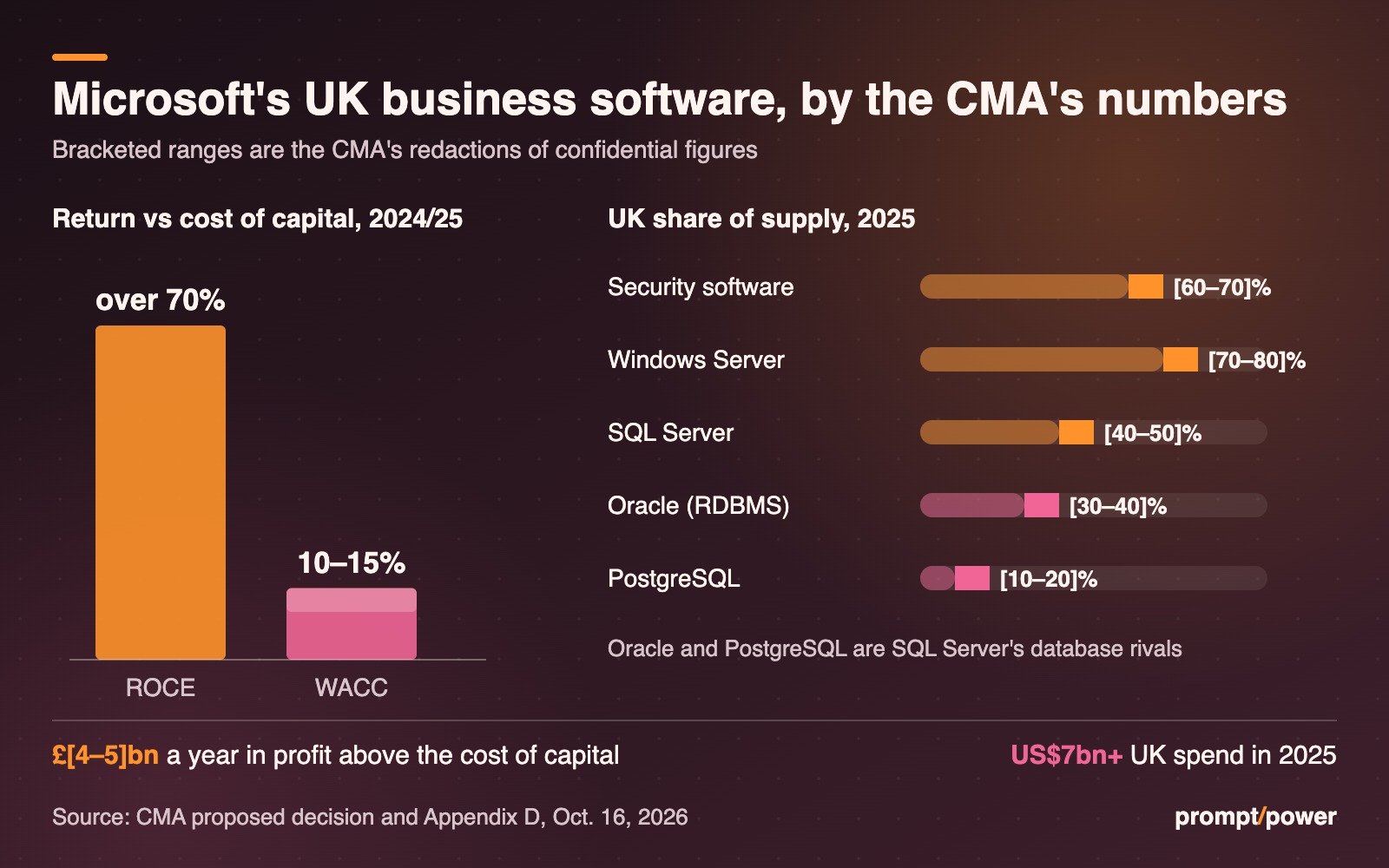
Paragraph D.7(d) of the appendix is the sentence Microsoft will fight hardest. The CMA writes that the UK ecosystem “has generated a return on capital employed (ROCE) of over 70% in financial year 2024/25 compared to an estimated weighted average cost of capital (WACC) of 10%-15%, equating to profits in excess of the WACC of £[4-5] billion.” That is roughly US$5.4bn to US$6.7bn a year above what a competitive market would be expected to pay.
Its provisional view (D.6) is that Microsoft “is earning profits substantially above its cost of capital.” The main decision (paragraph 1.19) adds that margins have been rising for a decade and sit “well above what we would expect in a competitive market”. There is a caveat in D.14: Microsoft “was unable to provide” UK-level financial data, so the CMA worked from global figures.
What do customers pay into that? According to paragraph 1.10, more than a million UK organisations “together spent more than $7 billion in 2025 on Microsoft products” (the CMA states that figure in US dollars; about £5.2bn). Paragraph 1.15 explains why the bill can look smaller than it is: Enterprise Agreement volume discounts “may mask prices that are higher than they would be if Microsoft faced stronger competition”, because dropping one product can shrink the discount on everything else.
Microsoft market share in security, Windows Server and SQL Server
The shares, all for 2025 and all redacted to ranges, run like this in the proposed decision:
- Security software: [60-70]% of UK supply, a position “stable since at least 2020” (paragraph 5.73).
- Windows Server: a revenue share of [70-80]% (5.119).
- SQL Server: [40-50]%, against Oracle at [30-40]% and PostgreSQL at [10-20]% (5.126). SQL Server alone “generated UK revenue of $[1-2] billion USD in 2025”.
Databases are the one market with a big rival in sight, which makes the CMA’s choice to keep them in the bundle telling. In its June 4 submission, Microsoft argued that it “does not accept that these five activities are appropriately characterised as a single grouped digital activity” (paragraph 2.1). The CMA has grouped them anyway, as “Microsoft’s Business Software Ecosystem” (1.13). Microsoft clears the legal bar easily: only firms with more than £1bn in UK turnover or £25bn globally (about US$1.3bn or US$33.5bn) can be designated (2.6).
This is the CMA’s fourth SMS investigation, footnote 1 notes, after Google in general search and Apple and Google in mobile platforms during 2025.
Copilot, Cowork and Agent 365 are provisionally in scope
Microsoft asked for its AI products to be left out. Its position, recorded at paragraph 4.50, is that they form “a distinct and complementary ‘AI layer'”, sold as an “optional per-seat add-on” to Microsoft 365 or through Microsoft 365 E7, its top “frontier” suite.
The CMA disagreed, provisionally. The productivity-suite activity includes “Microsoft’s M365 Copilot Offerings, including Microsoft 365 Copilot, Copilot Chat and features such as Cowork and Agents for M365 Copilot”, plus Microsoft Graph API, Work IQ, the Microsoft 365 Admin Center and Agent 365 where they underpin the suite. Its reasoning is about distribution. Microsoft “appears well positioned to benefit from AI adoption given its presence across organisational business software environments”, the decision says (1.22(b)), and UK uptake of the Copilot offerings is “substantially higher than other providers of AI features and functionalities.”
“There is already an early indication of this in Copilot’s strong usage by customers in PSS, relative to alternative providers.” (CMA proposed decision, paragraph 1.22(b))
That rebuts the argument Microsoft made in June, when it pointed to Gemini’s 900 million monthly users as proof of competition. Consumer scale does not put a rival agent inside a council’s Outlook and SharePoint. AI is not yet a way out, either: customers told the CMA that AI coding tools are not “sufficiently powerful to overcome the wide range of competition barriers” to switching (1.22(c)). Microsoft has reason to defend the stack, having committed to custom Maia chips to run Copilot.
The CMA roadmap: four areas, including Teams and cloud licensing
The press release lists three areas for action. The roadmap itself sets out four (paragraphs 1.9 to 1.13):
- Cloud licensing. The CMA’s July 2025 cloud market investigation found Microsoft’s licensing limits choice. Since then, “Microsoft has not altered its licensing practices in respect of that software.”
- AI tools. Whether rival AI tools “can integrate with, work alongside and be discovered and accessed from” Microsoft’s ecosystem.
- Teams. The European Commission accepted Teams unbundling and interoperability commitments in 2025, but “These commitments do not currently apply formally in the UK.”
- Security. Rivals say Microsoft’s interoperability mechanisms “do not always enable functionality equivalent” to what its own security products get.
Rivals’ top complaint, at paragraph 3.6, is “asymmetric access to customer data”: preferential access to Microsoft 365 data and Graph APIs, plus integration points such as Entra ID, SharePoint, OneDrive, Teams, Windows, Intune and Defender. Any fix would come as conduct requirements or pro-competition interventions, each consulted on first. Cloud is being handled separately: the CMA says Microsoft and Amazon Web Services have dropped data-transfer fees for customers switching provider and are connecting data centres with rivals, starting with Google, with an update due in spring 2027.
CMA Microsoft timetable: final decision by Feb. 13, 2027
“We began this investigation on 14 May 2026 and must complete it by 13 February 2027,” the decision says (2.2). Responses go to business.software.sms@cma.gov.uk or the case page by 5pm on Nov. 13. The CMA’s indicative timetable then has Microsoft’s oral representations in November, more evidence-gathering into December and a final report drafted in January. Designation would not end it: rules come later, with their own consultations. Britain’s other big-tech fights show how long that can take; the Google Play Store class action only went to trial in October 2026.
What it means for UK businesses and public bodies
- Nothing changes yet. Licences, prices and Copilot terms stand until a final decision and later rules.
- Check your Enterprise Agreement. The CMA’s discount analysis (1.15) is the evidence it wants more of: what switching one product would cost you on the rest.
- Piloting a rival AI agent in Microsoft 365? Integration problems are exactly what the roadmap asks about.
More UK competition cases are in our policy coverage, including the CMA’s review of the BT and TalkTalk deal.
Customers worried about their contracts have one assurance. The case page records that “Microsoft has confirmed it will not use any confidentiality provision with a party to prevent them from responding.” The CMA wants to hear from the people paying the US$7bn.

Felix Strauss covers tech policy and regulation for prompt/power, from Brussels and Ottawa to Washington and Sacramento. He reads the 400-page regulation so you don't have to, and highlights the one sentence that actually matters.
Keep reading




Latest from prompt/power
- Meta Q3 Earnings Oct. 21: The Capex, Ads and Cash Numbers to WatchOct 21
- Anthropic’s 5% Pledge Is Worth About US$48B. Here’s the Fine PrintOct 21
- Commons AI Study Meets Parliament’s Interpreter Math: 44 Passes in 5 YearsOct 21
- CNN All Access Canada Price Is CA$7.99. Americans Pay About 23% MoreOct 20
- DeepSeek Federal Ban: DHS Order Also Covers Apps Built on Its ModelsOct 20
Leave a Reply