The Ofcom X Grok investigation has moved to its decisive stage: Ofcom (the Office of Communications), Britain’s online safety regulator, is now assessing whether X breached its duties under the Online Safety Act over sexualised deepfakes made with Grok, and will issue provisional findings first if it thinks it did. In the same update on Oct. 14, reported by City AM, Ofcom said X now hits its targets for reviewing reported hate and terror posts, but that it still doubts the posts are actually coming down. A further assessment of X’s moderation is due early next year.
Speed and removal are different measurements. X has improved the first, and Ofcom’s complaint is now about the second.
X met its targets. Ofcom says that isn’t the same as removal
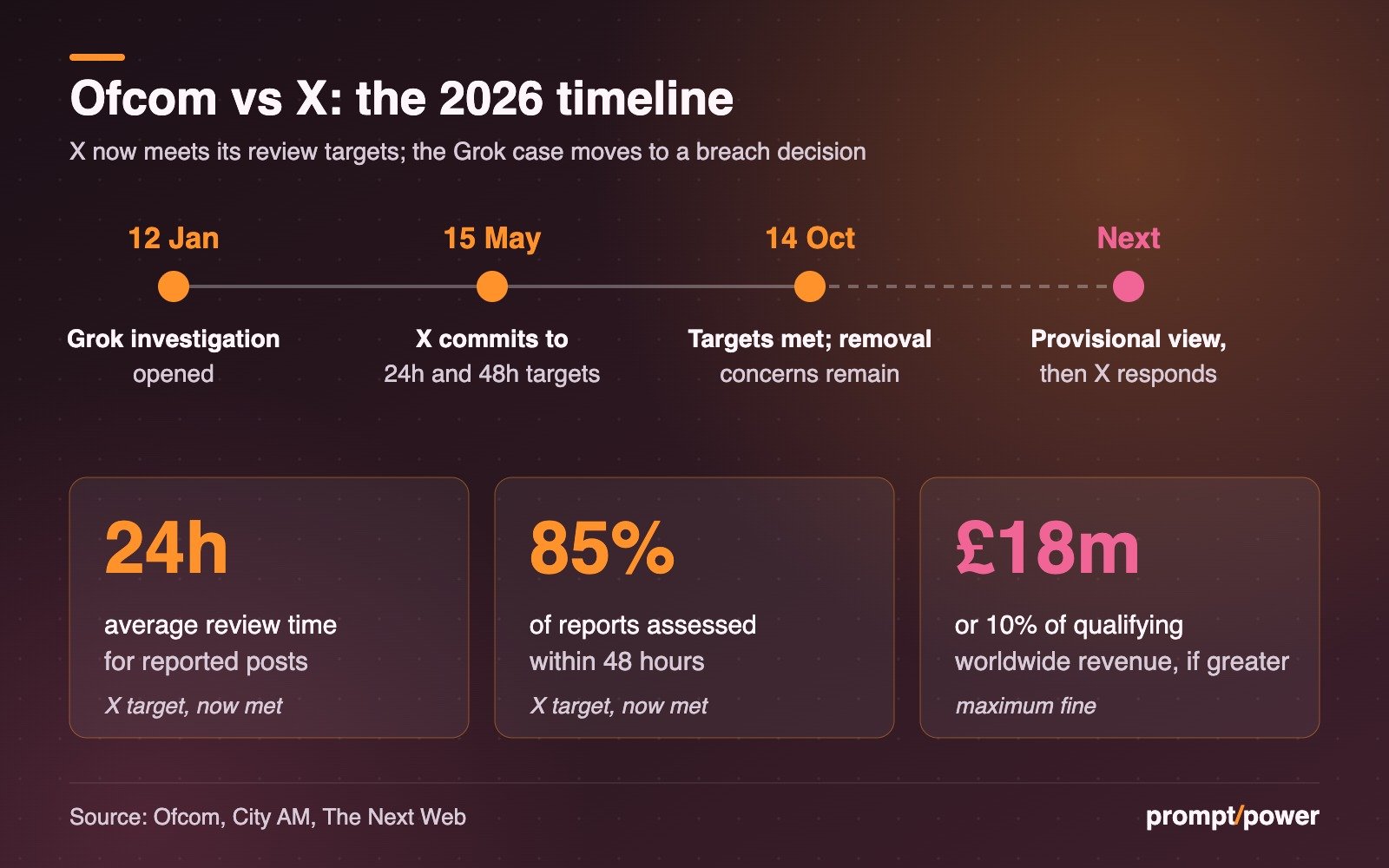
In May, X made formal commitments to the regulator. Under them, Ofcom’s 15 May statement says, X would review suspected illegal terrorist and hate content reported through its dedicated UK illegal content reporting tool within 24 hours on average, measured over three months, and assess at least 85% of those reports within 48 hours. It also promised to work with outside experts on its reporting systems and to send Ofcom performance data every quarter for a year.
The first quarterly report is in. X is meeting both review targets and acting faster than earlier in the year, The Next Web reported. Ofcom says it will check the figures against its own testing and expects X to keep it up.
Then the caveat, in Ofcom’s own words as quoted by City AM: “We have ongoing concerns around the effectiveness of X’s response to taking down illegal hate and terror content.”
That sentence is the story. A 24-hour review clock measures how quickly a moderator looks at a report. It says nothing about what the moderator decides. A platform could, in principle, meet every timing target while leaving most reported posts up, and the targets X agreed in May do not include a removal rate. Evidence on whether X is working with independent experts as promised is mixed, Ofcom said.
Civil society groups had flagged exactly this gap in May. Iman Atta, director of Tell MAMA, said in Ofcom’s statement at the time that “the test is not what is promised, but what is delivered.”
Ofcom X Grok investigation: what happens next
Ofcom opened the Grok case on 12 January after reports that Grok on X was being used to create and share sexualised images of real people, including children. Its case page names the company as X Internet Unlimited Company and lists the duties in play: illegal content risk assessment, illegal content safety, children’s risk assessment and child protection.
Ofcom has gathered extensive evidence using its formal powers and is now examining how X assessed the risk of illegal content, whether users could easily report it and how X handled moderation decisions, City AM reported. The sequence from here is fixed by the process:
- Provisional findings. If Ofcom finds reasonable grounds to believe X broke the law, it sends X a provisional view.
- X responds. The company can answer before any final decision.
- Final decision and penalty. Fines can reach £18m (about US$24m) or 10% of qualifying worldwide revenue, whichever is greater. In serious, ongoing cases Ofcom can ask a court for business disruption measures, including requiring UK internet providers to block a site.
Ofcom has not given a date for provisional findings. When it opened the case, Suzanne Cater, Ofcom’s director of enforcement, said the regulator would progress it “as a matter of the highest priority, while ensuring we follow due process.” Nine months on, that second clause is doing the work.
Porn, age checks and the Grok app
The update also closed one thread. Ofcom found pornography still visible to X accounts not verified as belonging to adults, and X has since restricted porn-labelled content to accounts that pass its age checks, according to City AM. The Next Web reported that Ofcom will now concentrate on illegal content and how users report it.
Separately, SpaceXAI, the company formerly called xAI, has changed the standalone Grok app for UK users, The Next Web reported: they can no longer view, create or share pornography with its image tool, and companion characters such as “Ani” no longer hold sexual chats with them.
Pressure is also arriving from outside Ofcom. Jess Asato, Labour MP for Lowestoft, asked the High Court in July to order xAI to stop Grok generating sexualised images of her, The Next Web reported. For what UK law does and doesn’t cover when someone’s likeness is cloned, see our explainer on deepfakes and the UK’s personality rights gap.
Why the 10% figure matters for X
X is not Ofcom’s only fight. X, Meta and TikTok have challenged parts of the regulator’s information-gathering powers in court, and Meta has contested how Ofcom calculates fees and penalties, City AM noted. Ofcom opened a separate case against Meta over Instagram Instants on Oct. 6, which we covered in Ofcom’s Instagram Instants investigation.
The penalty arithmetic is why “qualifying worldwide revenue” will be argued over line by line. For any company with more than £180m (about US$241m) in qualifying revenue, the 10% limb is the larger one. The more useful number to watch is the one Ofcom has not published: how many reported posts X reviewed in under 24 hours and then left up. More UK regulation coverage is on our policy page.

Felix Strauss covers tech policy and regulation for prompt/power, from Brussels and Ottawa to Washington and Sacramento. He reads the 400-page regulation so you don't have to, and highlights the one sentence that actually matters.
Keep reading



Latest from prompt/power
- Meta Q3 Earnings Oct. 21: The Capex, Ads and Cash Numbers to WatchOct 21
- Anthropic’s 5% Pledge Is Worth About US$48B. Here’s the Fine PrintOct 21
- Commons AI Study Meets Parliament’s Interpreter Math: 44 Passes in 5 YearsOct 21
- CNN All Access Canada Price Is CA$7.99. Americans Pay About 23% MoreOct 20
- DeepSeek Federal Ban: DHS Order Also Covers Apps Built on Its ModelsOct 20
Leave a Reply