The U.S. government owns 9.9% of Intel. Here’s how the deal works
Washington turned US$8.9 billion of chip grants into 433.3 million Intel shares in August 2025, with a warrant and passive voting terms.


It’s an unusual position for a U.S. company: one of its largest shareholders is the federal government. Since August 2025, Washington has owned about 9.9% of Intel, the only American company that both designs and manufactures leading-edge chips. With chip supply now central to the AI race, here’s how the deal is structured, from Intel’s own announcement.
The terms
On Aug. 22, 2025, Intel said the government would invest US$8.9 billion in its common stock. The money wasn’t new: it came from US$5.7 billion in CHIPS Act grants that had been awarded but not yet paid, plus US$3.2 billion from the Secure Enclave program.
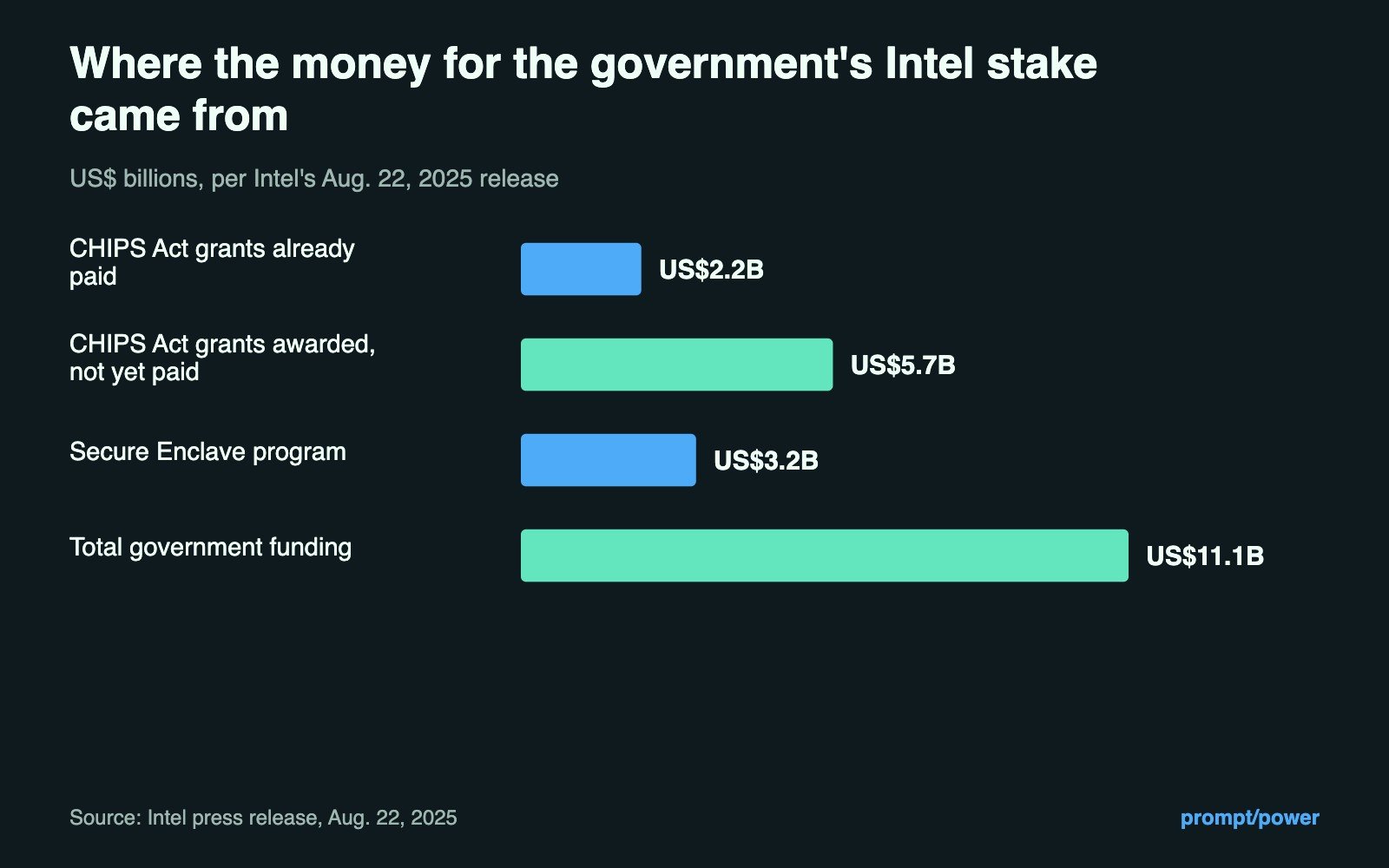
In exchange, the government bought 433.3 million newly issued shares at US$20.47 each, a 9.9% stake. Combined with US$2.2 billion in CHIPS grants Intel had already received, the government’s total investment came to US$11.1 billion.
The warrant
The deal also gave the government a five-year warrant to buy another 5% of Intel at US$20 a share. But it can only be used if Intel stops owning at least 51% of its foundry business, the unit that makes chips for other companies. In effect, it’s a penalty clause that discourages Intel from selling or spinning off control of its factories.
A passive owner
The government’s stake is passive. It has no board seat and no governance or information rights, according to Intel. It agreed to generally vote with Intel’s board on shareholder matters, with limited exceptions.
Intel’s chief executive, Lip-Bu Tan, framed the company’s case at the time: “As the only semiconductor company that does leading-edge logic R&D and manufacturing in the U.S., Intel is deeply committed” to American technology leadership.
Who else bought in?
Nvidia, a month later. On Sept. 18, 2025, the two companies announced that Nvidia would invest US$5 billion in Intel common stock at US$23.28 a share, subject to regulatory approval. That price was about 14% above what the government paid, by our calculation. The deal came with a product partnership: Intel would build custom x86 processors for Nvidia’s AI data-centre systems, and PC chips that combine Intel processors with Nvidia RTX graphics chiplets, connected with Nvidia’s NVLink.
“We appreciate the confidence Jensen and the NVIDIA team have placed in us with their investment,” Tan said. The pairing matters for the government’s stake: the most important AI chip company now has its own money in Intel’s success, though Nvidia’s leading-edge GPUs are still made by TSMC.
| Investor | Announced | Amount | Price per share |
|---|---|---|---|
| U.S. government | Aug. 22, 2025 | US$8.9 billion (433.3 million shares) | US$20.47 |
| Nvidia | Sept. 18, 2025 | US$5 billion | US$23.28 |
Why it matters for AI
Most advanced AI chips, including Nvidia’s, are made by TSMC in Taiwan, with a growing U.S. footprint in Arizona. Intel is Washington’s bet on a second, American-owned option. The stake gives the government a direct financial interest in whether Intel’s foundry wins customers, and the warrant gives it leverage over the foundry’s future.
For investors, it’s a reminder that industrial policy now runs through the share register. The stake is passive on paper, but a 9.9% holder with a stake in national security is not an ordinary shareholder.
What to watch
Foundry customers. Any big AI chip designer signing up to have Intel make its chips would be the clearest sign the bet is paying off.
The 51% line. Any move to bring in outside owners for the foundry business would bring the warrant into play.
Other stakes. The Intel deal set a template. Watch whether other strategic industries see grants turned into equity.
Last checked Nov. 24, 2026. This article is for information only and is not investment advice.
Sources
- Intel, Intel and Trump administration reach historic agreement (investor relations), Aug. 22, 2025
- Intel and Nvidia, Intel and NVIDIA to jointly develop AI infrastructure and personal computing products, Sept. 18, 2025
More from prompt/power: TSMC’s US$165-billion Arizona plan · Senators want the paper trail on Nvidia’s China chip sales · Microsoft Maia 300 will run Copilot from 2027
Researched and drafted with AI tools, fact-checked against primary sources and approved by a human editor before publishing. Prices and dates are as of publication. Our standards →
Sources- newsroom.intel.com — announced
- intc.com — Intel and Trump administration reach historic agreement
Jeff Cameron writes about the business and policy side of AI for prompt/power. A chief operating officer by trade, he also writes for Not An Atlas and The Remote.
All stories by Jeff →