Senators want the paper trail on Nvidia’s China chip sales
Warren and Coons asked Commerce, State and the White House to preserve records on licenses, a Singapore buyer of US$4.8 billion in Nvidia chips and an investigation that was reportedly handed off and then changed. A blacklisted Chinese university's H200 purchase shows what those records could reveal.
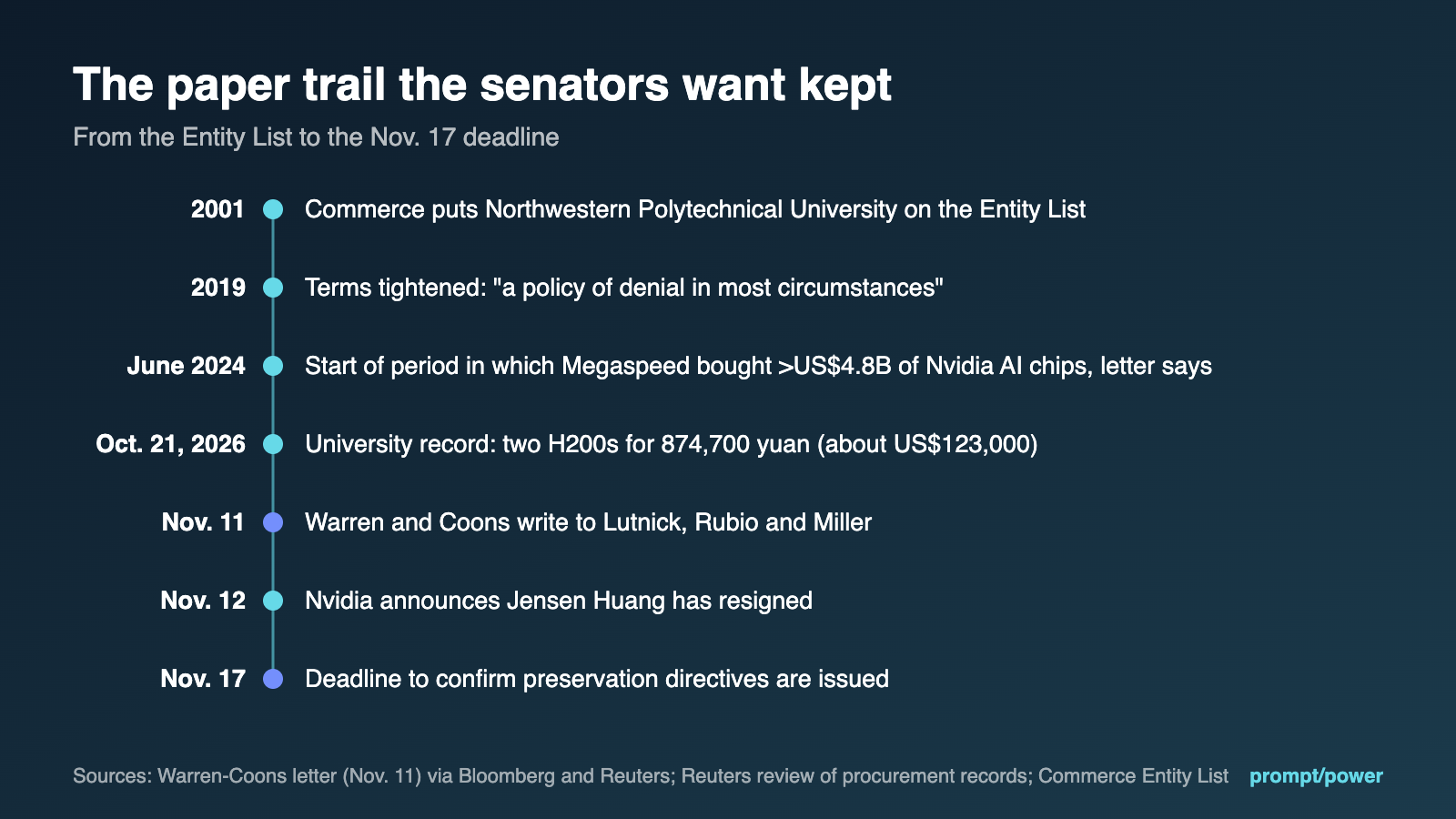
It was a small order: two Nvidia H200 processors for 874,700 yuan, about US$123,000, bought for the management school at Northwestern Polytechnical University in Xi’an. The purchase appears in an October 21 procurement record that Reuters found on the university’s own website. The seller was a reseller, Shaanxi Bosuan Network Technology, not Nvidia.

The trouble is who bought them. The Commerce Department put the university, one of China’s “Seven Sons of National Defense,” on its Entity List in 2001 over missile-proliferation work. In 2019 it tightened the terms so that licenses for controlled US technology face “a policy of denial in most circumstances.” Reuters says it reviewed 26 Chinese procurement and corporate records from this year and found five contracts the university signed in 2026 to rent computing capacity that included H200s.
Two chips won’t move the AI race. Our read: they show how much leaks through on paper. This week Washington started asking for that paper.
What the Warren-Coons letter asks for
On November 11, Sen. Elizabeth Warren of Massachusetts, the ranking Democrat on the Banking Committee, and Sen. Chris Coons of Delaware wrote to Commerce Secretary Howard Lutnick, Secretary of State Marco Rubio and White House chief of staff Stephen Miller. As Bloomberg reported, they asked the administration to keep every record on exports of Nvidia’s advanced chips to China and to “entities that may divert such chips.” The Wall Street Journal had the letter first, according to Reuters. The senators want written confirmation by November 17 “that preservation directives have been issued across your respective offices.”
A day later, Nvidia lost its chief executive.
The company announced on November 12 that Jensen Huang had resigned and that CFO Colette Kress would serve as interim CEO. The release gives no reason. Reuters reports that he stepped down days after reports linked him to a Singapore-based tech executive whom US authorities suspect of spying for Beijing. China’s foreign ministry calls the espionage allegations unfounded. That’s the personal story. The letter is about records.
Its center of gravity is Megaspeed, a Singapore-based computing company that the letter says “has purchased more than US$4.8 billion of NVIDIA’s advanced AI chips since June 2024.” The senators ask for intelligence assessments and risk reviews on Megaspeed and its former parent, 7Road Holdings, along with the tallies of chips Nvidia reportedly gave the Bureau of Industry and Security (BIS) on those sales.
One request names names. It covers August 2025 messages between Nvidia’s Tim Teter and Under Secretary Jeffrey Kessler, who runs BIS, about a Commerce investigation of Megaspeed that the letter says was reportedly handed to the Justice Department and later changed. Then comes the regulatory file: Nvidia’s license applications under BIS’s January 2026 rule, any changes to the so-called affiliates rule, and any proposed Entity List listings for Megaspeed and related firms.
“This incident raises significant concerns about the federal government’s ability to effectively enforce our export controls and protect our national security.” Sens. Warren and Coons, November 11, 2026
The letter never names the H20 or the H200, only “advanced AI chips.” That matters, because it sets aside the fight over which chips are legal to sell and asks something narrower: who knew a buyer might be a diversion channel, and what did they do about it? The request also reaches into diplomatic records from the Trump-Xi meetings in October 2025, May 2026 and September 2026 and from this month’s APEC meetings, and it cites the Federal Records Act and the Presidential Records Act.
From the H20 ban to now
April 9, 2025: The government told Nvidia that H20 exports to China needed a license. Nvidia expected charges of up to about US$5.5 billion.
August 2025: Nvidia was asked to give the US government 15 percent of its H20 revenue from China.
November 2025: BIS suspended for one year its September 2025 affiliates rule, which extends Entity List restrictions to companies at least 50 percent owned by listed parties. The suspension followed the US-China trade deal reached in Busan.
December 8, 2025: President Trump said on Truth Social that H200 sales to China could go ahead, adding that “25% will be paid to the United States of America.”
January 15, 2026: BIS’s final rule moved license review for H200-class chips (below 21,000 TPP and 6,500 GB/s of DRAM bandwidth) bound for China and Macau from a presumption of denial to case-by-case, with conditions. Exports to China are capped at 50 percent of what goes to US customers for the same chips. A US-based third-party lab must test every shipment. Buyers need know-your-customer procedures against unauthorized remote access, and military end users are excluded. As Reuters notes, the rule did not lift the separate Entity List restrictions that cover buyers like Northwestern Polytechnical.
April 23, 2026: Lutnick told Reuters of Chinese buyers, “We have not sold them chips as of yet,” blaming Beijing’s import curbs.
November 9, 2026: Commerce extended the affiliates-rule suspension to January 10, 2027, matching the extension of the Busan agreement.
Our read: the January rule governs licensed exporters. It doesn’t reach a provincial reseller selling two boards to a listed university, or a cloud contract that rents out the same silicon.
Congress wants it in the defense bill
Lawmakers are trying to attach chip bills to the National Defense Authorization Act, and the Senate version already carries three, according to The Korea Times and Reuters. The AI Overwatch Act, from Warren and Sen. Jim Banks, would give Congress a bigger say over changes to export rules. The Chip Security Act, backed in the House by Reps. Bill Foster and Bill Huizenga, would require chipmakers to track where advanced processors end up and report likely diversion. Sen. Pete Ricketts’s Match Act would press allies to restrict chipmaking equipment bound for China.
A fourth bill sits outside that package. The Remote Access Security Act, which targets rented compute in overseas data centers, passed the House in January and is waiting on the Senate; Nvidia said in July it could have “a material impact on our business.” That is the bill aimed at the kind of rental contracts Northwestern Polytechnical signed.
House Democratic leader Hakeem Jeffries, in line to become Speaker when the new Congress is sworn in on January 3, has said he will work to keep the Senate’s chip provisions in the final bill. Trump hasn’t publicly endorsed any of them.
His administration’s own position is murkier. On November 11, Axios reported, citing unnamed senior administration officials, that Lutnick resisted or delayed controls on companies suspected of diverting Nvidia chips to China at least three times this year, even after Trump had approved them. A Commerce spokesperson disputed the report’s account of a confrontation over Megaspeed, according to a summary of the report, which also cites CNN reporting that Commerce had declined to add Megaspeed to the Entity List.
The senators’ deadline is Tuesday. The affiliates rule, which would automatically cover companies at least half-owned by listed firms, stays suspended until January 10, 2027. Northwestern Polytechnical University has been on the Entity List for 25 years.
Its management school got its H200s anyway.
More from prompt/power: DeepSeek federal ban: what the DHS order covers · ASML’s record quarter and its supply warning · Nvidia DSX POD and Britain’s grid
Researched and drafted with AI tools, fact-checked against primary sources and approved by a human editor before publishing. Prices and dates are as of publication. Our standards →
Sources- aljazeera.com — Reuters found on the university's own website
- banking.senate.gov — wrote to Commerce Secretary Howard Lutnick, Secretary of State Marco Rubio and…
- bloomberg.com — As Bloomberg reported
- news.bgov.com — entities that may divert such chips
- srnnews.com — according to Reuters
- nvidianews.nvidia.com — announced

Andrew Lovesey is the editor-in-chief of prompt/power and the founder of Loveseyland, a Toronto studio that builds worlds and the companies inside them. Before that he spent 12 years at Canadian Geographic and the Royal Canadian Geographical Society, finishing as Director of Digital and Video, and later led the digital practice at Navigator. He is a Fellow of the RCGS and received its Quest Medal for his part in the expedition that located the wreck of Shackleton's Endurance. At prompt/power he covers Apple and writes the big-picture analysis. He has helped find a ship lost for more than a century, and still can't reliably find a phone charger that works.
All stories by Andrew →Keep reading



Latest from prompt/power
- Nvidia beats its own forecast with US$115.8 billion, then guides margins lowerNov 18
- Apple, the NSA and Chase: what each says broke in a week of outagesNov 18
- ChatGPT for Healthcare now has agents that click through hospital software. The fine print is all AmericanNov 17
- ChatGPT Wallet lets an AI agent pay for you. Here’s who can use it, and why Canada and the U.K. waitNov 17
- Gemini 4 Argon’s API price doubles Dec. 1. Here’s what it costs in US$, CA$ and £Nov 17
[…] The same week, senators Elizabeth Warren and Chris Coons asked the administration to confirm by Nov. 17 that records on Nvidia chip exports to China are being preserved, as we reported in the paper trail story. […]