
Microsoft unveiled Maia 300, the third generation of its in-house AI chip, on Oct. 12, and said Maia will become the primary system running AI inference in its own products and services from 2027. The company plans “multi-gigawatt deployments” starting next year that could mean more than a million Maia 300 chips, Reuters reported. Microsoft claims about 40% more output per megawatt than “leading GPU-based systems,” without saying which ones. It plans to share more at its Ignite conference in San Francisco, Nov. 17 to 20.
Updated Oct. 19, 2026: Nvidia has not publicly answered Microsoft’s 40% claim as of Oct. 19, and Microsoft still hasn’t named the GPU systems behind it. The next chances to press it are Microsoft’s fiscal first-quarter results, due after the market closes on Oct. 28, and Ignite, which runs Nov. 17 to 20 at San Francisco’s Moscone Center.
Microsoft is one of Nvidia’s largest customers, and inference, the work of answering prompts rather than training models, is the part of AI spending that grows every time someone opens Copilot. That is the workload Microsoft now says it will run mostly on its own silicon. The unnamed comparison in the headline claim is where the story gets interesting.
Microsoft Maia 300 specs: what was announced
Maia 300 is built from chiplets. The compute dies use TSMC’s 2-nanometre-class process, which Interesting Engineering identifies as N2P, while other chiplets that move data use cheaper 3-nanometre technology, according to Reuters. Each chip carries eight stacks of HBM4 memory with 18 TB/s of peak bandwidth inside a 950-watt power envelope, Interesting Engineering reported. A rack holds 96 chips, draws about 167 kW and pools 27.6 TB of HBM, roughly 288GB per chip by our arithmetic. Microsoft says a full rack delivers up to seven times the token throughput of a Maia 200 rack.
The jump is visible against Maia 200, announced Jan. 26: a 3-nanometre TSMC chip with 216GB of HBM3e at 7 TB/s in a 750-watt envelope. Microsoft says Maia 200 already runs OpenAI’s GPT-5.2 models, Microsoft 365 Copilot and Foundry, from datacentres near Des Moines, Iowa, with Phoenix next. GitHub Copilot is due to join by the end of 2026, The Next Web reported.
Rani Borkar, who leads Azure hardware systems and infrastructure, framed the pitch to Reuters as “delivering more intelligence for every watt, every dollar, and every byte of memory.”
The Nvidia math behind the 40% claim
Reuters supplied the obvious benchmark: Nvidia’s GB300 racks hold 72 GPUs and draw about 142 kW. So a Maia 300 rack packs a third more chips for about 18% more power.
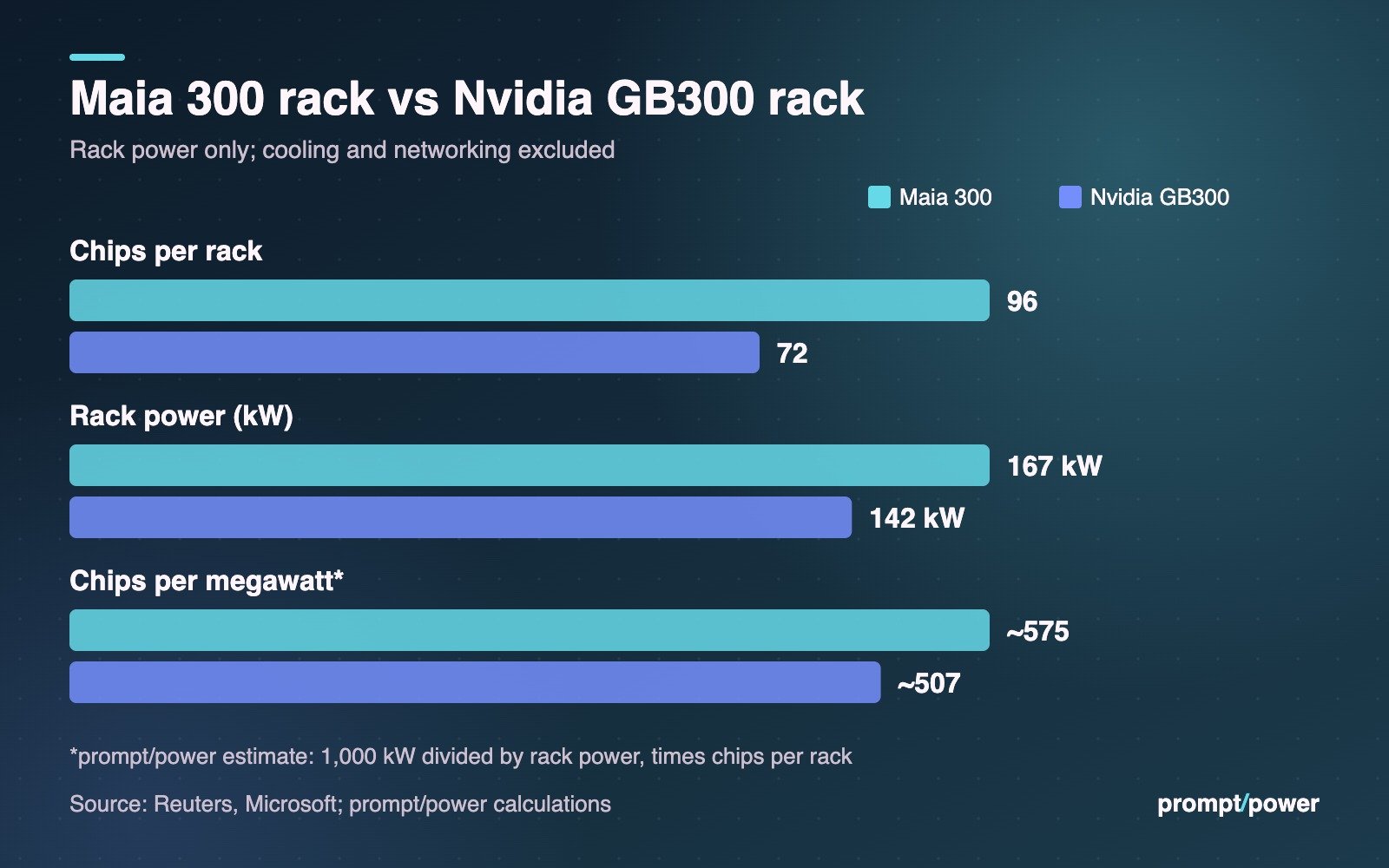
Run it per megawatt, counting rack power only and ignoring cooling and networking. One megawatt fits about six Maia 300 racks, or roughly 575 chips. The same megawatt fits about seven GB300 racks, or roughly 507 GPUs. If GB300 is Microsoft’s baseline, 40% more tokens per megawatt means each Maia 300 would need to produce about 1.24 times the tokens of one GB300 GPU. That is our back-of-envelope estimate, not a figure Microsoft has published, and it rests on a claim nobody outside Microsoft has tested: Interesting Engineering notes Microsoft has published no independent benchmarks.
Then there is the calendar. Maia 300 ships in 2027. At the same OCP Global Summit in San Jose, Nvidia’s event page was promoting Vera Rubin NVL72, which “unifies 72 NVIDIA Rubin GPUs, 36 NVIDIA Vera CPUs.” If the 40% was measured against today’s GB300 rather than the Rubin systems Microsoft will actually be choosing between in 2027, the gap could narrow considerably. Microsoft did not say which it used.
The scale numbers at least hang together. A million chips is about 10,400 racks, or roughly 1.74 GW at the rack, which squares with “multi-gigawatt.” In August, The Information reported Microsoft was talking to TSMC about more than 300,000 Maia 300 chips for 2027, according to The Next Web. That would be closer to half a gigawatt, so either the order grew or the million is a ceiling.
What’s left on Nvidia hardware at Microsoft
Plenty, for now. Maia is an inference chip, and nothing Microsoft announced moves frontier training off GPUs. Azure customers who rent Nvidia instances keep renting them. Microsoft expects capital spending of more than US$175 billion this calendar year, Reuters reported, and only part of that is silicon it designs.
Scott Guthrie, who runs Microsoft’s cloud and AI group, made the same point in an Oct. 12 interview with Tae Kim: “we’re big partners of NVIDIA and AMD, and we’ll continue to be big partners of them.” He was less firm on timing. “So I don’t know the exact time frame for when we’ll get to multi gigawatt,” he said.
“Maia 300 is really when we’re expanding the program in a big, big way.” Scott Guthrie, Microsoft
Our read: what moves is the steady, repeatable work, the Copilot answers and agent loops Microsoft serves to its own users. That is exactly the volume that made hyperscalers Nvidia’s best customers. Google and Amazon already run their own chips, and OpenAI has built one with Broadcom. Demand for Nvidia hardware is not shrinking, but its biggest buyers are building somewhere else to put the next workload. For background on why custom accelerators exist at all, our Project Suncatcher explainer walks through Google’s TPUs.
AMD Helion puts AI agents on CPUs
AMD used the same day for a different argument. Its Helion release describes an open rack blueprint in two versions. A CPU-only rack supports up to 32,768 cores of 6th Gen AMD EPYC processors, the “Venice” generation, per DCD, and is pitched at hyperscalers as dedicated capacity for running agents, connected to separate model-inference hardware. An all-in-one rack mixes EPYC nodes with AMD Instinct MI350P GPU nodes for enterprises. Both come liquid- or air-cooled, include a token router that sends agents’ model calls across frontier and open models, and are planned for November 2026 with partners including Cisco, Dell, Hon Hai (Foxconn), HPE, Lenovo, QCT, Supermicro and Wiwynn. AMD says it will contribute the specification to the Open Compute Project.
“Agentic AI is not a single workload,” said Dan McNamara, AMD’s senior vice-president and general manager for compute and enterprise AI. The bet is that agents spend much of their time running code and calling tools, jobs a CPU handles, while the GPU or Maia-style accelerator answers the model calls.
What it means for you
If you use Copilot, nothing visible changes; Microsoft has not tied Maia to any price. If you buy cloud capacity, expect Microsoft to steer first-party AI services toward Maia while selling you Nvidia and AMD instances alongside. More hardware coverage is in our hardware section.
Nvidia’s own keynote at the summit, delivered by Ian Buck at 5:45 p.m. on Oct. 12, carried the title “Advancing Open Infrastructure for Agentic AI.” By then, AMD had a rack for agents and Microsoft had a chip for them.

James Whitfield covers hardware for prompt/power: chips, semiconductors, laptops, components and the benchmarks behind the launch-day claims. He thinks the most important number on any spec sheet is usually the one in the footnote.
Keep reading

Latest from prompt/power
- Meta Q3 Earnings Oct. 21: The Capex, Ads and Cash Numbers to WatchOct 21
- Anthropic’s 5% Pledge Is Worth About US$48B. Here’s the Fine PrintOct 21
- Commons AI Study Meets Parliament’s Interpreter Math: 44 Passes in 5 YearsOct 21
- CNN All Access Canada Price Is CA$7.99. Americans Pay About 23% MoreOct 20
- DeepSeek Federal Ban: DHS Order Also Covers Apps Built on Its ModelsOct 20
[…] That rebuts the argument Microsoft made in June, when it pointed to Gemini’s 900 million monthly users as proof of competition. Consumer scale does not put a rival agent inside a council’s Outlook and SharePoint. AI is not yet a way out, either: customers told the CMA that AI coding tools are not “sufficiently powerful to overcome the wide range of competition barriers” to switching (1.22(c)). Microsoft has reason to defend the stack, having committed to custom Maia chips to run Copilot. […]