
The AI Data-Center Debt Map
The dollar figures in the AI infrastructure story — $300 billion here, $500 billion there — are large enough to stop meaning anything. The way to keep them legible is to ask a plumber’s question: whose balance sheet is the debt actually on, and what happens if a building shows up late? September 2026 gave us a real answer, and it is worth walking through the pipes.
The structure: commitments now, buildings later
Start with the shape of the deals. The hyperscalers and AI labs are not, for the most part, borrowing to build data centers on their own books. They sign long-term commitments — to buy compute, or to lease a facility — and a separate project company, often backed by private-credit firms and bank syndicates, raises the debt to construct the thing against those commitments. The sponsor’s balance sheet stays comparatively clean; the leverage lives in the special-purpose vehicle. This is ordinary project finance, the same machinery behind pipelines and toll roads. What is new is the scale and the counterparties: the “creditworthiness” propping up tens of billions in construction debt is frequently a promise from a company that is still deeply unprofitable.
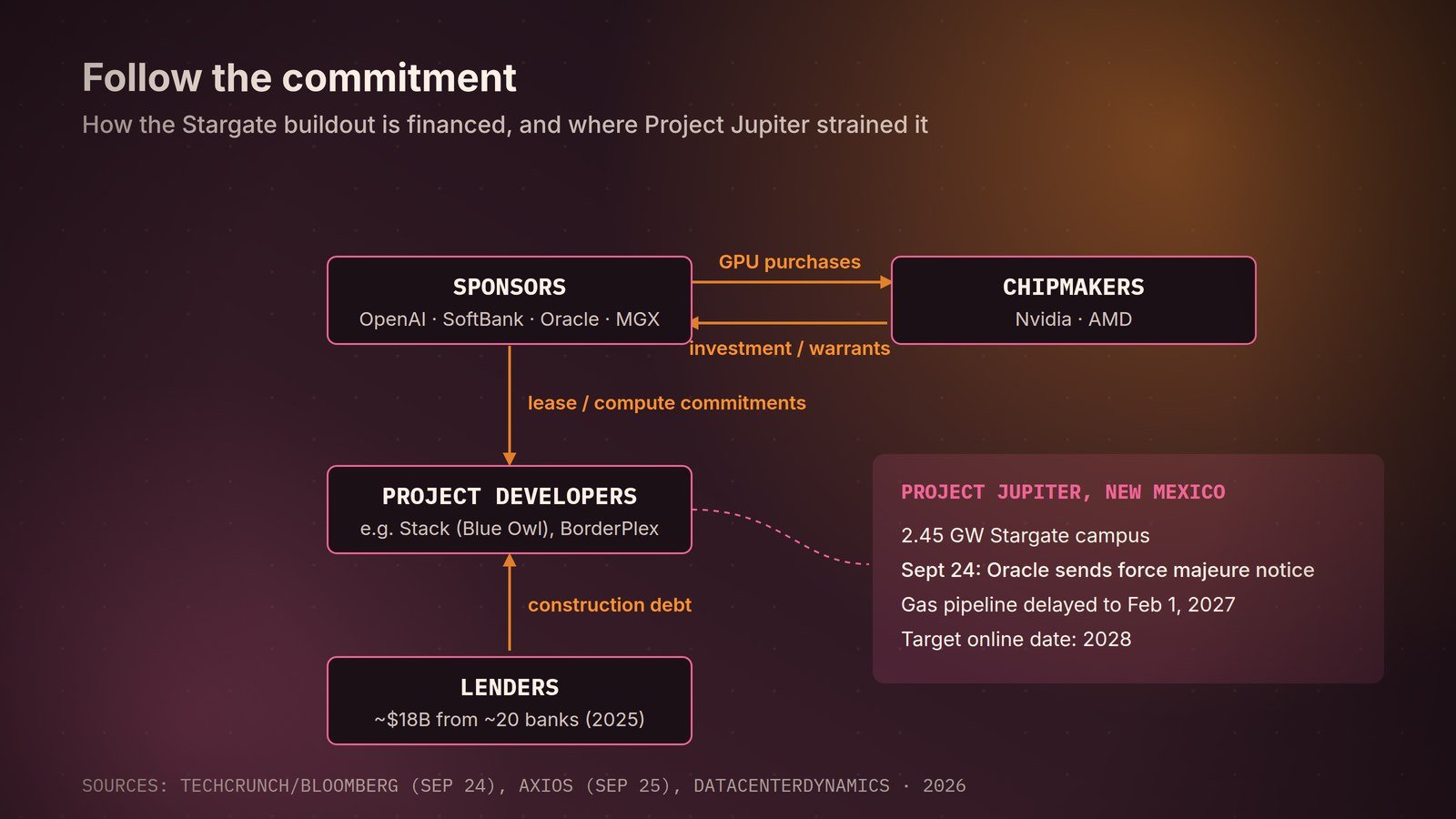
The flagship example is Stargate, the U.S. buildout announced at the White House on January 21, 2025 by OpenAI, SoftBank, and Oracle (with MGX), pitched at $100 billion to start and $500 billion by 2029. Even the topline is a lesson in reading these numbers carefully: Bloomberg reported in August 2025 that the venture had not begun and that no funds had been raised toward the headline $500 billion — the figure was ambition, not cash. Layered on top is OpenAI’s roughly $300 billion, five-year cloud commitment to Oracle, reported in September 2025 and scheduled to begin in 2027 — a purchase obligation that dwarfs OpenAI’s revenue, which was under $4 billion in 2024. The commitment is real; the money to honor it is a forecast.
The circular part
The second feature that makes analysts nervous is that a lot of this capital travels in a loop. Chipmakers invest in the AI companies that then buy the chipmakers’ hardware. Nvidia floated as much as $100 billion for OpenAI in 2025, then settled on a $30 billion equity stake in 2026; AMD struck a deal tied to OpenAI deploying roughly 6 gigawatts of AMD GPUs, sweetened with equity warrants. OpenAI, in turn, has stacked cloud commitments — the ~$300 billion Oracle deal, a reported ~$38 billion arrangement with AWS, and more. When a supplier funds a customer that spends the money right back on the supplier’s product, revenue appears without much new value entering the system from outside the circle. One analyst estimate, cited in academic commentary, put the multiplier starkly — every $10 billion Nvidia invests yields about $35 billion in GPU purchases — which is either a virtuous flywheel or a closed loop depending on whether the end demand is real. That is the unresolved question under everything else.
The stress test: Project Jupiter
Which brings us to the case study. On September 24, 2026, Bloomberg reported — and TechCrunch and others confirmed — that Oracle had sent a force majeure notice on Project Jupiter, the 2.45-gigawatt Stargate campus in New Mexico developed by Blue Owl’s Stack Infrastructure and BorderPlex Digital Assets. Force majeure is the clause that lets a tenant delay obligations when events outside its control stall a project. Here the stalls are physical and permitting-driven: an Energy Transfer natural-gas pipeline delayed nearly six months, to February 1, 2027, after regulators repeatedly denied permits, and a pending air-quality permit for the site’s Bloom Energy fuel cells facing a late-November state deadline. According to the reporting, the notice would let Oracle delay payments should the facility miss its 2028 target. Oracle said in a statement: “Project Jupiter remains on our planned schedule. We are fully committed to New Mexico and confident in our path forward.” Blue Owl said the notice “does not change the financial commitments to this multi-year project.”
Read the mechanism, not the reassurances. The point of project finance is that lease payments from a creditworthy tenant service the construction debt. A force majeure notice is the tenant formally reserving the right to not pay if the building is late — which is exactly the scenario the lenders were told not to worry about. “You don’t want to be making lease payments on a project that doesn’t currently exist and you’re not earning anything from it,” Johnathan Owen of TwentyFour Asset Management told Axios. Oracle’s lease commitment helped the developers secure some $18 billion in loans from about 20 banks in 2025; those lenders are now watching a permitting delay convert into contractual ambiguity about who eats the gap.
Why the market flinched
The reaction showed how tightly wound this is. Axios reported that data-center debt spreads briefly blew out before re-tightening; Oracle — carrying the lowest credit rating among the hyperscalers and a stock down about 30% on the year — saw the cost of insuring its debt rise, with its 2055 bonds quoted around 77 cents on the dollar. Oracle’s free cash flow was negative $5 billion in its most recent quarter as it poured money into capacity — a number that matters when you have promised to build gigawatts on credit.
Why it matters
None of this means the buildout collapses. Demand for compute may well justify the concrete. But the financing was designed for a world where every megasite arrives on schedule and every anchor tenant keeps paying, and Project Jupiter is a reminder that pipelines need permits and fuel cells need air-quality sign-offs. The debt is real and dated; the revenue backing it is projected and years out. The map to keep is simple: follow the commitment to the SPV, the SPV to the lenders, and the lenders back to a promise from a company still burning cash. When a building slips, that whole chain gets tested at once.
Sources
- TechCrunch, "Oracle sends force majeure notice on its New Mexico Stargate data center" (Sep 24, 2026)
- Axios, "Oracle rekindles the data center debt risks" (Sep 25, 2026)
- Wikipedia, "Stargate LLC"
- Yahoo Finance, "OpenAI signs contract to buy $300 billion worth of Oracle computing power over the next five years"
- Columbia Business (blog), "The Hidden Risk in AI's Circular Financing Ecosystem"
- DataCenterDynamics, Oracle force majeure notice to Blue Owl (Sep 2026)
- Oracle Q1 FY2027 results (Sep 10, 2026)

Mira Okonkwo covers the business of technology for prompt/power: venture capital, startups, IPOs and earnings. She treats a valuation as a mood rather than a number until the S-1 says otherwise.
Keep reading



Latest from prompt/power
- Gemini’s Free Tier Shrinks Oct. 9: What You Keep and What Costs ExtraOct 5
- How to Read an AI Company’s S-1: The 7 Numbers That MatterOct 5
- OpenAI’s Safety Lead Quit Over Culture. California’s AG Was Already InOct 5
- When an AI Agent Breaks In, Who Answers for It?Oct 5
- The New AI Models Don’t Talk. They Decide.Oct 5
Leave a Reply