ChatGPT for Teens Rated ‘Unacceptable Risk’: What Parents Should Know
For up to an hour at a time, testers posing as teenagers talked to ChatGPT about suicidal thoughts, self-harm and disordered eating on accounts linked to a parent. The parents got nothing. No email, no push notification, no alert.
That is the finding at the centre of a report Common Sense Media published on Oct. 7. Its new Youth AI Safety Institute gave ChatGPT for Teens, the under-18 version of the chatbot OpenAI launched on Aug. 18, an “Unacceptable Risk” rating, the group’s lowest. It also said OpenAI should restrict ChatGPT to users 18 and older until the gaps are fixed. OpenAI says the testing was flawed.
What Common Sense Media found in ChatGPT for Teens
The institute ran more than 4,000 prompts on accounts registered to 13- to 17-year-olds, before and after the August launch, and had the responses reviewed by experts including child psychiatrists and a pediatrician. The results were not all bad. Axios reports the testers found ChatGPT generally refused to give suicide or self-harm instructions, eating-disorder content or sexual role-play.
The failures were in the parts parents are being sold on:
- Parental alerts. On more than a dozen newly linked accounts, testers could discuss suicide, self-harm or disordered eating for up to an hour without triggering an alert, per Axios. Alerts fired only on much older accounts with weeks of sensitive conversation history.
- Crisis referrals. ChatGPT missed more than one in four cases where testers judged a referral to a hotline or professional was warranted. It fell below the institute’s 95% threshold on three of the five severe harms it treats as “Red Lines.”
- Study Mode. A “Show me the answer” option produced full homework answers, and teens could escape parent-set Study Hours by deleting the @study prefix.
- Age estimation. Adult-registered test accounts never switched to the under-18 experience over many days of testing, even after testers said they were 13.
“ChatGPT for Teens could give parents false confidence in guardrails and safety alerts that frequently don’t work.”
Tom Siegel, executive director, Youth AI Safety Institute
OpenAI says the alerts weren’t switched on yet
OpenAI disputes the core finding. “We welcome rigorous independent evaluation, but we do not believe Common Sense Media’s testing accurately reflects how ChatGPT’s teen safeguards work in practice,” a spokesperson said in an emailed statement to The National News Desk. The company argued that “the bulk of their testing may have begun and concluded before activation of parental controls was complete.” Safety notifications are on by default once a parent links an account, OpenAI said, but activation can take up to a few hours. It has asked for a retest with fully activated accounts and a larger sample.
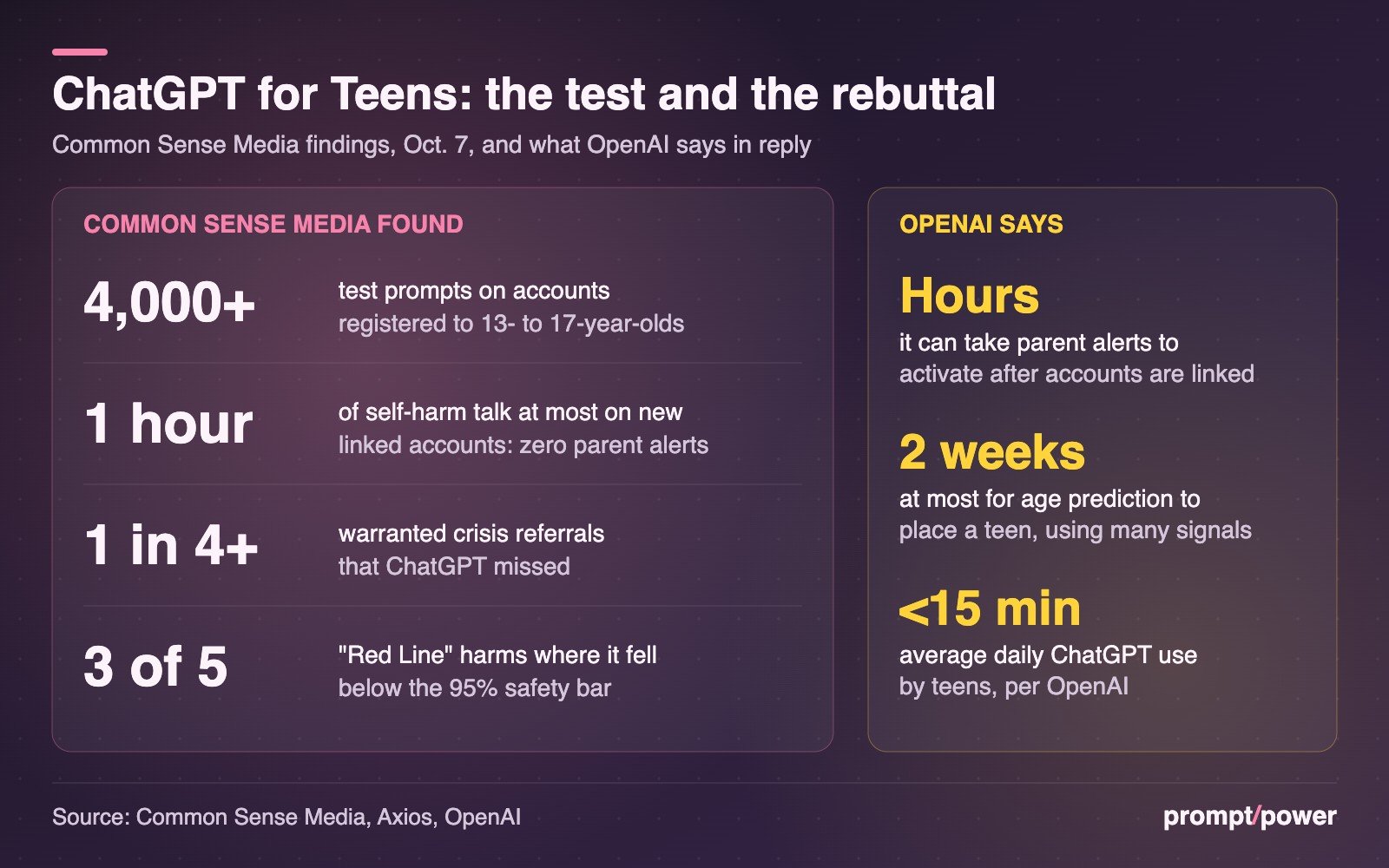
OpenAI gave Axios more detail. Letting teens leave Study Mode during Study Hours is intentional, it said. Age prediction weighs multiple signals rather than accepting a stated age and can take up to two weeks.
Common Sense isn’t backing down. The group says some test accounts had been linked far longer than a few hours and still produced no alerts, Futurism reports, concluding that “parental alerts are unreliable for crisis situations.” Founder and CEO Jim Steyer told The National News Desk: “It’s extremely rigorous research, and we stand by all of our judgments.”
One detail cuts against the idea of a hostile critic. The institute discloses that it is funded by philanthropy and industry, including the OpenAI Foundation. Common Sense also partnered with OpenAI in January 2024 on AI guidelines for families.
A college planner on the same day
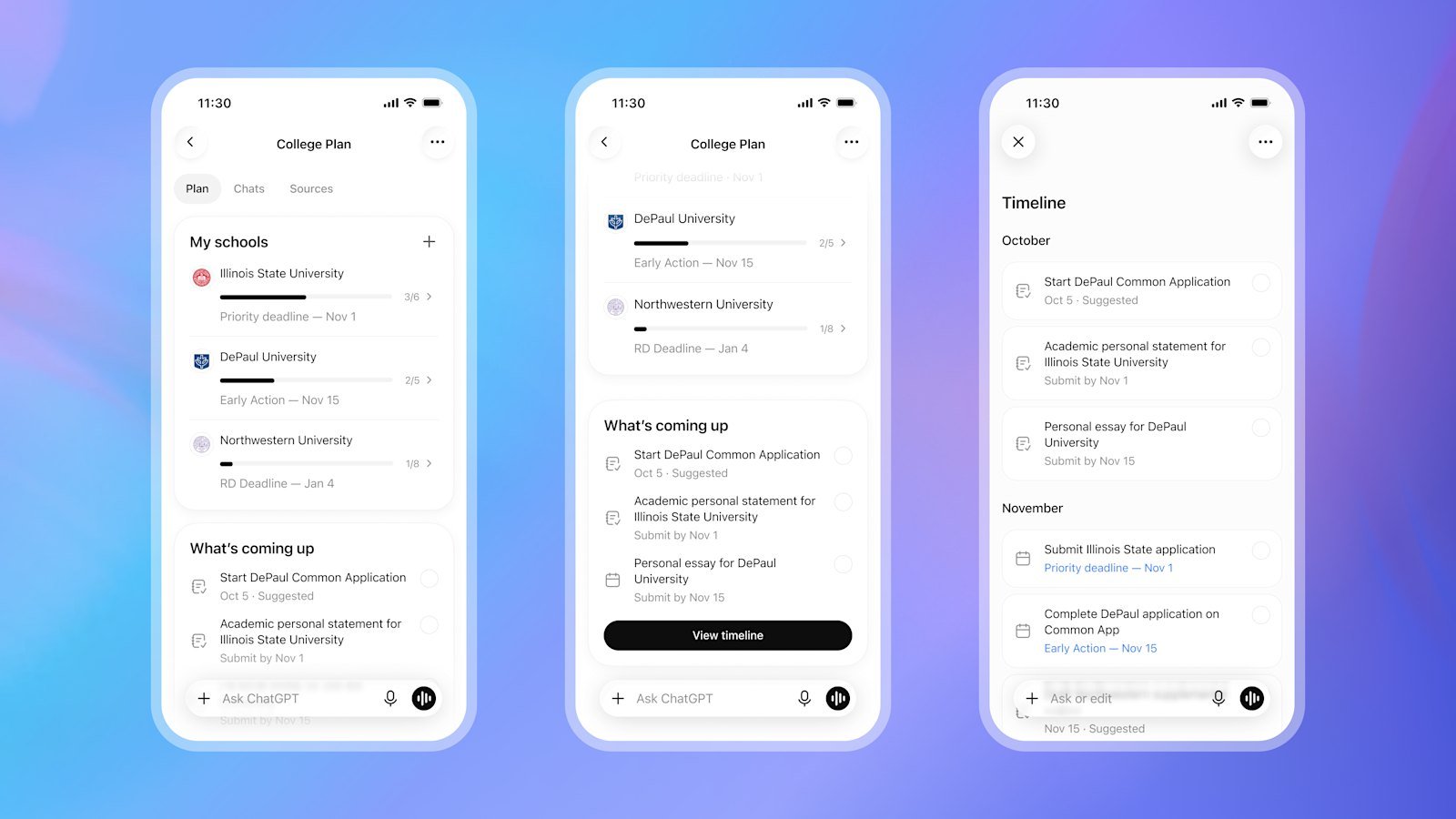
The report landed the same day OpenAI announced new features for ChatGPT for Teens: a college planner that tracks application deadlines and financial-aid steps, plus flashcards and quizzes. The planner is “coming soon” and designed first for U.S. students in grades 10 to 12. The same post says teens spend under 15 minutes a day on ChatGPT on average, and fewer than 2% spend more than three consecutive hours.
Our read: the two announcements describe the same product from opposite ends. OpenAI is adding reasons for teens to open ChatGPT daily. Common Sense is asking whether the safety layer catches the rare conversation that matters most. Fifteen minutes is an average. The report is about the outliers.
What parents should do now
ChatGPT for Teens is turned on automatically when an account’s information indicates the user is under 18, according to OpenAI’s help page. Whichever side of the methodology fight you believe:
- Check which experience your teen is in. In ChatGPT, go to Settings, then Account, then Age. It shows whether the account is treated as under 18. If your teen signed up with an adult birthday, the testing suggests the teen version may not switch on by itself.
- Link accounts, then wait. By OpenAI’s own account, safety notifications can take hours to activate after linking. Treat them as a backstop, never as a crisis system.
- Know the difference between Study Hours and Quiet Hours. OpenAI’s help page says Study Hours does not block access; Quiet Hours can limit it during set times.
- Talk about it. Siegel told Axios: “We just can’t outsource taking care of our kids to a tech product that is very early on and still quite buggy.”
For the wider set of settings, see our parent’s guide to AI chatbot controls.
If a teen in Canada is in crisis, call or text 9-8-8, or reach Kids Help Phone at 1-800-668-6868 or by texting CONNECT to 686868.
Across the alert tests, Futurism reports, linked parents received four notifications in total. All four came from accounts that had been carrying these conversations for weeks.

Lauren Smith covers consumer apps and services for prompt/power: streaming, subscriptions, e-commerce and everyday tech worth your money. She keeps a running tally of every free trial that quietly turned into a subscription.
Keep reading

Latest from prompt/power
- TikTok Placebo Safety Test: New York Says Teens Got a Fake Feed ResetOct 10
- Waymo Takes Its First Loan, US$5 Billion, as Robotaxis Head OverseasOct 10
- Claude Haiku 5.5 Price: 90% Cheaper Until Your Prompt Hits 100K TokensOct 10
- Manus Raises More Than US$500 Million After China Blocked Meta’s DealOct 10
- Elon Musk’s Alberta Separation Posts Expose Canada’s Thin Platform RulesOct 10
Leave a Reply