
App Store Age Checks: Apple and Google Want Self-Declared. Meta Wants Proof
The bill language that Apple and Google lobbyists have been handing to state legislators contains one sentence that matters more than the rest, according to Politico: nothing in it “shall be interpreted to serve as the basis for a private right of action.” Translation: parents couldn’t sue.
That is the core of Politico’s Oct. 4 report by Owen Dahlkamp, which describes a large lobbying push by the two app store owners for kids’ online safety laws that rely on self-reported ages and leave enforcement to state attorneys general. The language surfaced in Arizona, Georgia and Kansas, according to a summary of the report. Politico drew on draft legislation, internal emails and seven people familiar with the effort, Quartz noted.
On the other side sits Meta, which has spent years arguing that Apple and Google, not individual apps like Instagram, should verify ages.
App Store Accountability Acts: where the state laws stand
The model Meta backs is the App Store Accountability Act, which makes app stores confirm a user’s age and get a parent’s consent before a minor downloads apps or makes purchases. Four states have enacted a version: Utah, Texas, Louisiana and Alabama, the last in February, per a Future of Privacy Forum comparison.
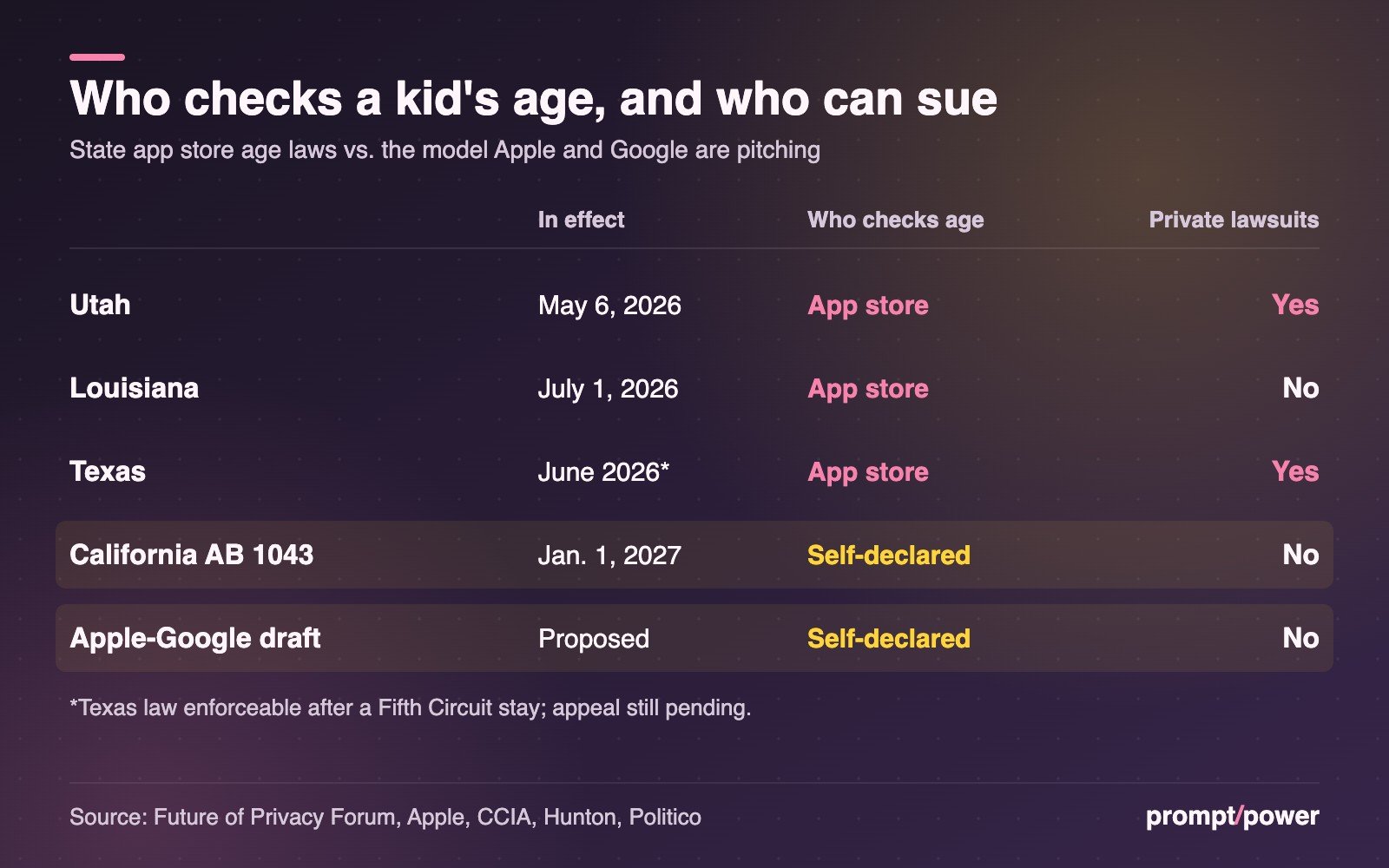
- Utah: Apple’s requirements took effect May 6, 2026, according to its developer notice. The law is enforced through private lawsuits, FPF says.
- Louisiana: in force July 1, 2026, with no private right of action.
- Texas (SB 2420): Judge Robert Pitman blocked it on Dec. 23, 2025, finding it “likely unconstitutional,” per the industry group CCIA, which sued. The Fifth Circuit stayed that injunction in late May, and the Supreme Court declined to intervene in July. The law is enforceable while the appeal continues.
Then there is California. Its Digital Age Assurance Act (AB 1043), signed Oct. 13, 2025 and operative Jan. 1, 2027, has the operating system ask for a birth date or age at account setup and pass an age bracket to developers. The attorney general enforces it, with penalties up to US$2,500 per affected child for negligent violations and US$7,500 for intentional ones (about CA$3,475 and CA$10,425). There is no private right of action. Bloomberg Government called it “Google-backed.”
Our read: California is the template Apple and Google are now selling to other states.
Why Meta wants app stores to check ages
The fight is about liability. If the store vouches for a user’s age, the app downstream has less to answer for when a 13-year-old ends up somewhere they shouldn’t.
Meta frames it as privacy. “By verifying a person’s age just once at this device level, the phone itself acts as a single, secure checkpoint,” Antigone Davis, Meta’s head of global safety, wrote in June, as quoted by Social Media Today.
Apple frames the same mechanism as the privacy threat. In its developer guidance on the Texas law, it wrote:
“We worry they could undermine the privacy of all users by requiring the collection of sensitive personal information just to download an app – even those that simply provide weather forecasts or sports scores.” Apple Developer
Each argument lines up neatly with the legal exposure of the company making it.
Declared Age Range and Play Age Signals: what developers get
Both stores have already built the plumbing. Apple’s Declared Age Range API gives an app the user’s age category, a signal about how that age was established, and whether age rules apply to that user. Parents decide whether to share a child’s range always, per request or never, Apple said in June 2025.
Google’s Play Age Signals API returns age ranges and verification or supervision status. It has returned signals in Brazil since March 17, 2026, and in Texas for eligible accounts created after May 28, 2026. Google’s terms bar developers from using those signals for advertising, marketing, profiling or analytics.
What parents see now, in Texas and in Canada
In Texas, new Apple accounts are subject to the law since June 4. Apple’s guidance says age is confirmed with a credit card or government ID, minors are sorted into under 13, 13 to 15, and 16 to 17, and a parent must approve downloads, purchases and significant app changes. Parents can also revoke consent, which stops the app from launching.
Canada has no app-store law. The federal Safe Social Media Act (Bill C-34), introduced June 10 by Marc Miller, would set a minimum age of 16 for social media accounts and create a Digital Safety Commission. As Robert Diab notes in his analysis, it puts the age-verification or age-estimation duty on platforms, the approach Meta has argued against. The bill is still at second reading; its most recent debate was Sept. 24.
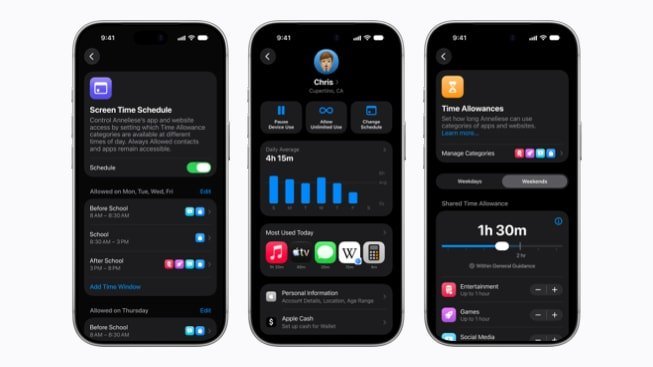
What to do in the meantime: the controls that exist are the ones you switch on. Apple’s child accounts with Ask to Buy, and Google’s supervised accounts, already let a parent approve app downloads. Our parents’ guide to AI chatbot controls walks through the settings app by app.
None of it checks whether the birthday a 12-year-old typed into a new phone is true. Under the California model, that typed birthday is the check.

Lauren Smith covers consumer apps and services for prompt/power: streaming, subscriptions, e-commerce and everyday tech worth your money. She keeps a running tally of every free trial that quietly turned into a subscription.
Keep reading




Latest from prompt/power
- National Medal of Science Goes to Musk, Brin, Huang and Su. Nvidia Pledged US$1BOct 10
- TikTok Placebo Safety Test: New York Says Teens Got a Fake Feed ResetOct 10
- Waymo Takes Its First Loan, US$5 Billion, as Robotaxis Head OverseasOct 10
- Claude Haiku 5.5 Price: 90% Cheaper Until Your Prompt Hits 100K TokensOct 10
- Manus Raises More Than US$500 Million After China Blocked Meta’s DealOct 10
Leave a Reply