
Waymo Takes Its First Loan, US$5 Billion, as Robotaxis Head Overseas
Ever since it took its first outside money in 2020, Waymo has paid for its growth the same way: by selling pieces of itself. On Oct. 8, it tried something new. “Today, Waymo closed a $5 billion term loan, marking our first debt financing,” chief financial officer Steve Fieler wrote in a post on Waymo’s blog.
That is US$5 billion (about CA$7 billion) borrowed, not raised, and it arrives eight months after Waymo pulled in a US$16 billion (CA$22.2 billion) equity round. The company says the loan will speed up the expansion of its driverless ride-hailing service “across the United States and internationally,” and give it “additional financial flexibility to strengthen our balance sheet.”
Who lent Waymo the money
The lender list reads like a who’s who of private credit. According to Waymo’s announcement, PIMCO, Blackstone and Sixth Street led the syndicate. Capital Group, Loomis Sayles and T. Rowe Price came in as significant lenders, joined by Apollo, Blue Owl, Diameter Capital Partners, Franklin Templeton, Fidelity Management & Research Company, HPS Investment Partners and Oaktree. Goldman Sachs was sole lead bookrunner.
The deal also grew as it went. In July, Octus reported that Waymo was sounding out private lenders for US$2 billion to US$3 billion, with Goldman mandated and pricing still under discussion; market participants expected lenders to demand a premium because Waymo’s EBITDA is negative. By Oct. 6, Bloomberg reported the deal had been boosted to US$5 billion. Waymo has not published the interest rate or the maturity.
Why a robotaxi company borrows now
Our read: this is what a company does when it starts to look less like a research lab and more like a fleet operator. Waymo described the loan as a step in its evolution into a “scaling commercial enterprise,” TechCrunch’s Kirsten Korosec reported.
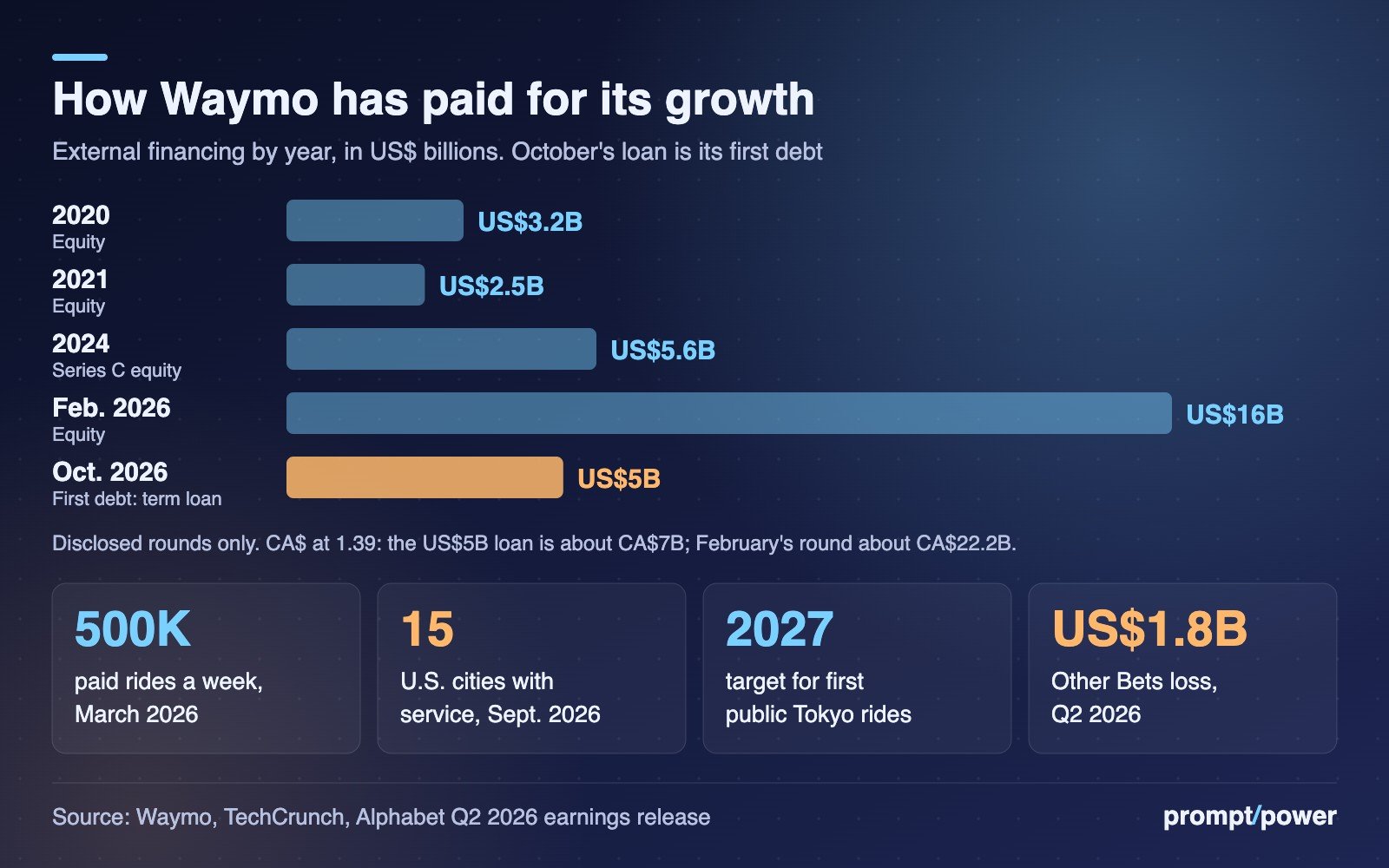
Equity is expensive in a specific way. Every new share sold at February’s US$126 billion valuation dilutes Alphabet, which remains the majority investor. A loan doesn’t. It costs interest instead, and lenders only sign up when they believe there will be cash to pay it back.
The ridership curve is the argument Waymo can now make to those lenders. Waymo said in a post on X in late March that it was serving 500,000 paid rides a week across 10 U.S. cities, TechCrunch reported, up from about 50,000 in May 2024. In February, Bloomberg reported that co-CEO Tekedra Mawakana had outlined a path to more than 1 million paid weekly rides in the U.S. by the end of 2026. The fleet behind that was more than 3,000 vehicles as of December 2025, per Sherwood News.
Cars are the expensive part. Each robotaxi is a physical asset that has to be bought, fitted with sensors, insured, cleaned, charged and parked, in every new city, before it earns a fare. That is the kind of spending debt is built for, and it is a lot of spending: Alphabet’s Other Bets segment, whose revenue comes “primarily from the sale of autonomous transportation services and internet services,” lost US$1.8 billion (CA$2.5 billion) in the second quarter of 2026, Alphabet’s earnings release shows, up from US$1.25 billion a year earlier. Alphabet does not break out Waymo’s own numbers.
London, Tokyo and the cities still waiting
Waymo’s loan announcement does not name a single city. It says only that last month the company “launched service in our fifteenth U.S. city and announced new international cities.” Its September posts fill in the map, and the dates are later than the ambition suggests.
- London: Waymo said in October 2025 it intended to offer rides “with no human behind the wheel” in 2026, and repeated “this year” in April. Its Sept. 24 vision document says it will apply under the U.K.’s Automated Passenger Services permitting scheme, which needs approval from the Department for Transport and consent from Transport for London. No launch date is given, and the year has under three months left.
- Tokyo: With taxi operator Nihon Kotsu and the GO app, Waymo plans its first public rides in 2027, scaling to about 100 vehicles, subject to national and local approval.
- Singapore: Vehicles arrive in the coming months, with a commercial launch planned for 2028.
London is where the competition is closest. On the same day Waymo closed its loan, Uber and Pony.ai said they would start testing Pony.ai’s Gen-7 robotaxis in London “in the coming weeks,” TechCrunch reported. Uber also backs British startup Wayve, which plans its own London robotaxi service; Uber says it expects autonomous trips in as many as 15 cities worldwide by the end of 2026.
The difference is the balance sheet. Uber spreads its bets across more than 30 autonomous-vehicle partners; in Zagreb, a third company, Verne, owns and runs the Pony.ai fleet. Waymo is carrying its expansion on its own books, now partly on borrowed money, while U.S. regulators keep watching: TechCrunch notes open federal investigations into Waymo vehicles illegally passing stopped school buses and a Santa Monica crash in which a robotaxi hit a child near a school, causing minor injuries.
None of that kept PIMCO, Blackstone and a dozen other lenders out. They will want their money back on a schedule. Fifteen U.S. cities and 500,000 rides a week are Waymo’s case that it can pay on time; London, with its permit still pending, is the first place that promise gets tested abroad.

Elena Vasquez covers space and frontier tech for prompt/power: launches, satellites, robotics, autonomy and defence tech. She counts rocket launches the way some people count sheep, and somehow sleeps less for it.
Keep reading




Latest from prompt/power
- TikTok Placebo Safety Test: New York Says Teens Got a Fake Feed ResetOct 10
- Elon Musk’s Alberta Separation Posts Expose Canada’s Thin Platform RulesOct 10
- Microsoft’s H-1B Green Card Freeze Puts Canada’s Promise to the TestOct 10
- FBI Seizes Flax Typhoon Hacking Tools as Canada and UK Join China WarningOct 10
- Alexa Tablet Canada Price: Amazon Swaps Fire OS for Google PlayOct 10
Leave a Reply