NHS Skin Cancer AI Can Now Discharge Patients Without a Dermatologist
If your GP in the South East of England sends you on an urgent skin-cancer referral this winter, there is a growing chance the first opinion on your mole will come from software. If that software decides the lesion is harmless, you may never see a dermatologist at all.
London-based Skin Analytics announced on Oct. 7 that NHS England’s South East region will roll out its AI tool, DERM, across all 18 NHS South East trusts from this autumn, extending it to “a further 9 million people” over a three-year rollout. The company calls it “the largest deployment of autonomous medical AI in NHS history.” The announcement came from the company, not the NHS, and neither has disclosed what the contract is worth, The Next Web noted.
How DERM decides who goes home
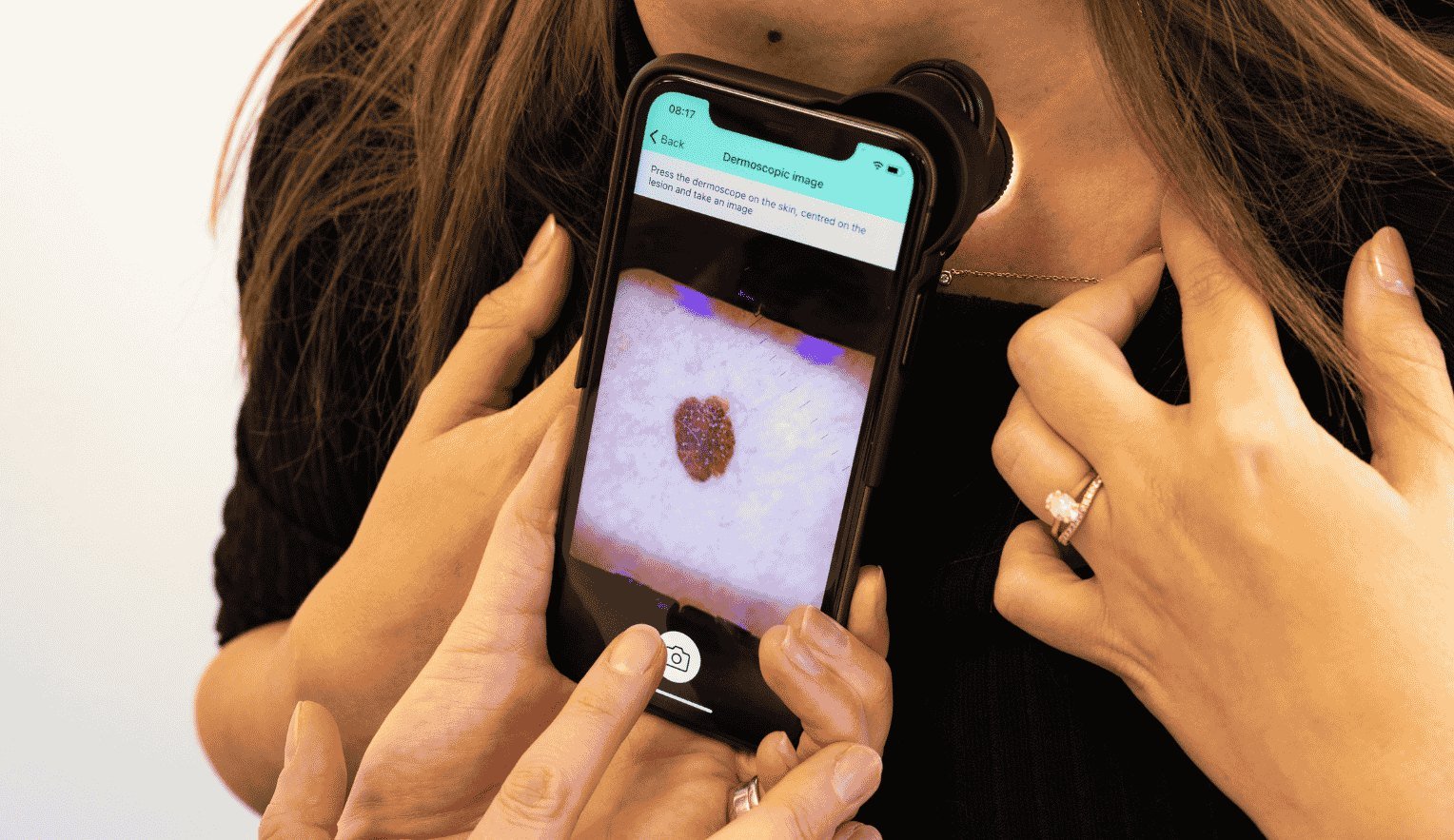
After a GP makes an urgent suspected skin-cancer referral, the patient attends an imaging clinic where magnified (dermoscopic) images of the lesion are taken with a smartphone fitted with a magnifying lens. DERM analyses them. Under the conditions set by the National Institute for Health and Care Excellence (NICE), lesions it rates as benign are discharged from the urgent pathway with written advice, while anything it flags as pre-cancerous or cancerous goes to an NHS dermatologist for virtual review.
There are guard rails. NICE’s conditional recommendation covers adults only, and patients with black or brown skin get an extra review by a healthcare professional during the evidence period, because the tool’s accuracy on Fitzpatrick skin types 5 and 6 is less certain. NICE’s guidance also requires “regular performance monitoring” and can be withdrawn if evidence-gathering conditions are not met. That recommendation, issued on May 1, 2025, runs for three years.
On regulation, Skin Analytics says DERM holds a Class III CE mark and is the only AI certified for autonomous use at that level. We could find no UKCA certificate mentioned on the company’s site. It does not need one yet: the Medicines and Healthcare products Regulatory Agency (MHRA) lets EU-compliant CE-marked devices be placed on the Great Britain market until 30 June 2030.
Skin cancer referrals: why the NHS wants an AI gatekeeper
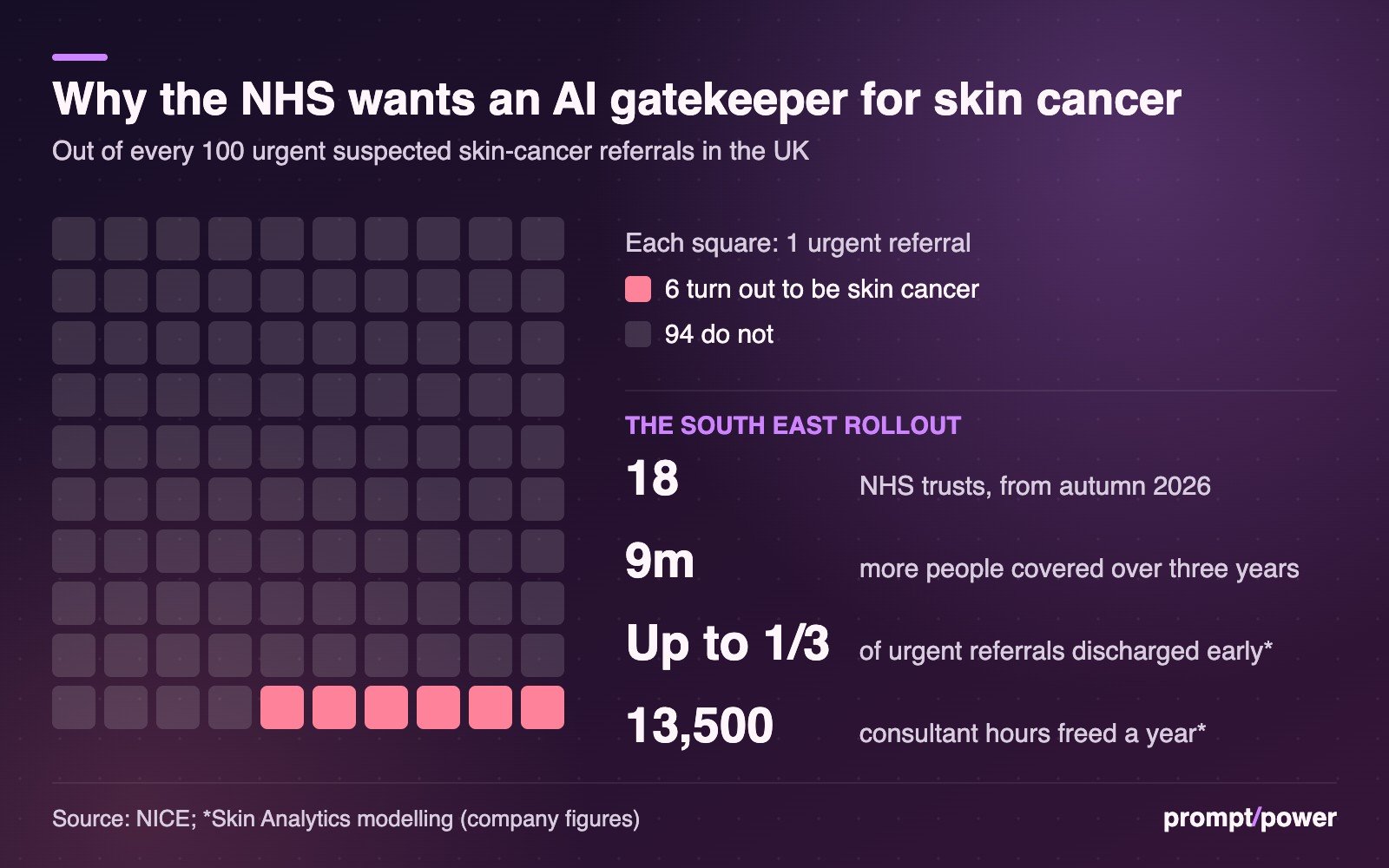
The case for DERM is a numbers problem. According to NICE, UK dermatology services receive about one million referrals a year from primary care, around 60% of them urgent suspected skin cancer. Only 6% of those urgent referrals turn out to be cancer.
Dr Alexandra Kemp, a consultant dermatologist at Buckinghamshire Hospitals NHS Trust, where DERM is already in use, put it bluntly in the company’s release: “there are not enough dermatologists to manage these referrals.”
Skin Analytics’ modelling for the South East says up to a third of urgent referrals could be discharged before a first outpatient appointment, freeing an estimated 13,500 consultant hours a year, or around 27,000 appointments. The Next Web spotted that the same release elsewhere uses a figure of up to 40%, a discrepancy the company has not explained.
The accuracy figures are also the company’s. Skin Analytics says DERM has assessed more than 250,000 patients in 25 trusts, found more than 25,000 cancers, rules out skin cancer 99.5% of the time and finds about 98% of skin cancers. The most independent number available is older. A July 2024 evaluation by Edge Health, written for NHS England, put DERM’s negative predictive value for melanoma at 99.8%, against 98.9% for dermatologists in face-to-face checks.
A 99.5% rule-out rate sounds close to perfect. At the scale of 9 million people, the remaining fraction is not an abstraction; it is a list of names.
Who is accountable when an autonomous AI misses a melanoma
The rollout lands one day after the government accepted all 44 recommendations of the National Commission into the Regulation of AI in Healthcare on Oct. 6. Chaired by Professor Alastair Denniston, the Commission argued that AI devices should be monitored across their working life rather than approved once. The MHRA opened applications for AI Airlock Phase 3, its regulatory sandbox now focused on post-market surveillance, on the same day; the first innovators will be picked in November.
“Innovation must never come at the expense of patient safety.” James Frith MP, Health Innovation Minister, in the government’s Oct. 6 announcement
Liability is the unresolved piece. The Commission’s report warned that “responsibility for errors may be transferred onto healthcare professionals and providers,” The Pharmaceutical Journal reported, because negligence claims fall most easily on whoever owes the clearest duty of care. Its Recommendation 32 asks for contracts between manufacturers and NHS providers to include “an explicit allocation of responsibilities for controlling risk.”
Our read: for most patients DERM discharges, no clinician sees the lesion, so the trust that switched it on is the obvious target if a melanoma is missed. The South East’s contract terms, which are not public, matter as much as the accuracy statistics. Our AI safety case explainer covers how developers are meant to prove a system is safe.
What it means for patients in the South East
- If DERM discharges you, you should get written advice. Keep it, and go back to your GP if the lesion changes in size, shape or colour.
- If you have black or brown skin, NICE’s conditions say a healthcare professional should also review your images.
- You can ask your trust whether AI was used in your assessment. The government’s response added commitments to keep patients informed when AI is used in their care.
Northern Ireland has already approved DERM for autonomous assessment for its 1.9 million residents. NICE’s three-year evidence clock on the tool runs out in May 2028, about halfway through the South East contract.
Priya Natarajan covers science and society for prompt/power: climate and energy tech, data centres, and the physical cost of the digital world. Every query has a water bill, and she would like to see the receipt.
Keep reading

Latest from prompt/power
- AI Safety Hearing: MPs Will Question OpenAI, Anthropic, Google and Meta on 13 OctOct 11
- National Medal of Science Goes to Musk, Brin, Huang and Su. Nvidia Pledged US$1BOct 10
- TikTok Placebo Safety Test: New York Says Teens Got a Fake Feed ResetOct 10
- Waymo Takes Its First Loan, US$5 Billion, as Robotaxis Head OverseasOct 10
- Claude Haiku 5.5 Price: 90% Cheaper Until Your Prompt Hits 100K TokensOct 10
Leave a Reply