National Medal of Science Goes to Musk, Brin, Huang and Su. Nvidia Pledged US$1B
The first National Medal of Science, presented in 1963, went to Theodore von Kármán, the aerospace engineer who helped found the Jet Propulsion Laboratory at Caltech. On Oct. 8, President Donald Trump hung the same medal on Elon Musk.
Musk was one of four tech executives awarded the National Medal of Science at the White House’s “Science: A New Golden Age” summit in Washington, alongside Nvidia CEO Jensen Huang, Google co-founder Sergey Brin and AMD CEO Lisa Su, according to the White House. Microsoft CEO Satya Nadella and Dell Technologies CEO Michael Dell received the National Medal of Technology and Innovation. Trump said the six were “helping pioneer an incredible future for America” and called Musk “our modern-day Thomas Edison,” Al Jazeera reported.
Huang’s company made its own announcement the same day. Nvidia committed US$1 billion (about CA$1.39 billion) over five years to US science, tied to the Energy Department’s Genesis Mission. It was not alone: Anthropic committed US$150 million (about CA$209 million) over three years to the same initiative that day, making Claude available to more than 15 participating agencies, including NASA, the National Institutes of Health and the National Science Foundation.
What the National Medal of Science is, and who usually gets it
Congress created the medal in 1959. The National Science Foundation calls it “the highest recognition the nation can bestow on scientists and engineers,” given for “outstanding contributions to knowledge in the physical, biological, mathematical, engineering, or social and behavioral sciences, in service to the nation.” Peers nominate. A committee appointed by the president recommends. The president decides.
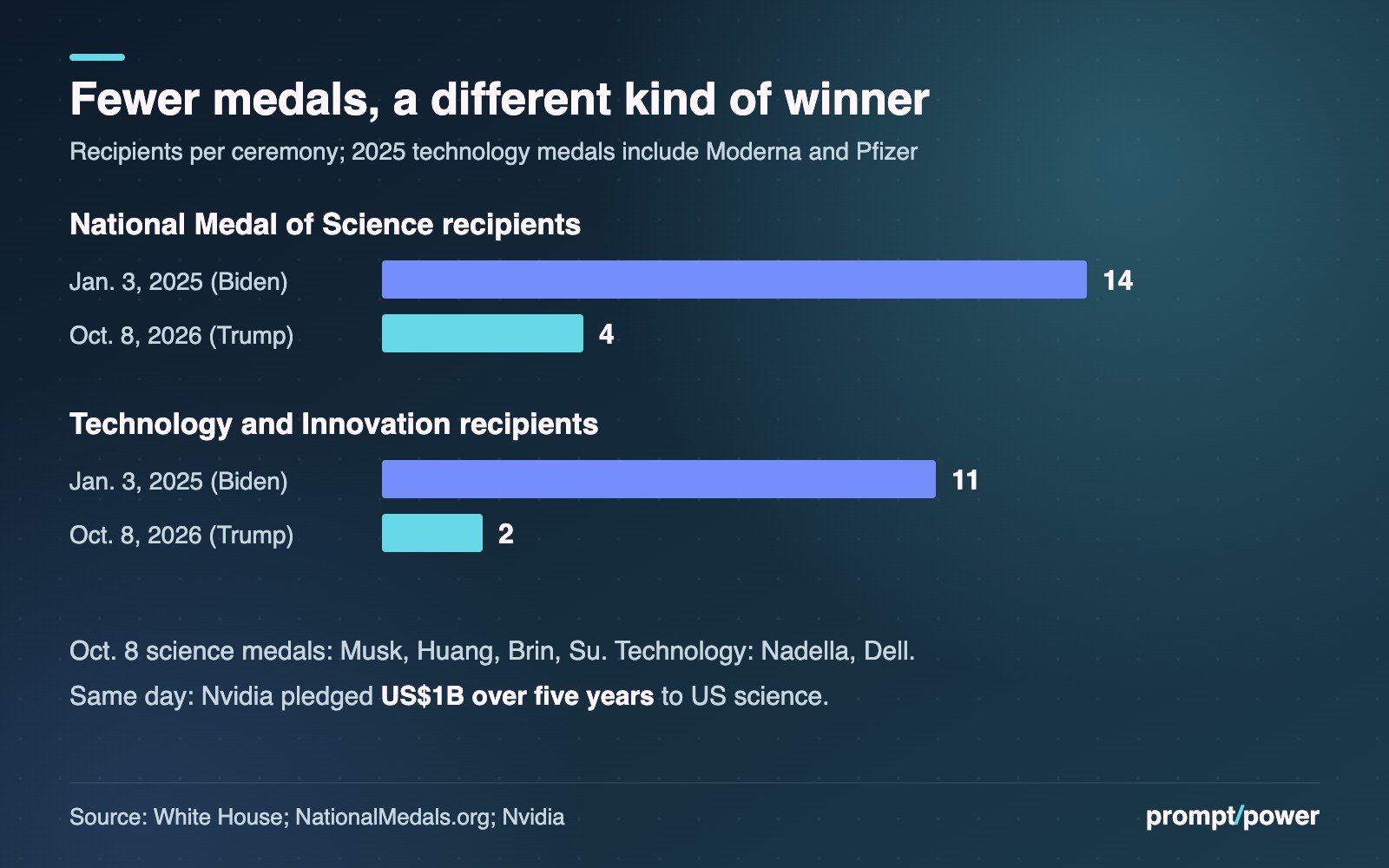
The previous round, presented by Joe Biden on Jan. 3, 2025, honoured 14 people with the science medal, among them Bonnie Bassler, Ingrid Daubechies and Cynthia Dwork. The technology medal that year went to 11 recipients, including Jennifer Doudna, Martin Cooper and two companies, Moderna and Pfizer.
Trump did not confer the science medal in his first term, Wikipedia’s record of the award shows. Fox News reported this is the first time he has presented either medal, according to TeslaNorth.
The citations themselves are technical. Huang’s honours him “for advancing the graphics processing unit into a general-purpose computing architecture,” which is a fair description of why most AI runs on Nvidia hardware. Brin’s cites “foundational algorithms for information retrieval and data processing.” Our read: the precedent being broken concerns the room more than the résumés. Five of the six honourees run companies with live business before this administration, from visas to a deal giving Washington a 15% cut of some Nvidia and AMD chip sales to China.
The donor math, and the H-1B timing
TechCrunch, citing The New Republic, says the honourees have given nearly US$6 billion (about CA$8.3 billion) to efforts tied to Trump. The New Republic’s own wording is “at least $6 billion,” and it does not publish its method.
Most of the money is a single pledge. Michael and Susan Dell committed US$6.25 billion (about CA$8.7 billion) to Trump Accounts, a government-backed investment program for children born during Trump’s second term. That is money for kids’ accounts, not a campaign, and on its own it exceeds the headline total. The New Republic’s smaller items include US$1 million each from Google and Microsoft to the inauguration fund and US$1 million from AMD to MAGA Inc. It also counts Nvidia’s US$1 billion Genesis pledge. Musk spent at least US$230 million of his own money helping elect Trump in 2024, Spectrum News reports.
Then there is the timing. Hours before the ceremony, the administration suspended Microsoft and other large tech companies from the H-1B visa system, alleging fraudulent use, Al Jazeera reported. Spectrum News described the Microsoft action as a suspension from an employment-based green card program. Nadella received his medal the same day. Al Jazeera also noted that five of the six honourees were born outside the US.
What Nvidia’s US$1 billion science pledge actually funds
Nvidia’s release names its targets without splitting the money: research at universities, US quantum computing, cloud providers that serve government missions and “super intelligence for science.” Nvidia is also a collaborator on phase-two Genesis Mission projects in quantum computing, fusion, accelerator design and microelectronics, and it is building the Energy Department’s largest scientific supercomputer at Argonne National Laboratory, plus seven new systems across Argonne and Los Alamos.
“President Trump’s Genesis Mission is launching a new golden age of American discovery,” Huang said in the release.
The pledge was one line in a bigger package. The administration announced more than US$6 billion in science investments at the summit, including US$2.4 billion in compute credits and contributions from Nvidia, AMD, OpenAI and other companies, Spectrum News reported. The White House now prefers “super intelligence” to “AI” in its own language, as we noted when the rename started, and Nvidia’s release follows suit.
Our read: a pledge from the dominant AI chipmaker, spent on compute credits, cloud and supercomputers, is likely to circle back through Nvidia hardware. The release does not say how much of the billion is cash and how much is product. That question matters more as Washington takes a financial interest in the companies it regulates, a pattern Intel shareholders already know.
The NSF still describes the medal as recognition for contributions to knowledge “in service to the nation.” On Oct. 8, White House science office director Michael Kratsios offered a different yardstick: “Each of these medalists has transformed their field or industry.”
Elena Vasquez covers space and frontier tech for prompt/power: launches, satellites, robotics, autonomy and defence tech. She counts rocket launches the way some people count sheep, and somehow sleeps less for it.
Keep reading
Latest from prompt/power
- TikTok Placebo Safety Test: New York Says Teens Got a Fake Feed ResetOct 10
- Waymo Takes Its First Loan, US$5 Billion, as Robotaxis Head OverseasOct 10
- Claude Haiku 5.5 Price: 90% Cheaper Until Your Prompt Hits 100K TokensOct 10
- Bell, Virgin, Public Mobile Plan Changes: The New Canadian Price ListOct 10
- Manus Raises More Than US$500 Million After China Blocked Meta’s DealOct 10
Leave a Reply