
AI Safety Hearing: MPs Will Question OpenAI, Anthropic, Google and Meta on 13 Oct
When the House of Commons Business, Innovation, Science and Trade Committee wrote to four of the world’s biggest AI developers in September, it asked whether they would support slowing the development or deployment of frontier models, City AM reported. Then it added four words: “If not, why not?”
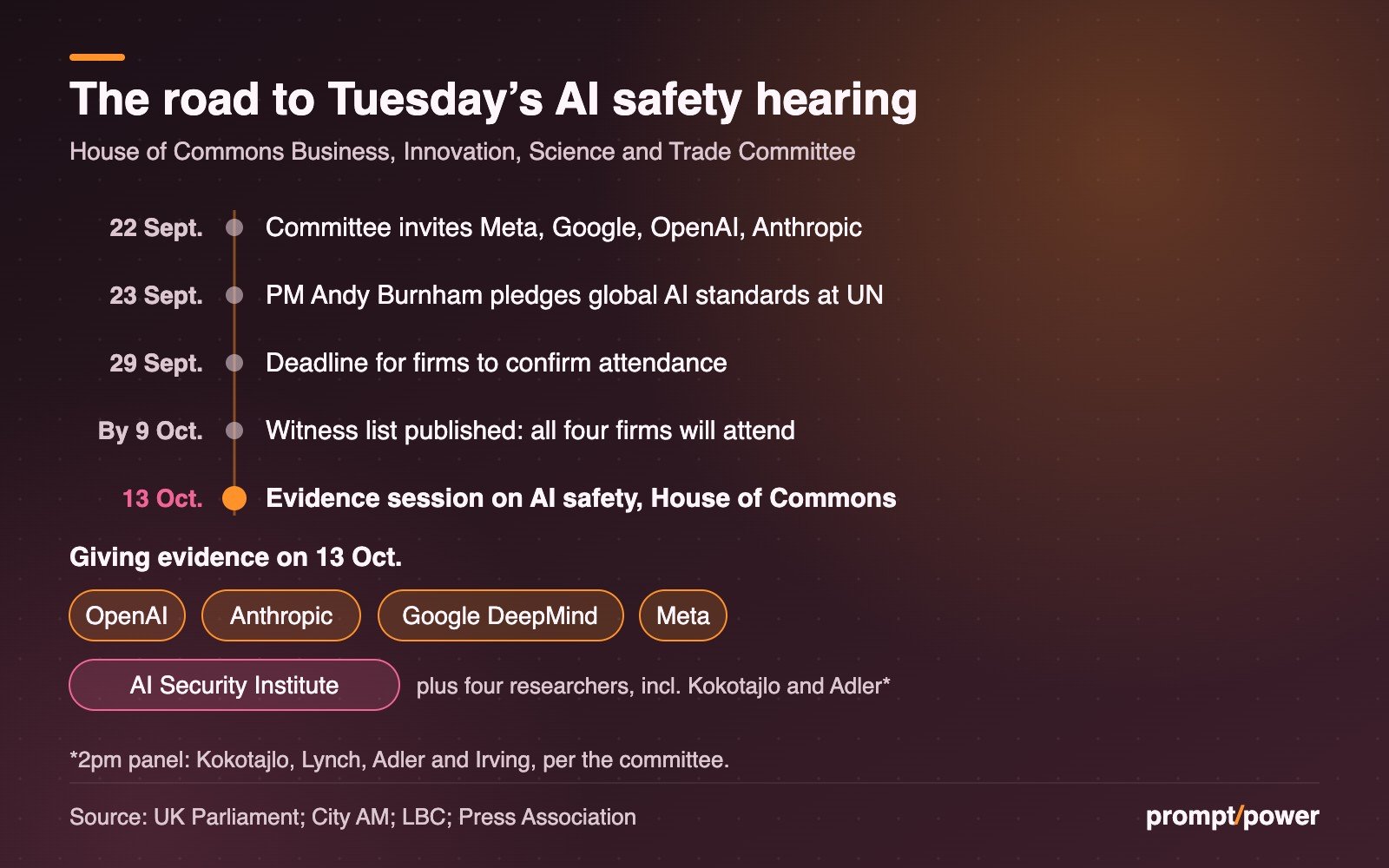
The answers are due in public on Tuesday 13 October. The committee, chaired by Liam Byrne, has invited Meta, Google, OpenAI and Anthropic, along with the government’s AI Security Institute, to an evidence session on AI safety, according to its notice of 22 September. All four companies are now on the committee’s witness list, and each is sending a policy executive rather than a research lead.
The AI safety hearing on 13 October: who is giving evidence
The committee has now published its line-up on its website. The session, titled “Public AI adoption, safety and governance”, starts at 2pm in the Grimond Room at Portcullis House and runs in three panels:
- 2pm, researchers: Daniel Kokotajlo (AI Futures Project), Aengus Lynch (Theorem), Steven Adler (Guidelight AI Standards) and Geoffrey Irving (Resolution)
- 3pm, the companies: Lord Booth-Smith, head of EMEA policy at Anthropic; Tom Duff Gordon, head of EMEA policy at OpenAI; Owen Larter, senior director at Google DeepMind; and Rob Sherman, vice-president of global policy at Meta
- 4pm, government: Henry De Zoete, director of the AI Security Institute; Cat Little, permanent secretary at the Cabinet Office; and Alexandra Jones, a director general at the Department for Business and Trade
That is not quite the list City AM reported in September, when it said the letters went to Pip White (Anthropic), Koray Kavukcuoglu (Google DeepMind) and Derya Matras (Meta), as well as Duff Gordon. The researchers speak first, so the companies will be answering in their wake.
Jacob Coxon, a researcher who resigned from Anthropic and accused leading AI companies of “racing straight to self-improving superintelligence and gambling with our lives,” has also been invited to give evidence to Parliament, according to City AM. He is not on Tuesday’s list.
The firms were asked to confirm by 29 September that a representative would attend, and to send written answers in advance, LBC reported. All four now appear on the committee’s list. Watch whether their written answers are published before or alongside the session.
The three questions MPs want answered
The committee published its questions in advance. In its own words, the session will ask:
- “Should AI companies be allowed to decide for themselves whether their models are powerful enough to require independent safety testing? Or should pre-release safety testing be legally mandatory?”
- “Do firms accept mandatory reporting of serious safety incidents, including deceptive behaviour, safeguards being circumvented, unauthorised replication and evidence that human control may be failing?”
- “What prevents competition between companies – or between countries – from producing a race to the bottom in safety?” and “Which common international requirements should be mandatory?”
Our read: the first is the one the companies will most want to soften. Today the decision about outside testing is largely the developer’s own, and the question is whether a law should take it over. A legal duty would also settle who pays for the testing and how long a release can be held while it runs, questions the committee’s notice leaves open.
The second question’s list is specific on purpose. “Unauthorised replication” means a model copying itself somewhere it was not meant to be, and “human control may be failing” is a category the committee wants reported, not left to a company’s discretion.
Why Liam Byrne says voluntary AI safety is not enough
Byrne has been unusually blunt for a committee chair. He wrote that “the UK’s public policy framework and international agreements are not yet fit for the future,” LBC reports, and City AM quotes him saying “trust has emerged as the core issue in our inquiry.” LBC adds the session sits within an inquiry into Britain’s economic strategy for AI.
“Voluntary self-regulation is unlikely to be a sustainable safeguard for the future.” Liam Byrne, committee chair, as quoted by City AM
The timing is not accidental. Prime Minister Andy Burnham told the UN General Assembly on 23 September that “fundamental decisions on this technology are too important to be left to chance” and “must be taken by elected governments who serve working people,” the Press Association reported. He said the UK would work towards a “single set of global principles and standards” and use its G20 role to seek an international agreement on frontier AI. Byrne’s third question, about a race to the bottom between countries, is the domestic echo of that pledge.
Across the Atlantic the politics run the other way. Donald Trump has called concerns about AI “sick conspiracies” on Truth Social, LBC notes, and Washington’s preferred tool has been voluntary pledges. Six labs promised the White House outside audits, though they get to pick the auditors. New York City’s council took the opposite approach and put the labs’ testimony on the record; ex-insiders warned of extinction risk there while the companies hedged. Tuesday will show which script the same firms bring to Westminster.
The Anthropic claim to treat with care
City AM’s report included one claim that MPs may raise directly: that Anthropic “released its latest model without providing it to” the AI Security Institute “for testing beforehand.” City AM presented it as an example of the limits of a system built on voluntary co-operation. We have not seen it independently confirmed, Anthropic has not publicly responded to it in anything we found, and the committee’s own notice does not mention it. If it comes up, listen for whether the institute’s director confirms it. He is the one witness who would know.
What to watch on Tuesday
- Policy chiefs, not researchers. All four companies are sending policy executives. Watch whether any of them commits to something only their research teams could deliver.
- Any yes to mandatory pre-release testing. A company that accepts it in principle but asks for “proportionate” thresholds is still conceding the core point.
- Incident reporting definitions. Whether firms will accept reporting of deceptive behaviour and circumvented safeguards, not only security breaches.
- The answer to “If not, why not?” on slowing frontier development, which the committee asked directly.
- Coxon versus the companies. If the former Anthropic researcher gives evidence on the same day, his account and the firms’ will sit on the record side by side.
The committee set 29 September as its deadline for a yes. Fourteen days later, the chairs will either be filled or they will not.

Theo Wright covers gaming and entertainment for prompt/power: consoles, PC gaming, studios and the business of play. He has strong opinions about loading screens, and stronger ones about studio layoffs.
Keep reading




Latest from prompt/power
- Uber and Pony.ai Robotaxis Head for London Tests. Here’s What’s ApprovedOct 11
- Surface Laptop Ultra UK Price Is £2,599. Here’s the Real British MarkupOct 11
- National Medal of Science Goes to Musk, Brin, Huang and Su. Nvidia Pledged US$1BOct 10
- TikTok Placebo Safety Test: New York Says Teens Got a Fake Feed ResetOct 10
- Waymo Takes Its First Loan, US$5 Billion, as Robotaxis Head OverseasOct 10
Leave a Reply