
Mistral Large 4 ‘Le Chonk’ Has 1 Trillion Parameters. Weights Come Later
Mistral says it trained a trillion-parameter model on about 4,000 Nvidia GPUs, entirely on its own compute. (Its launch post gives the exact count as 3,800 Grace Blackwell GPUs.) That number is the argument. Pierre Stock, the French lab’s vice-president of science, told TechCrunch it is “two to three times less than our Chinese competitors, and significantly less than the closed source competitors.”
The model is Mistral Large 4, released on Oct. 6 and nicknamed “Le Chonk” for its roughly 1 trillion parameters. It is multimodal, and for now it is not open-weight. TechCrunch reports it is reachable only through a public “guardrail endpoint,” with weights promised in about three weeks, once safety testing is done. That puts the download, if Mistral hits its own date, in the final week of October.
Mistral Large 4 specs: what’s confirmed and what isn’t
Mistral’s Oct. 6 launch post includes its own preliminary scores: 61.7% on DeepSWE v1.1, 59.4% on SWE-Atlas-QnA, 28.3% on Terminal-Bench 4, 49.8% on the Coding Agent Index and 93% of Cybench challenges solved. Those are the company’s numbers. No third party has reproduced them yet, so any claim that ML4 beats a rival is still Mistral’s measurement rather than an independent one.
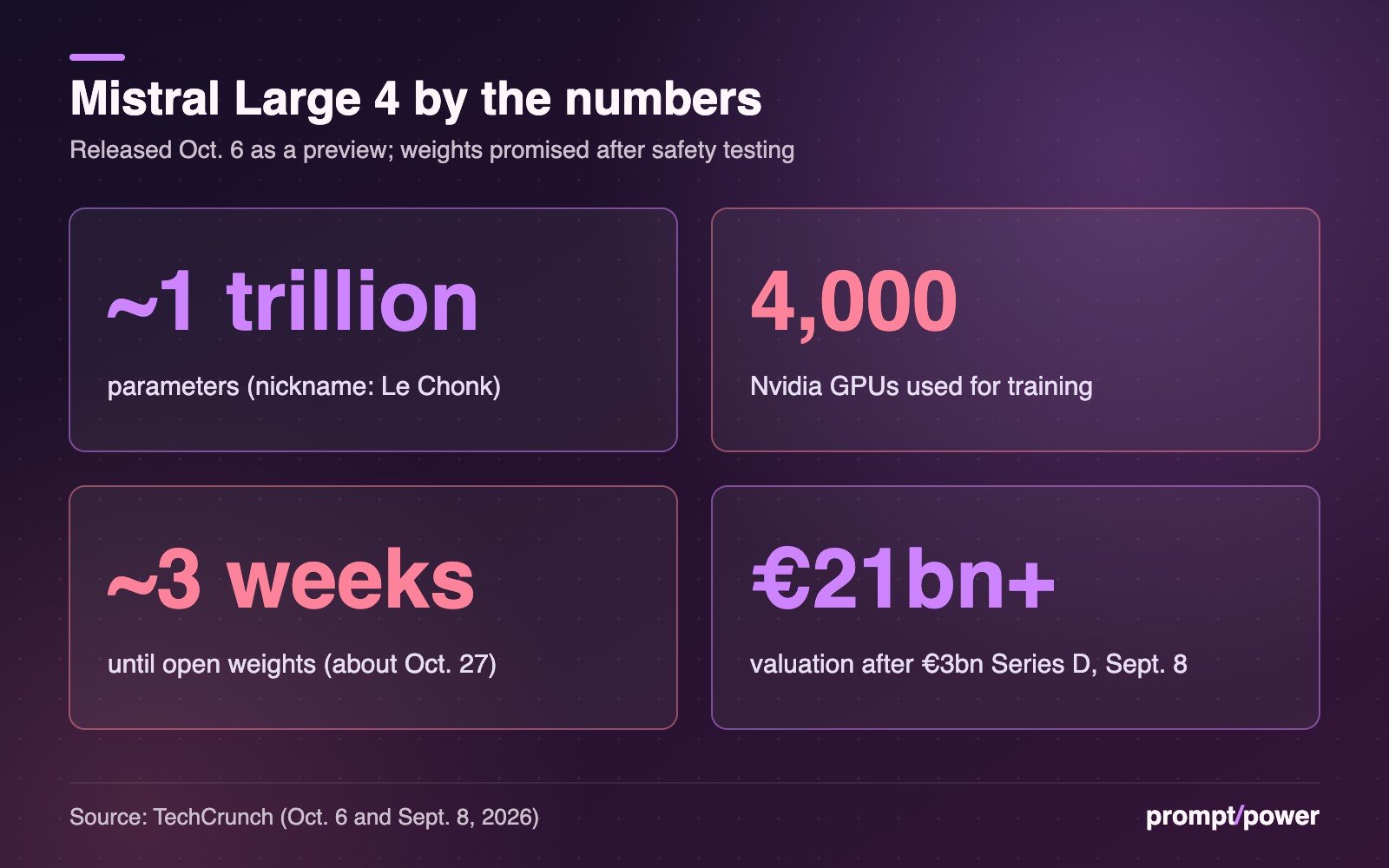
Mistral’s model documentation describes a mixture-of-experts design with about 1.05 trillion total parameters and 52 billion active per token, a 1 million-token input context, and preview API pricing of US$0.68 (about CA$0.95) per million input tokens and US$2.09 (about CA$2.91) per million output tokens, discounted from list prices of US$1.36 and US$4.18. Mistral has not yet named the licence the weights will ship under, which will matter a great deal when they land.
If the 52-billion-active figure holds, ML4 is in the same weight class as the Western open models it is chasing. Reflection AI’s Beam, which we explained on Oct. 7, is a 501-billion-parameter open-weight model pitched at exactly the same target: China’s open labs.
Why chip design and cybersecurity, and why ASML and Samsung care
Mistral says ML4 is tuned for cybersecurity, finance and chip design. The last one is not random. As TechCrunch notes, semiconductors are the core business of two of Mistral’s biggest backers. Dutch lithography maker ASML led its Series C in 2025. Samsung Electronics led its Series D on Sept. 8, a €3 billion round (about US$3.6 billion, or CA$5 billion) at a post-money valuation above €21 billion (about US$24.4 billion, or CA$34 billion). Mistral called it “the largest equity fundraising round ever completed by a European technology company.” EQT’s Scaleup Europe Fund and PSG Equity co-led, with a16z, Nvidia, Salesforce Ventures, Advent, BlackRock and the Grand Duchy of Luxembourg also in.
Cybersecurity is the more interesting bet. Stock’s case is that open weights are easier to audit, and that Mistral will “work with trusted partners and governments to make sure that the open source weights can be used to defend.” A defender can only run a model inside a secure network if they hold the weights. That is also the reason a powerful open model worries security people, and it is why the three-week safety window exists.
Macron’s ‘third way in AI’ and the sovereign pitch
The “third way” line came first in September. When the Series D closed, President Emmanuel Macron said the round reflected France and South Korea’s goal of “building a third way in AI,” TechCrunch reported. ML4 is the product that phrase was waiting for: an alternative to closed American models and to the open models often made in China.
There is a wrinkle. Mistral has started hosting Chinese models on its own platform, and TechCrunch reports the company insists that was not a pivot into “a mere inference provider.” A frontier lab that also resells its competitors is a hedge. ML4 is Mistral’s attempt to show the lab half is still the main business.
How Canada’s sovereign AI bet compares
Ottawa is chasing the same sovereign-AI argument with far less money. In June the federal AI for All strategy named open-source AI a priority, and Montreal’s Mila now leads the open-source file. AI minister Evan Solomon said its new federal funding would be “in the tens of millions,” BetaKit reported on Sept. 17. That is a research budget. Mistral’s September round alone came to roughly CA$5 billion.
Canada’s commercial champion has taken a different path. Toronto’s Cohere sells to enterprises and governments that want control over where data lives, and its North 2 agent platform, launched Oct. 5, will run rival models, including Chinese ones, rather than insisting on its own. Mistral is betting that sovereignty means owning a frontier-scale model and giving it away. Cohere is betting it means owning the deployment.
What to watch
- The licence. “Open weights” under restrictive terms is not the same as Apache 2.0. Check it before you build.
- Independent benchmarks. Until third parties test ML4, treat performance claims as marketing.
- The date. Three weeks from Oct. 6 is Oct. 27.
The number to hold Mistral to is the one it chose to lead with. If 4,000 GPUs can produce a model that competes with labs spending two to three times as much compute, the weights will prove it. If the release slips past October, the cheaper training run will look a lot more like a smaller one.

Cassandra Lee covers AI and machine learning for prompt/power: the labs, the model releases, the research and the safety fights that come with them. She reads model cards the way other people read horoscopes: skeptically, and mostly for what's left unsaid.
Keep reading



Latest from prompt/power
- AI Safety Hearing: MPs Will Question OpenAI, Anthropic, Google and Meta on 13 OctOct 11
- National Medal of Science Goes to Musk, Brin, Huang and Su. Nvidia Pledged US$1BOct 10
- TikTok Placebo Safety Test: New York Says Teens Got a Fake Feed ResetOct 10
- Waymo Takes Its First Loan, US$5 Billion, as Robotaxis Head OverseasOct 10
- Claude Haiku 5.5 Price: 90% Cheaper Until Your Prompt Hits 100K TokensOct 10
Leave a Reply