Utah Lets an AI Write Your First Acne Prescription for US$4.99 a Month
A Utah adult with a stubborn breakout can now open an iPhone app, verify their identity, answer an intake questionnaire, hold still for a five-angle face scan and, about 10 to 15 minutes later, receive a prescription for a topical acne cream chosen by software. The price, according to Nolla Health, is US$4.99 (about CA$6.94) a month.
Nolla’s approval was the most eye-catching item at an Oct. 5 press conference at the Utah State Capitol, where the state’s Office of Artificial Intelligence Policy expanded its health-care AI sandbox, Fierce Healthcare reported. Nolla describes itself as “the first organization in the U.S. authorized by a state regulator for AI to issue an initial prescription, not just a refill.”
That last clause is doing real work. Utah was already letting software handle refills: in January the state announced a partnership with Doctronic on AI-assisted renewals of existing prescriptions, which it called the “first state-approved program in the country” of its kind. What changed on Oct. 5 is that an algorithm may now start a treatment, not merely continue one a doctor began.
How Nolla’s AI acne prescriptions work in Utah
The pilot is open to Utah residents 18 and older. The software picks from a short list of physician-approved topical treatments and is barred from isotretinoin and all oral medications, SiliconANGLE reported. Severe acne, pregnancy and other out-of-protocol cases go to a human clinician.
“The AI can’t improvise. It can only choose from a short list of physician-approved topical treatments.” Dr. Zaid Fadul, Nolla’s chief medical adviser, to Medical Economics
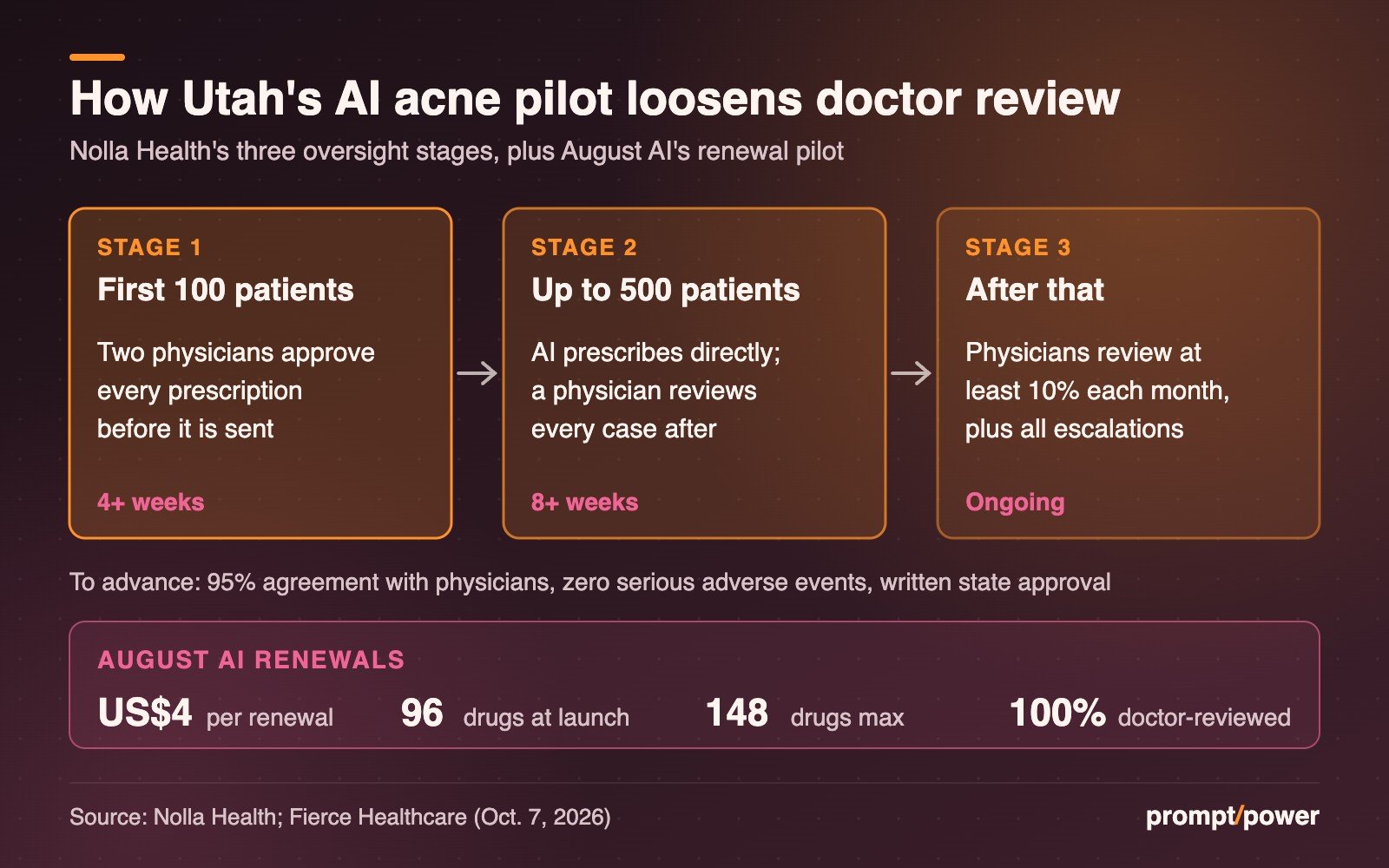
Oversight loosens in three steps, per Nolla’s own description. For the first 100 patients, two licensed physicians independently approve every AI prescription before it reaches the patient, for at least four weeks. In stage two, covering up to 500 patients over at least eight weeks, the software prescribes directly and a physician reviews every case afterward, at least weekly. In stage three, physicians review at least 10 per cent of prescriptions each month, plus every escalation or side effect. Moving up a stage requires 95 per cent agreement with physicians, zero serious adverse events and written approval from the state.
Nolla says clinicians agree with its recommendations in 96 per cent of real-world cases, with the gaps mostly about the strength of a cream. That is the company’s figure; no outside evaluator has published one.
August AI’s US$4 renewals, and who checks the software
The other named newcomer is August AI, which will run AI-assisted renewals of routine, non-controlled medications for chronic conditions such as diabetes, high blood pressure, asthma and glaucoma. It starts with 96 medications and can expand to 148 across 76 conditions, at US$4 (about CA$5.56) per renewal, according to Fierce Healthcare. A Utah-licensed physician reviews every renewal, patients are told when AI is involved, and expansion is gated drug class by drug class. A third pilot, from Expect Fitness, covers pelvic floor physical therapy.
Utah’s office director, Zach Boyd, framed the approach as an experiment in both directions: the aim is to “let the market learn and the state learn together.” Boyd told KSL that companies “just submit to us things like the number of patients that they’ve served, any outcomes they’ve observed.”
The state also named six independent evaluators, including the Coalition for Health AI and Stanford’s Clinical Excellence Research Center, to stress-test guardrails and inspect decision logs. One detail deserves more attention than it got at the podium. As Medical Daily found on the state’s evaluator page, “The company being evaluated pays the evaluator directly. The state does not pay for evaluations.” Fees have not been disclosed.
Doctors have pushed back before. The Utah Medical Licensing Board complained that it was not consulted on the Doctronic pilot and called for more physician oversight; it now has a physician-led working group vetting applications, and board member Dr. William Hamilton said that group is not a blanket approval of pilots, Fierce reported.
Could an AI prescribe in Canada?
Not under the rules as written. In Canada, who may prescribe is set by provincial law and the regulatory colleges, and the colleges are pointing the other way. The College of Physicians and Surgeons of Ontario’s advice on AI in clinical practice, last updated in August 2025, says “Physicians are ultimately accountable for their use of AI tools” and that “AI is meant to complement clinical care, not replace medical expertise.” It says nothing at all about software prescribing on its own.
There is a federal layer too. Software that recommends treatment can count as a medical device, and Health Canada’s pre-market guidance for machine learning-enabled medical devices covers licence applications for Class II, III and IV devices. Our read: a Canadian Nolla would need a college to rewrite its prescribing rules and, most likely, a Health Canada licence. We could find no province that runs a sandbox like Utah’s, one that lets the state waive the usual rules for a specific AI product.
What it means for you
In Utah, the pilot is opt-in and the earliest patients get the most human attention, since two doctors sign off on each of the first 100 prescriptions. Ask which stage the pilot is in before you enrol. In Canada, nothing changes: an acne prescription still comes from a licensed human prescriber. For the wider U.S. picture, see our state AI law map.
Nolla’s pitch rests on one number from its own announcement. The average wait for a dermatology appointment in Utah is 61 days, and 11 of the state’s counties have no dermatologist at all. The software answers in about a quarter of an hour.

Lauren Smith covers consumer apps and services for prompt/power: streaming, subscriptions, e-commerce and everyday tech worth your money. She keeps a running tally of every free trial that quietly turned into a subscription.
Keep reading


Latest from prompt/power
- Uber and Pony.ai Robotaxis Head for London Tests. Here’s What’s ApprovedOct 11
- Surface Laptop Ultra UK Price Is £2,599. Here’s the Real British MarkupOct 11
- AI Safety Hearing: MPs Will Question OpenAI, Anthropic, Google and Meta on 13 OctOct 11
- National Medal of Science Goes to Musk, Brin, Huang and Su. Nvidia Pledged US$1BOct 10
- TikTok Placebo Safety Test: New York Says Teens Got a Fake Feed ResetOct 10
Leave a Reply