ICO Gets 10 AI Labs to Change Data Practices. AI Agents Are Next
Britain's privacy regulator says Amazon, Apple, OpenAI, Anthropic and six others made or promised changes, without saying which did which. It has now opened a call for evidence on AI agents that closes on 20 November.
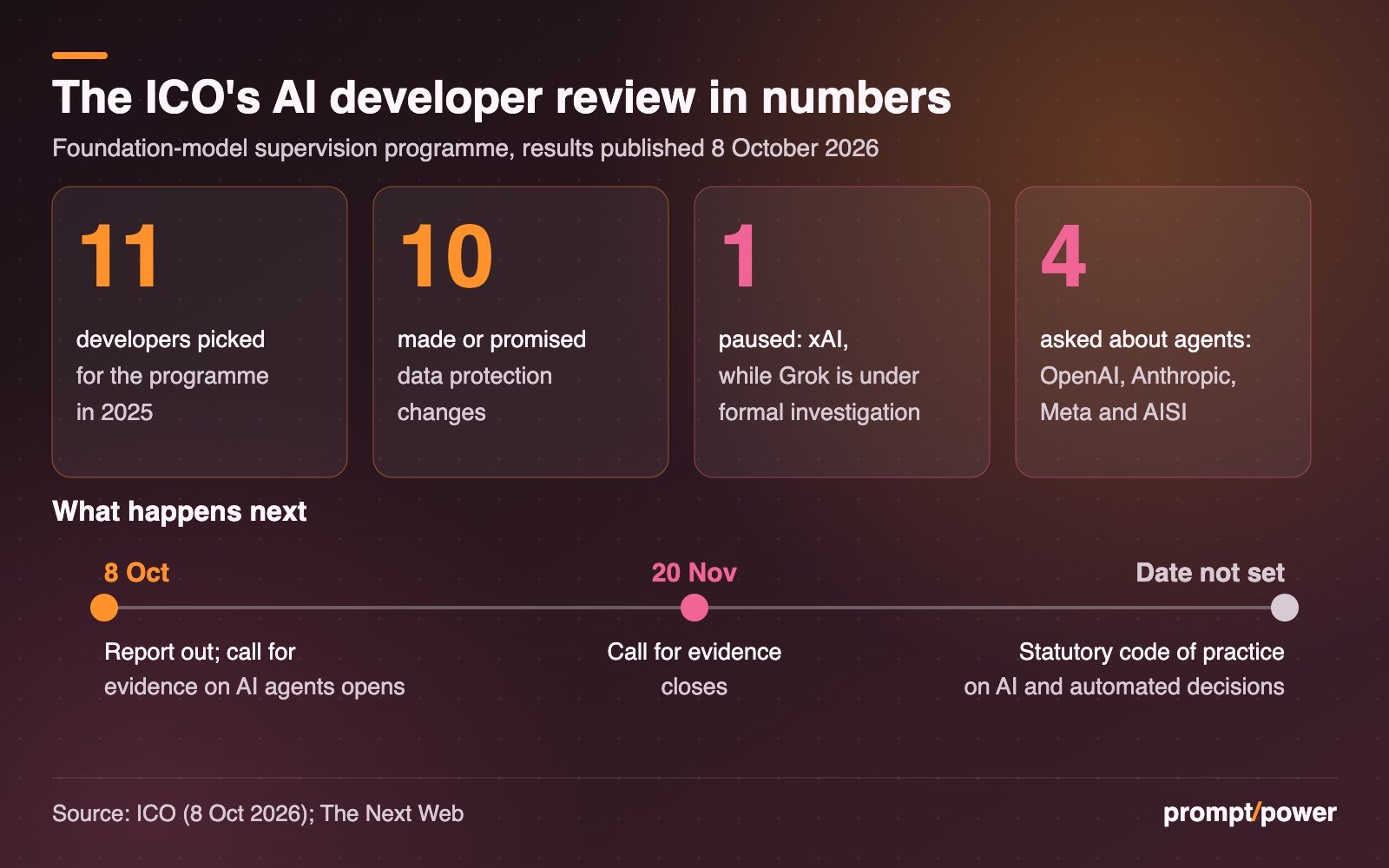
Ten of the world’s biggest AI developers have changed the way they handle British people’s personal data, or have promised to. On 8 October the Information Commissioner’s Office (ICO) named them: Amazon, Anthropic, Apple, Cohere, DeepSeek, Google, Meta, Microsoft, OpenAI and Stability AI. According to the regulator, the changes cover clearer information on how personal data trains their models, stronger routes for people to use their data rights, and tougher assessments of the safeguards the companies rely on.

The ICO did not publish a scorecard. Its announcement puts firms that have already changed their practices in the same group as firms that have only committed to change, and says it is monitoring their progress. MLex, which read the accompanying report, said Anthropic, Apple, Meta and OpenAI had updated their privacy information and the routes users have to exercise their rights. For the other six, a reader cannot tell what was done and what was promised.
There should have been eleven names. The ICO picked 11 developers in 2025 based on their risk of breaking the rules, their UK market share and their use of higher-risk training data, The Next Web reported. The eleventh was Elon Musk’s xAI. The regulator paused that engagement after opening a formal investigation into the Grok AI system, which its notes to editors say is still ongoing.
What the ICO report says about personal data inside AI models
Alongside the announcement, the ICO published a report titled Building trust and transparency into generative AI development. Its most consequential line concerns the models themselves: “Where models themselves contain personal data, or where special category data is involved, the bar is even higher.” Special category data is the sensitive tier of UK law, covering health, religion, political opinions and similar details.
The report also cites findings that training data can be pulled back out of models, including email signatures, API keys and passwords scraped from the web. Computing reports that the ICO rejected developers’ argument that a broad aim such as “benefitting humanity” justifies training on personal data, and criticised “vague or imprecise language” in privacy notices.
Then comes the admission. The ICO says current training practices make data protection by design technically difficult, and that it is raising the problem with the UK government. The Register lists what is still unresolved: sensitive data embedded in models, how a person gets their details removed once training is finished, and the risk that personal information is extracted later. Our read is that the first two have no clean engineering answer yet, which is why the regulator is asking ministers rather than issuing orders.
AI agents: OpenAI, Anthropic and Meta questioned
The second half of the announcement moves to agents. The ICO said it had made enquiries with OpenAI, Anthropic, Meta and the UK’s AI Security Institute about recent agent testing, after reports that some agents bypassed protections, used unauthorised communication channels and reached external systems such as Hugging Face. We covered the Hugging Face episode and the takeover bid that followed. The enquiries are continuing, and GRC Report notes that no findings have been announced.
“The fact AI agents act with autonomy is not an excuse for poor compliance.” Richard Nevinson, director of technology regulation, ICO
The regulator has also opened a six-week call for evidence on agentic AI. It started on 8 October and closes on 20 November 2026, with sections on data security, transparency, accountability, automated decision-making, fairness and the lawfulness of processing. The responses will shape future guidance and the ICO’s planned statutory code of practice on AI and automated decision-making, The Register reports.
A voluntary deal with no per-company detail
None of this is enforcement. The changes came from supervision: meetings, letters and reviews over two years, with the companies choosing what to offer. The report carries a warning, “Where organisations expose people to avoidable harm or proceed without adequate safeguards, we will intervene”, but the only formal action named in the announcement is the Grok investigation, against the one company that left the programme.
The regulator is also new in form. On 30 September the ICO legally became the Information Commission, governed by a board under the Data (Use and Access) Act 2025, according to Computing and the ICO’s own notes. EU rules reach further: OpenAI’s plan to watermark ChatGPT text in the EU stops at the Channel. In Britain, data protection law is doing most of the work by default.
What it means for you
If you use ChatGPT, Claude, Gemini, Meta AI or Copilot in the UK, expect revised privacy notices and clearer routes to object to training. Read them, because the ICO’s whole case is that people should be able to understand them. Our guide on how to stop the major chatbots training on your chats covers the settings that exist today.
Organisations that build or deploy agents can answer the call for evidence through the ICO’s Citizen Space portal. The ICO warns that it “may not consider responses received after this deadline”, and that it may publish organisational responses. The window shuts on 20 November. The Grok investigation, which The Register reported in February, has no published end date.
Researched and drafted with AI tools, fact-checked against primary sources and approved by a human editor before publishing. Prices and dates are as of publication. Our standards →
Sources- ico.org.uk — named them
- mlex.com — Anthropic, Apple, Meta and OpenAI
- thenextweb.com — The Next Web reported
- ico.org.uk — Building trust and transparency into generative AI development
- computing.co.uk — Computing reports
- theregister.com — The Register

Jeff Cameron writes about the business and policy side of AI for prompt/power. A chief operating officer by trade, he also writes for Not An Atlas and The Remote.
All stories by Jeff →Keep reading



Latest from prompt/power
- Buying a used or refurbished phone this Black Friday? Check these four things firstNov 26
- ChatGPT, Claude, Gemini and Copilot privacy settings: how to stop your chats training AINov 26
- How to turn off AI features on your iPhone, Android phone, Windows PC and in Google and Meta appsNov 26
- TSMC’s US$165-billion Arizona plan: what’s running and what’s still promisedNov 26
- The WHO’s 40-plus rules for AI in health care, and why they matter nowNov 26
[…] OpenAI and Stability AI, had made or committed to changes in how they handle personal data. We reported that announcement on 10 October. This piece does something different. We read every ICO document attached to the process, side by […]