
TikTok Placebo Safety Test: New York Says Teens Got a Fake Feed Reset
In 2023, some TikTok users who tapped a button to wipe their recommendations and start over were told it had worked. Their feeds did not change. According to New York Attorney General Letitia James, that was by design: they were the placebo group.
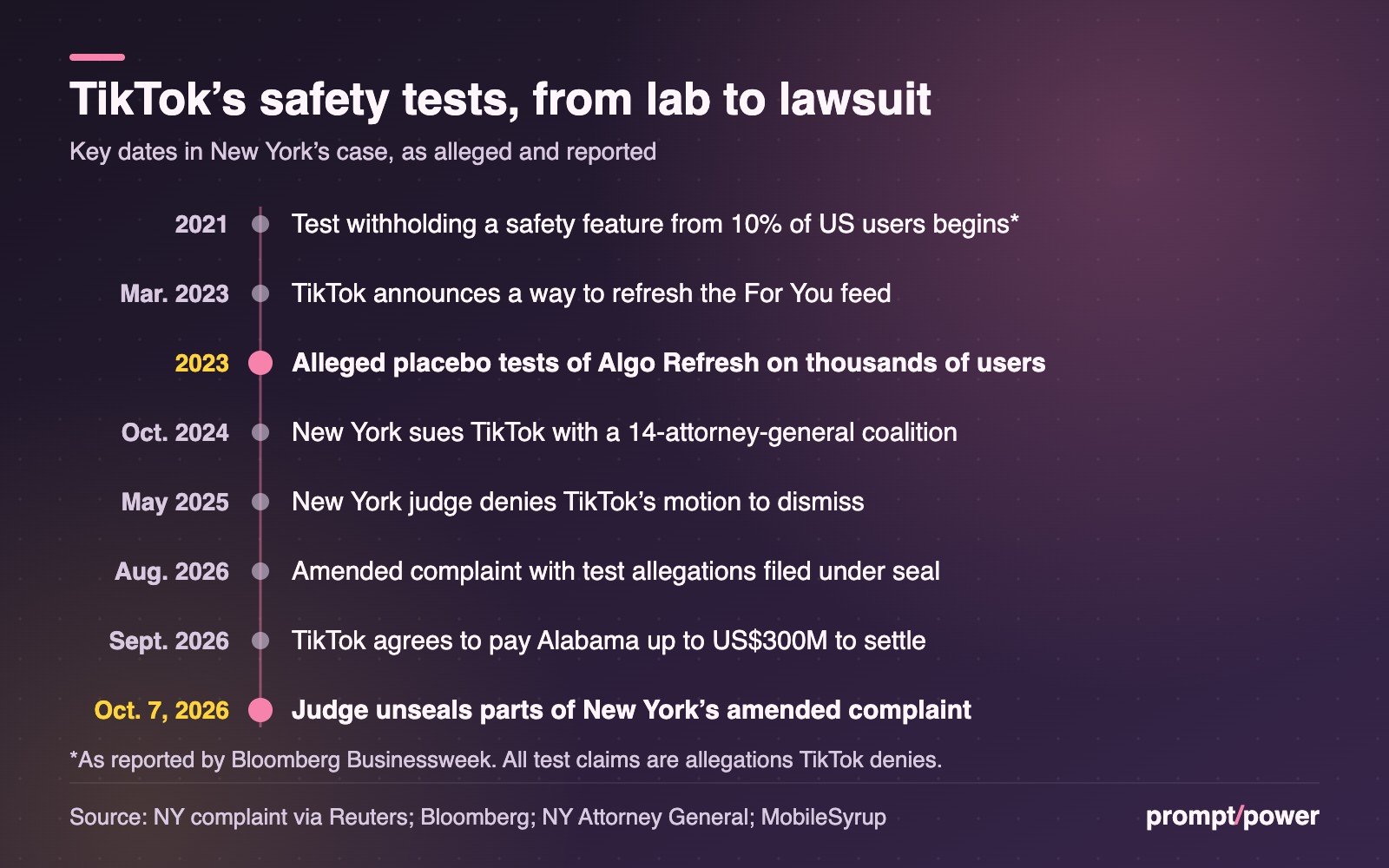
Portions of James’s amended complaint against TikTok were unsealed on Oct. 7, Reuters reported. The suit alleges the company ran “ghost” or placebo experiments on thousands of users, including teens and children, who tried to switch on a feature called Algo Refresh. People outside the experiment got a working version. The complaint says TikTok ran the tests repeatedly in 2023 while tracking how long users stayed in the app and what happened to ad revenue.
These are allegations in active litigation, not findings. TikTok told Reuters the suit mischaracterizes how Algo Refresh works, that it regularly tests features and that keeping young users safe is a priority. It has broadly denied New York’s claims in court filings.
What the unsealed TikTok complaint alleges
Algo Refresh appears to be the feed-reset option TikTok announced in March 2023. At launch, TikTok said it let someone “view content on their For You feed as if they just signed up for TikTok,” MobileSyrup reported at the time, noting the button had not yet reached Canada.
The complaint argues the feature was oversold even when it worked, because TikTok described a temporary change as a reset of the recommendation algorithm. The sharper allegation comes from inside the company. A product manager on TikTok’s Digital Well Being team objected in an internal chat, according to the complaint as quoted by The Next Web:
“This feature is about algorithm transparency and control. A placebo group completely conflicts with that.”
Placebo arms are routine in drug trials, where participants consent and an ethics board signs off. In consumer apps, A/B tests are just as routine, and the person in the control group almost never knows. New York is pressing on the gap between those two worlds: a user who got the dud version had asked for a safety control and been shown a confirmation.
The Bloomberg test: 15 million users, one safety feature withheld
The amended complaint also folds in a separate experiment that Bloomberg Businessweek first reported, based on a confidential TikTok document. That algorithmic test began in 2021 and withheld a new safety feature from 10% of US users, about 15 million people, to see whether the change reduced time spent on the platform. A New York teenager in the group that did not get the safety features later died by suicide after being shown self-harm and suicide content, according to Bloomberg. No court has made a finding about what role, if any, the test played.
James’s complaint says TikTok made its platform “less safe by design” for users in those A/B tests, Bloomberg reports. In a court filing, TikTok said some tests “may involve a portion of platform traffic that continued to receive the original experience,” and denied that this made the platform less safe. Senators Marsha Blackburn and Richard Blumenthal sent TikTok 13 written questions about that test in August, per The Next Web.
New York’s case runs separately from the multidistrict litigation that holds most of the thousands of youth-harm suits against Meta, TikTok, Snap and YouTube. James sued in October 2024 as part of a bipartisan coalition of 14 attorneys general, and a New York State Supreme Court judge refused to dismiss the case in May 2025. In September, TikTok agreed to pay Alabama up to US$300 million (about CA$417 million) to settle the first state case headed for trial, Reuters reports, and TechCrunch counts more than two dozen state suits in all.
Why Canadian parents should care, and what Ottawa could see
Nothing unsealed so far says Canadian accounts were in either experiment. The passages describe US users. Canadian teens still use the same app, built by the same product teams, and the question for them is whether anyone here could ever see documents like these without a lawsuit.
Ottawa’s answer sits in a bill that has not moved. Bill C-34, the Safe Social Media Act, introduced on June 10, would make platforms keep records showing compliance and file a digital safety plan for each service, overseen by a new Digital Safety Commission of Canada. Fasken’s summary of the bill notes the commission could order platforms to give accredited researchers access to data referenced in those plans, and that making misleading statements would be an offence. LEGISinfo shows C-34 still waiting for second reading, with no recorded activity since first reading on June 10.
Our read: a safety plan is a company describing itself. What makes the New York filing land is the chat log, an employee telling colleagues the test undercut the feature’s purpose. No plan volunteers that.
What to do if your teen uses TikTok
- Check the result, not the confirmation. After any feed reset, scroll together for a few minutes and see whether the videos actually changed.
- Treat a reset as temporary. By the complaint’s own account, even the working version was a short-term change, so pair it with the app’s other content controls and with regular conversations about what shows up.
- Apply the same skepticism to AI chatbots. Our parent’s guide to AI chatbot controls covers what the settings in ChatGPT, Gemini and others really do, and why Common Sense Media rated ChatGPT for teens an unacceptable risk.
The product manager’s objection, as the complaint quotes it, ran seven words: “A placebo group completely conflicts with that.” The complaint says the tests ran repeatedly through 2023.

Lauren Smith covers consumer apps and services for prompt/power: streaming, subscriptions, e-commerce and everyday tech worth your money. She keeps a running tally of every free trial that quietly turned into a subscription.
Keep reading




Latest from prompt/power
- Waymo Takes Its First Loan, US$5 Billion, as Robotaxis Head OverseasOct 10
- Claude Haiku 5.5 Price: 90% Cheaper Until Your Prompt Hits 100K TokensOct 10
- Bell, Virgin, Public Mobile Plan Changes: The New Canadian Price ListOct 10
- Manus Raises More Than US$500 Million After China Blocked Meta’s DealOct 10
- Elon Musk’s Alberta Separation Posts Expose Canada’s Thin Platform RulesOct 10
Leave a Reply