
UK Non-Compete Clauses: Burnham Pledges a Law, but Not Yet a Ban or a Cap
The Prime Minister, Andy Burnham, told the Innovation Nation Summit in Manchester on 9 October that the government “will legislate to make sure that non-compete clauses will no longer be a barrier to hiring” for “our most promising start-ups and scaling firms”, PA Media reported. He did not say when, through which bill, or whether that means a ban.
The start-up lobby is treating it as a win anyway. Dom Hallas, chief executive of the Startup Coalition, called it “a huge move”, Tech.eu reported.
What Burnham said in Manchester
Burnham framed the problem as overreach by employers. “I believe some businesses have gone too far in their use of restrictive practices such as non-compete clauses,” he said, according to PA. He also reached for a football comparison: “Call it, if you like, the Bosman ruling for the innovation sector, but I think it’s needed and long overdue.”
The Bosman case is the European Court of Justice ruling that let out-of-contract footballers move between clubs freely. The analogy fits the founders’ complaint: talented people stuck on the sidelines, unable to join a rival or start a company.
Hallas put the case in a sentence: “Because talent matters and mobile talent means startups can build.”
Ban or cap? What is not yet known
Quite a lot. Tech.eu’s headline says the UK will ban non-compete clauses. The quotes we found do not use that word, and PA’s report does not settle it either.
- Ban or cap. Before the speech, a source told the Financial Times that Burnham would “set the direction of travel”, with finer details to follow, Personnel Today reported.
- Scope. The pledge was pitched at start-ups and scale-ups, but Burnham also said, per PA, that “workers in the foundational economy, the everyday economy, are not prevented from moving jobs too.” That reads wider than tech.
- Notice periods and garden leave. Personnel Today’s preview described a clampdown on non-competes and long notice periods. The speech reports we read quote Burnham only on non-competes.
- Timing. No bill or date was given. Burnham hinted at tax measures to help firms scale ahead of the Budget on 28 October, PA reported, but did not tie the non-compete law to it.
The options on the table
The government has already laid out the choices. A Department for Business and Trade working paper, published on 26 November 2025, set out options including a statutory limit on non-compete length (the previous government proposed three months, and the paper also looks at one to three, six and 12 months), limits that vary by company size, an outright ban, a ban below a salary threshold, and a combined approach pairing that threshold ban with a three-month cap for higher earners. Responses closed on 18 February 2026.
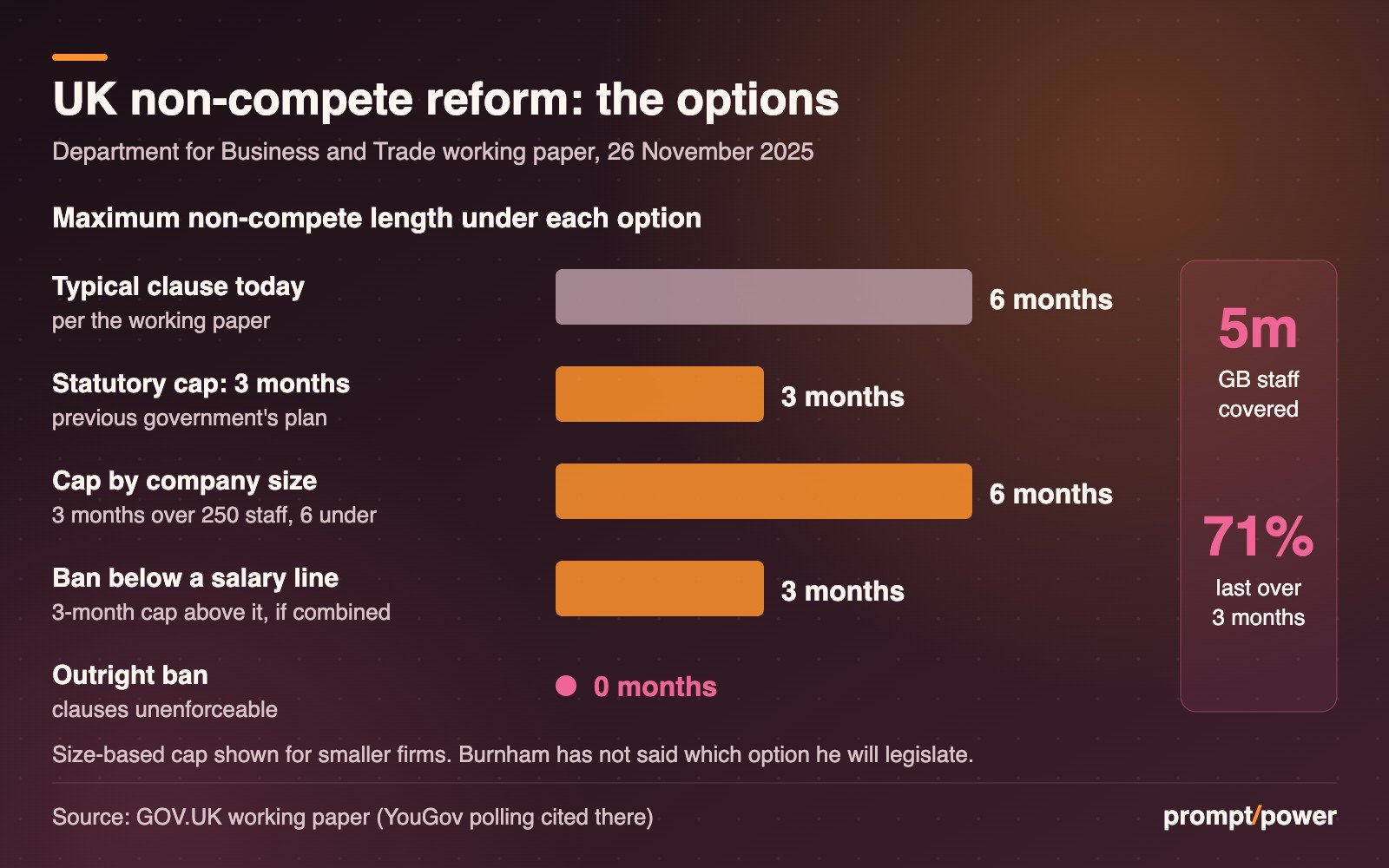
The same paper says around 5 million employees in Great Britain have non-competes in their contracts, typically lasting about six months. In YouGov polling it cites, 71% of non-competes ran longer than three months, and some lasted up to 24.
Our read: a three-month cap would already shorten most existing clauses. An outright ban is the version the start-up campaigners want, and the one Tech.eu’s headline describes, but the government has not yet said which it has chosen.
Why ElevenLabs and Synthesia pushed for it
On 1 October, founders published an open letter titled “Free to Start and Scale”, Personnel Today reported, led by the chief executives of ElevenLabs, the voice AI company valued at about £8.2bn (US$11bn), and Synthesia. Investors Index Ventures, Entrepreneurs First, Plural and Kindred backed it. “We therefore call on the government to ban lengthy post-termination restrictions,” the letter says, and it also asks for limits on extended notice periods and garden leave.
Alexandru Voica, head of global affairs at Synthesia, explained the hiring problem to Personnel Today: “You need to move much faster, typically in weeks or at most a couple of months.” On our arithmetic, a hypothetical six months of garden leave followed by a typical six-month non-compete would keep an engineer out of the market for a year.
The fight is over people. The big US labs are investing in British talent too: Anthropic’s new academy for consultants, for one, is running a London cohort. And equity is part of the pitch: Revolut’s July staff share sale valued the company at about £86bn (US$115bn), the kind of number that makes joining a scale-up early look worth a clause fight.
What it means for employers and staff now
Nothing has changed yet. Until a bill passes, existing clauses stand, and employers have been enforcing them more: claims in the High Court to enforce non-competes rose 43% in the first nine months of 2025, according to law firm Nockolds, cited by Personnel Today.
Employment lawyers expect firms to lean harder on confidentiality and intellectual property protections if non-competes go. Enterprise Britain’s “Time to Act” report already backs a ban “while maintaining protections on intellectual property and confidentiality”.
If you are weighing a move to a start-up now, read your contract for three separate things: the non-compete, the notice period and any garden leave clause. Burnham has spoken only about the first.

Felix Strauss covers tech policy and regulation for prompt/power, from Brussels and Ottawa to Washington and Sacramento. He reads the 400-page regulation so you don't have to, and highlights the one sentence that actually matters.
Keep reading




Latest from prompt/power
- Uber and Pony.ai Robotaxis Head for London Tests. Here’s What’s ApprovedOct 11
- Surface Laptop Ultra UK Price Is £2,599. Here’s the Real British MarkupOct 11
- AI Safety Hearing: MPs Will Question OpenAI, Anthropic, Google and Meta on 13 OctOct 11
- National Medal of Science Goes to Musk, Brin, Huang and Su. Nvidia Pledged US$1BOct 10
- TikTok Placebo Safety Test: New York Says Teens Got a Fake Feed ResetOct 10
Leave a Reply