
Manus Raises More Than US$500 Million After China Blocked Meta’s Deal
At the start of 2026, Manus belonged to Meta. On Oct. 8, the AI agent startup said it had raised more than US$500 million (about CA$695 million) as an independent company again, Reuters reported, five months after Beijing ordered Meta’s US$2-billion-plus purchase undone.
Boyu Capital and IDG Capital co-led the round, according to Reuters. Existing backers Tencent, ZhenFund and HSG, the firm formerly known as Sequoia China, also took part. Butterfly Effect, the company behind Manus, confirmed the close in a WeChat post, Decrypt reported, without giving a valuation or saying what the money is for.
That a Chinese-founded, Singapore-based agent company can still raise this much tells you investors think the Meta mess is survivable. How it got into the mess is the more useful story.
Manus funding: who invested, and the US$4 billion question
Manus has not disclosed what the round values it at. In September, Bloomberg reported that the company was seeking about US$500 million at roughly US$4 billion (about CA$5.6 billion), according to TNW, around double what Meta agreed to pay.
Revenue is the case investors are buying. Manus said it reached US$100 million (about CA$139 million) in annual recurring revenue by December 2025, about eight months after its March 2025 launch, Decrypt noted. In June, The Information reported that its annualised run rate had hit about US$500 million, up from US$100 million when Meta acquired it, Reuters wrote. A run rate is recent sales multiplied out to a year, not booked annual revenue, and Manus has published no audited figures. We have looked before at how run-rate maths flatters fast-growing AI companies.
“The fundraising shows that the short-term fallout of the Meta case has been contained.” Dan Wang, China director at Eurasia Group, speaking to CNBC, as quoted by Quartz
How China unwound Meta’s Manus acquisition
Manus tried to put distance between itself and Beijing early. Around mid-2025 it moved its team to Singapore, shut most of its China operations and laid off dozens of employees in July, according to Decrypt. By the time Meta bought it in December 2025, Manus was incorporated in Singapore, TNW reported. The deal closed on Dec. 29.
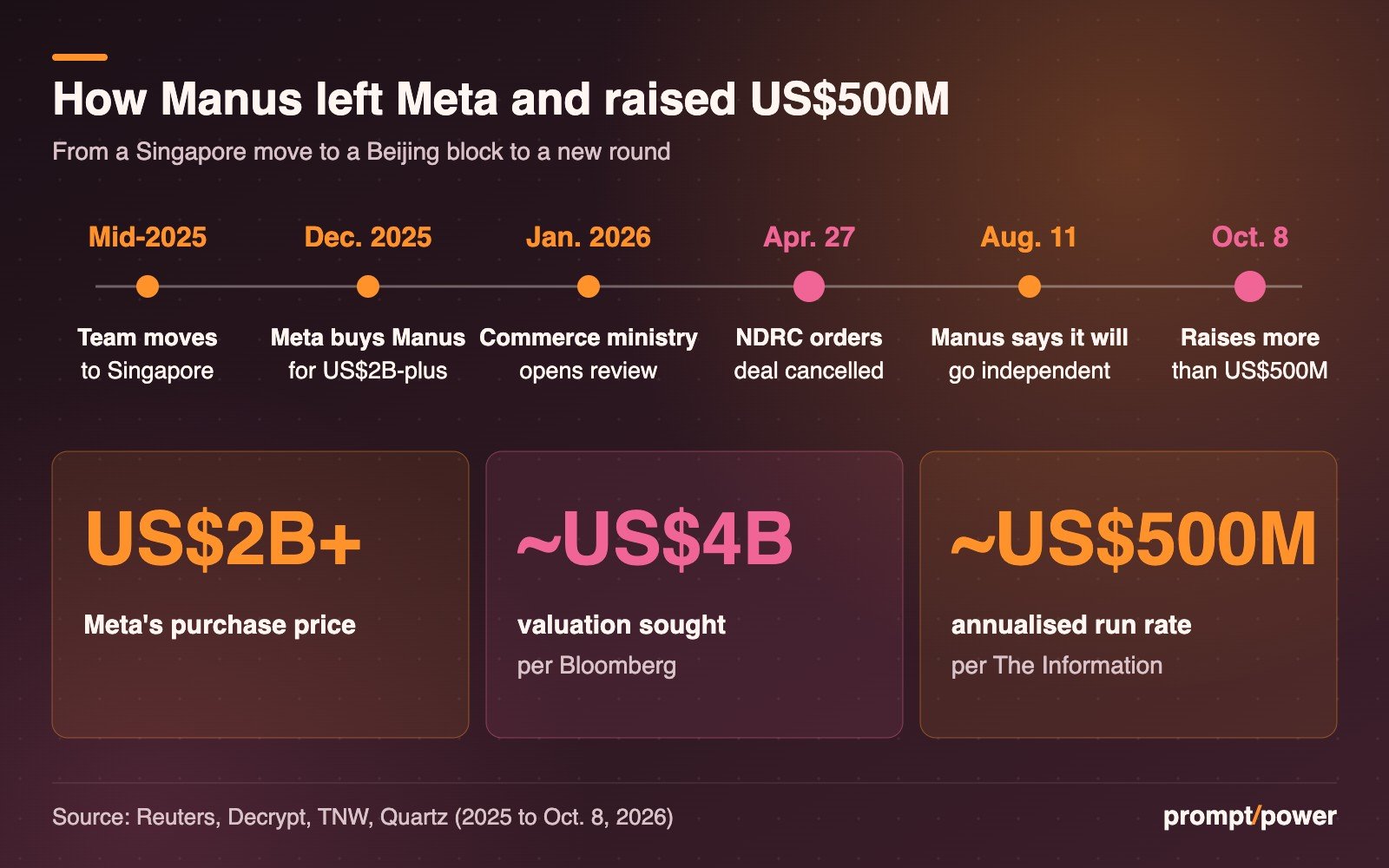
It did not help. In January 2026, China’s Ministry of Commerce opened a review that TNW said was framed around export controls, treating the sale as a possible technology export. By March, co-founders Xiao Hong, the chief executive, and Ji Yichao, the chief scientist, had been summoned to Beijing and barred from leaving the country, Reuters reported. On April 27, the foreign investment security review office run by the National Development and Reform Commission (NDRC), China’s state planner, ordered the deal cancelled. Decrypt rendered the NDRC’s instruction as an order to “prohibit foreign investment in Manus in accordance with laws and regulations.”
The unwinding took months. Meta cut Manus off from its internal data systems in June, and early investors moved to buy the company back at the US$2 billion valuation, TNW reported. On Aug. 11, Manus said it would resume operating independently, a separation that meant deleting some users’ data.
Why cross-border AI deals keep getting stuck
Manus was squeezed from both sides of the Pacific. In Washington, a Treasury Department rule that took effect on Jan. 2, 2025 bars Americans from certain equity investments in Chinese companies working on advanced chips, quantum computing and some AI systems without notifying or getting approval from Treasury, as TNW summarised it. In April 2026, Bloomberg reported that Beijing planned to require government approval before its leading tech companies, including top AI startups, accept US capital. No Chinese official confirmed that plan.
The bigger signal is what the NDRC chose to ignore. Its order said offshore incorporation does not shield a deal when the technology and talent originated in China, Quartz reported, a direct hit at what Quartz called “Singapore washing.” Moving the headquarters, the cap table and the staff was not enough. Beijing looked at where the product was built.
Our read: that is the rule every Chinese-founded AI team now has to plan around, and it cuts against American buyers, too. A US acquirer can no longer assume a Singapore address settles the question, at a moment when Chinese labs are closing the performance gap with US models and their talent is worth fighting over.
What Manus does next: a Hong Kong listing?
The new money appears to buy Manus room rather than a clean exit from politics. The company was reportedly weighing a China-incorporated joint-venture structure that could open the way to a Hong Kong listing, Reuters wrote, which would put it back under Beijing’s jurisdiction by choice.
Han Lin, China country director at The Asia Group, told CNBC, according to Quartz: “The immediate task for Manus now is proving scale, profitability and regulatory alignment.” Butterfly Effect said it plans to keep hiring in China and abroad, per Decrypt.
The data deletion is the detail that lingers. When Manus split from Meta, it removed some data that users had created on or after Dec. 29, 2025, the day the deal closed. For those customers, the nine months Manus spent as a Meta company simply no longer exist.

Yuna Park covers mobile and gadgets for prompt/power: phones, accessories, consumer electronics and the supply chains behind them. Her favourite test for any new phone: would you notice if someone swapped it for last year's?
Keep reading

OpenAI’s Revenue Run Rate Is Near US$50 Billion, Not US$70 Billion

BT TalkTalk Takeover: Virgin Media O2 Calls the Rescue a Stitch-Up

Personal Agent Protocol: Meta, Walmart and Shopify’s AI Agent Front Door

PQ Wins Quebec: Montreal AI’s Bigger Risk Is Immigration, Not a Referendum
Latest from prompt/power
- National Medal of Science Goes to Musk, Brin, Huang and Su. Nvidia Pledged US$1BOct 10
- TikTok Placebo Safety Test: New York Says Teens Got a Fake Feed ResetOct 10
- Waymo Takes Its First Loan, US$5 Billion, as Robotaxis Head OverseasOct 10
- Claude Haiku 5.5 Price: 90% Cheaper Until Your Prompt Hits 100K TokensOct 10
- Bell, Virgin, Public Mobile Plan Changes: The New Canadian Price ListOct 10
Leave a Reply