
Personal Agent Protocol: Meta, Walmart and Shopify’s AI Agent Front Door
On Sept. 21, Amazon blocked Meta’s new personal agent, Muse, from shopping on its users’ behalf because the agent didn’t identify itself, SiliconANGLE reported. Fifteen days later, Meta came back with a proposed fix for the whole industry.
On Oct. 6, Meta and Sierra, the customer-service AI company run by Bret Taylor and Clay Bavor, announced the Personal Agent Protocol, or PAP: an open standard for how a consumer’s AI agent introduces itself to a business, signs in and declares what it is allowed to do. Walmart, Ottawa-founded Shopify and Stripe are among the partners. “It is kind of chaos until such a standard exists,” Taylor told CNBC, as reported by Quartz.
Today a shopping agent mostly behaves like a very fast, very confused human. It loads web pages, clicks through forms and, when it gets stuck, falls back to web chat or a phone line. Sierra’s announcement argues that a direct connection could do the same job “securely in seconds.”
PAP is meant to be that connection. Taylor and Bavor sum up the principle in their launch post: “consumers decide what access to give their personal agents, and companies set parameters for what those agents can do.” The post adds that “It’s open for anyone to implement,” though the announcement names no licence or governance body.
Genesys chief executive Tony Bates put the pitch more bluntly in Sierra’s post. “Personal AI is creating a new front door to the enterprise,” he said. The protocol is the doorframe: a shared way for the business to see who an agent represents and what it has been cleared to touch.
How PAP works: guest first, then read-only or write
Sierra’s post describes a session in roughly four stages. The v0.1 specification has not been published, so treat this as the design intent rather than settled detail.
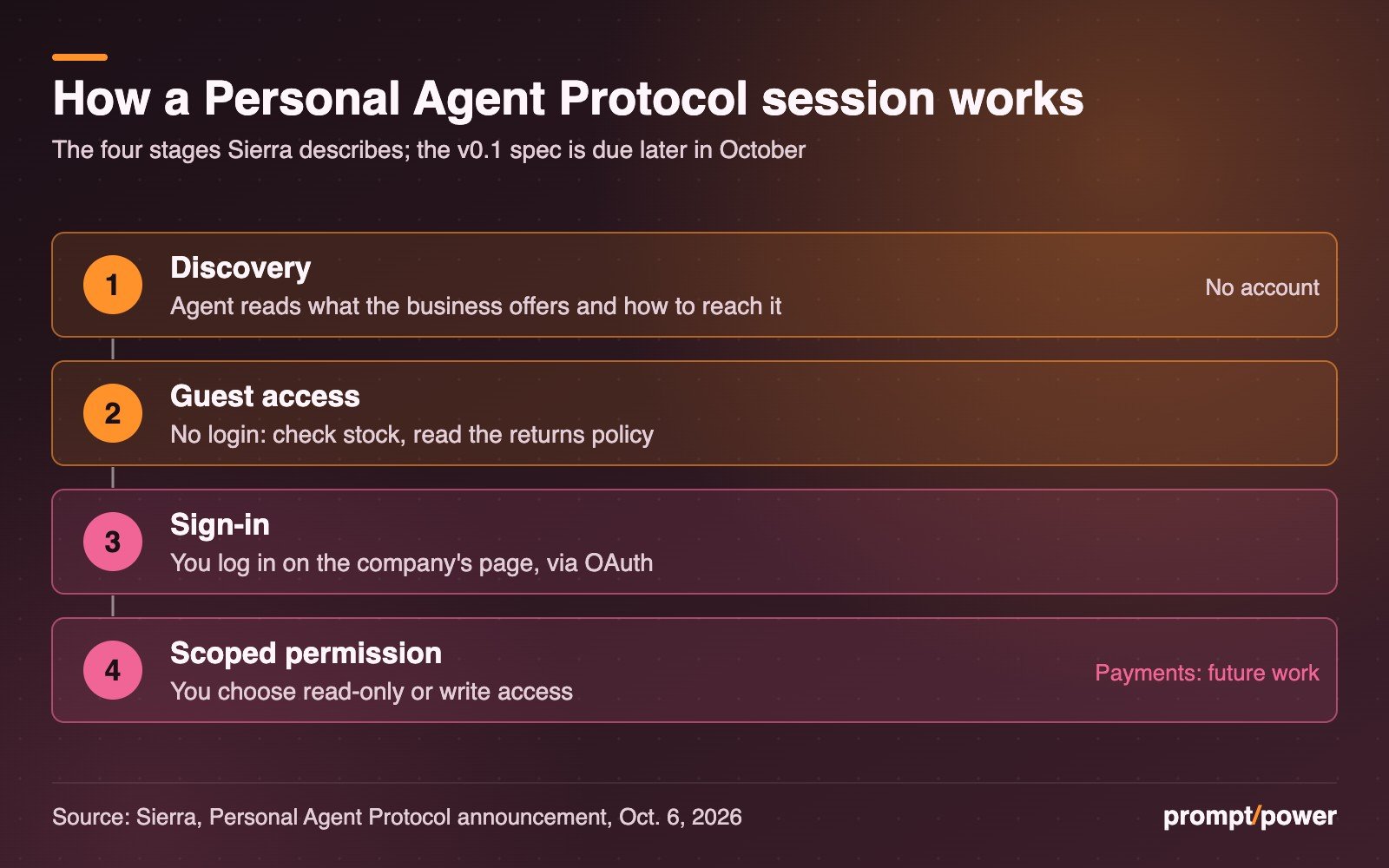
- Discovery. The agent starts on the company’s website, where PAP tells it what the business offers and how to reach it.
- Guest access. With no login, the agent can do low-stakes things such as checking whether an item is in stock or reading the returns policy.
- Sign-in. When a task needs your account, you sign in on the company’s own page or use credentials you have already set up with your agent.
- Scoped permission. “The customer is always in control, deciding whether the agent has read-only or write access,” Sierra writes. Read-only might mean checking an order; write access means changing it.
Under the hood the session is built on OAuth, the same authorisation standard behind most “Sign in with Google” buttons. The session follows you across channels, so a question asked before you log in and an order change made afterward count as one visit. The business picks the route: its regular website, its APIs (built on standards such as MCP and OpenAPI), or its own customer-service agent for conversational jobs like a warranty claim.
Who signed on, and who didn’t
Sierra lists Genesys, Instinct, Rocket, Shopify, Stripe and Walmart as partners developing PAP with Meta and Sierra. Meta’s own announcement adds contact-centre companies NiCE and Decagon, CMSWire noted. NiCE chief executive Scott Russell framed the appeal in time terms: “Personal AI agents have endless time that consumers don’t.”
For Meta the motive is obvious. Muse launched Sept. 8 and is available only in the U.S. so far, per The Associated Press. David Singleton, a vice-president at Meta Superintelligence Labs, compared PAP to email, which “works great because it is a standard that everyone can use to talk to each other,” he told CNBC, according to SiliconANGLE.
The absences are louder. OpenAI, Anthropic and Amazon are not in the founding group, Forkast noted. Taylor, who also chairs OpenAI’s board, said he expects OpenAI and Anthropic to join and would be “really disappointed” if competitors didn’t adopt it, per Quartz. Amazon is the harder case: the company that kicked Muse off its store has also sued Perplexity over agent scraping.
“It is kind of chaos until such a standard exists.” (Bret Taylor, Sierra co-founder, to CNBC)
PAP vs UCP, ACP and Visa’s Trusted Agent Protocol
PAP arrives in a crowded field. Each of the big agent-commerce standards covers a different slice of the transaction, which is partly why the same companies keep appearing on several of them.
| Standard | Launched | Led by | Main job | Shopify’s role |
|---|---|---|---|---|
| Personal Agent Protocol (PAP) | Oct. 6, 2026 | Meta, Sierra | Agent sign-in and permissions | Partner |
| Universal Commerce Protocol (UCP) | Jan. 11, 2026 | Google, Shopify | Discovery, cart and checkout | Co-developer |
| Trusted Agent Protocol (TAP) | Oct. 14, 2025 | Visa, Cloudflare | Signed agent identity, optional payment data | Early contributor |
| Agentic Commerce Protocol (ACP) | Sept. 29, 2025 | OpenAI, Stripe | Checkout inside the agent | Not named |
Visa’s Trusted Agent Protocol lets approved agents pass merchants a cryptographic signature declaring intent and, optionally, payment details. Shopify and Stripe were both on its list of early partners. The Universal Commerce Protocol handles checkout steps like discount codes and loyalty credentials. ACP’s details come via a comparison by Beri; we could not open OpenAI’s or Stripe’s original pages for this story.
Our read: PAP is less a rival to these than a layer beneath them. It answers “who is this agent and what may it do here?” and leaves “how does the money move?” to someone else.
Shopify co-developed UCP with Google, contributed to Visa’s protocol and is now a PAP partner. That’s not indecision. Shopify’s merchants cannot each negotiate with every agent maker, so the platform wants a seat wherever the rules get written. Mani Fazeli, Shopify’s vice-president of product, said in Sierra’s post that PAP “helps establish how agents and merchants can work together.”
Shopify has spent the year rebuilding around agents; its Shop.com domain buy was part of the same push. Merchants already set up product data once and have it appear in ChatGPT, Microsoft Copilot and Google’s AI Mode, the company says.
Payments are missing, and so is the spec
Sierra says it will “publish the v0.1 specification later this month,” along with design workshops and a reference implementation. Until then, the partners have endorsed an idea, not a document.
Payments are explicitly out of the first version. Sierra lists them as future work, alongside push notifications (“the moment a flight is delayed or an order ships”) and finer-grained permissions. “Payments extensions could let a personal agent complete a purchase without sharing credit card information,” the post says. Could, later. The Next Web observed that no European retailer, bank or payment company is named among participants.
Constellation Research’s Larry Dignan raised a sharper question for retail partners: how disputes get handled when an agent, not a person, made the purchase.
What it means for you
- Shoppers in Canada: Muse isn’t available here yet, and nothing changes until businesses implement a published spec. When they do, look for sign-in screens that ask whether your agent gets read-only or write access, and choose read-only unless you want it changing orders.
- Canadian merchants on Shopify: you are unlikely to need to implement PAP yourself; platform support would arrive through Shopify. Watch for agent-access settings in your admin.
- Anyone comparing agents: our always-on agent comparison covers what Muse can already do.
In September, six banks including Bank of America and Capital One warned that AI agents could steer users toward products or payment methods that pay higher commissions, SiliconANGLE reported. PAP’s first draft, when it lands, will not touch payments at all.

Mira Okonkwo covers the business of technology for prompt/power: venture capital, startups, IPOs and earnings. She treats a valuation as a mood rather than a number until the S-1 says otherwise.
Keep reading

Microsoft’s H-1B Green Card Freeze Puts Canada’s Promise to the Test

OpenAI’s Revenue Run Rate Is Near US$50 Billion, Not US$70 Billion

BT TalkTalk Takeover: Virgin Media O2 Calls the Rescue a Stitch-Up

PQ Wins Quebec: Montreal AI’s Bigger Risk Is Immigration, Not a Referendum
Latest from prompt/power
- AI Safety Hearing: MPs Will Question OpenAI, Anthropic, Google and Meta on 13 OctOct 11
- National Medal of Science Goes to Musk, Brin, Huang and Su. Nvidia Pledged US$1BOct 10
- TikTok Placebo Safety Test: New York Says Teens Got a Fake Feed ResetOct 10
- Waymo Takes Its First Loan, US$5 Billion, as Robotaxis Head OverseasOct 10
- Claude Haiku 5.5 Price: 90% Cheaper Until Your Prompt Hits 100K TokensOct 10
Leave a Reply