
Facebook Your algorithm is a new section, opened from the three-dot menu on any post, where you type the topics you want more of in Feed and Reels, and Facebook adjusts what it recommends within the same session. Meta announced it on Oct. 13 and says it is “rolling out”, but it has not said which countries get it first or when everyone will have it.
Updated Oct. 19, 2026: Meta’s Oct. 13 announcement still names no countries, languages or dates for Your algorithm, and we found no Facebook Help Center page for it as of Oct. 19. On ads, Meta’s most recent stated policy remains its Sept. 30, 2025 post on using Meta AI interactions to personalize content and ads from Dec. 16, 2025, which does not mention typed feed requests.
That gap matters if you are standing in your kitchen, opening the menu and finding nothing new there. Below: how to use it, where it lives, what Meta has and hasn’t said, and how to tell whether it’s doing anything at all.
What Facebook “Your algorithm” actually does
Meta’s newsroom post describes two connected tools. The first is Your algorithm itself, which Meta calls a dedicated space to add and manage topics for Feed and Reels. You describe your interests in your own words rather than picking from a fixed list.
The second is an expanded version of the old “Interested” and “Not interested” buttons. After you tap one, Facebook may ask a follow-up question, and you can explain in plain language what you liked or disliked about the post, Meta’s Oct. 13 announcement says.
The engine underneath is new. Meta says large language models now help its ranking systems interpret what you type, and that those requests are combined with the signals Facebook already uses: likes, comments and how long you watch. According to Meta, recommendations update in real time.
“Facebook is at its best when it helps you find and do more of what you’re actually into.” Meta, Oct. 13
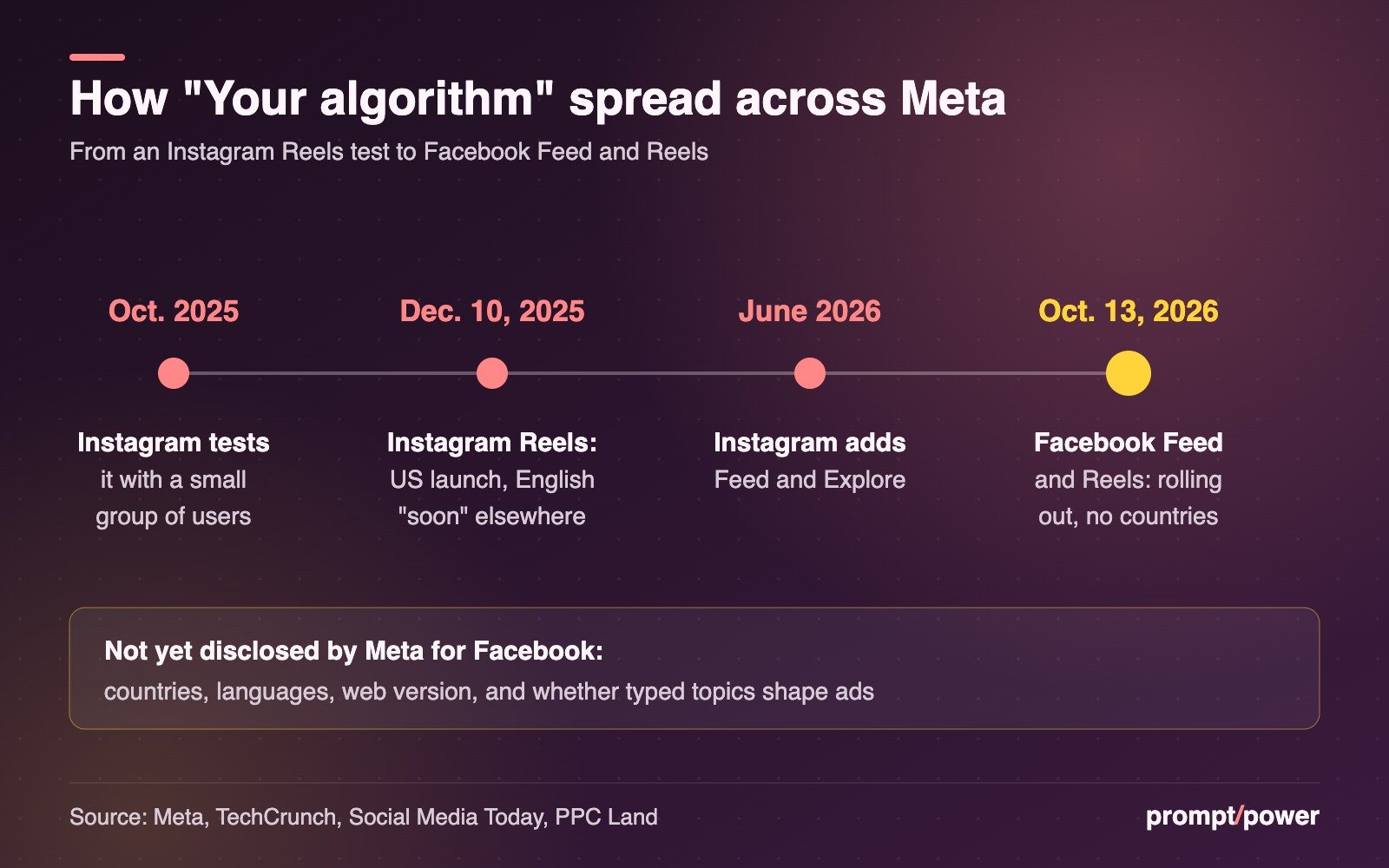
None of this is brand new inside Meta. Instagram got a tool with the same name first, in Reels, on Dec. 10, 2025, available that day in the US, TechCrunch reported at the time. Instagram extended it to Feed and Explore in June, and Threads has a related feature called “Dear Algo”, according to TechCrunch’s Oct. 13 story.
How to use Facebook Your algorithm, step by step
These steps follow the menu paths Meta and TechCrunch describe. Labels can shift slightly between app versions, and As of Oct. 19, Meta has not published a Help Center page for the feature that we could find.
- Update the Facebook app. Staged features usually arrive with a new app build plus a server-side switch, so an update is the cheapest thing to try first.
- Open any post in Feed or Reels and tap the three-dot menu. Meta says the menu on every post has been reorganized to surface the new tools.
- Tap “Your algorithm”. This opens the space where you add and manage topics. Type what you want to see, in plain language.
- Prune the list. The same space is where you manage existing topics, so remove anything that no longer fits.
- Use “Interested” or “Not interested” on individual posts. If Facebook asks a follow-up question, answer it. This is where you can be precise: “less of this creator’s rage-bait, more of the actual recipes.”
- Scroll for a few minutes. Meta says ranking adapts within the same session, so you should not need to wait a day to see a difference.
Writing prompts that work
Our advice, based on how language models read requests: specific beats broad. “Football” gives the system little to work with. “NFL tactics breakdowns, not trade rumors” tells it what to add and what to subtract in one line.
Say what you want less of, too. Meta’s own description leans on both directions (“more or less of”), and the “Not interested” follow-up exists precisely for the subtraction.
Can’t find Your algorithm? Rollout and availability
Meta’s post gives no dates, regions or languages, and it had not been updated as of Oct. 19. TechCrunch’s report adds none. PPC Land listed availability among the details Meta did not disclose, including whether the feature will reach the EU.
One data point from outside North America: MediaNama reported on Oct. 14 that neither Your algorithm nor similar features were available on Facebook, Instagram or Threads in India.
The Instagram precedent is the best guide we have. When Instagram’s version launched in the US in December 2025, Meta’s Chris Cox said it “will roll out soon to all English-speaking users”, according to Social Media Today. Our read: a US-first, English-first rollout on Facebook would follow the same pattern. Meta hasn’t confirmed that.
Web versus app is also unaddressed. Meta’s post talks about Feed and Reels and the three-dot menu, and does not say whether facebook.com in a desktop browser gets the same controls.
What it doesn’t change: ads and your typed preferences
Meta’s announcement says nothing about ads. It does not say whether the topics you type shape the ads you see, how long your requests are stored, or whether they are used to train models. PPC Land flagged all three as undisclosed, and MediaNama said it had sent Meta questions on data storage and ad use and would update its story when Meta replied.
There is relevant history. In October 2025 Meta said it would start using people’s interactions with Meta AI to personalize content and ads from Dec. 16, 2025, with conversations about topics such as religion, health and political views excluded from ad targeting, PPC Land noted. Whether typed Your algorithm requests are treated the same way is the open question.
So treat what you type as data you are handing Meta. If you would not type it into a search box, don’t type it here. We’ve collected the training opt-outs that do exist in our guide to stopping ChatGPT, Claude, Gemini and Meta from training on your chats.
What to do: test whether it’s working
Feed controls have a credibility problem. A recently unsealed New York complaint alleges TikTok’s 2023 “Algo Refresh” button did not do what it said, a claim TikTok denies; we covered it in TikTok’s placebo safety test. There’s no evidence of anything similar here. But a simple check costs you five minutes.
- Pick one niche topic you rarely see, something specific enough that you’d recognize it instantly.
- Add it in Your algorithm, then scroll Reels and Feed for five minutes and count how many posts match.
- Remove it the next day and count again.
If the count moves, the dial is wired to something. If it doesn’t, Meta’s existing signals, the likes and watch time, are still doing the steering, which is how Meta describes the system anyway: your words are added to those signals, not swapped in for them.
Meta hasn’t said how much a typed request weighs against hours of viewing history. That number is the whole story, and nobody outside Menlo Park has it. More on how platforms shape what you see is on our internet culture page.

Casie Stewart covers the creator economy, social platforms and wellness tech for prompt/power: who gets paid, who gets seen, and what the algorithm is really asking of the people who feed it. She has been publishing online since 2005, long before "creator" was a job title, and has spent most of that time on the other side of the platforms she now writes about. Based in Toronto. Her rule for any new app: if it promises to save you time, check how much of it you just spent reading the onboarding.
Keep reading

The Telltale Signs of AI Writing, According to Wikipedia’s Editors


The Hotel Lobby AI Trend, Explained, and the Takeoff Problem

Washington Says ‘SI’ Now. The Law It Points To Still Says AI.
Latest from prompt/power
- Meta Q3 Earnings Oct. 21: The Capex, Ads and Cash Numbers to WatchOct 21
- Anthropic’s 5% Pledge Is Worth About US$48B. Here’s the Fine PrintOct 21
- Commons AI Study Meets Parliament’s Interpreter Math: 44 Passes in 5 YearsOct 21
- CNN All Access Canada Price Is CA$7.99. Americans Pay About 23% MoreOct 20
- DeepSeek Federal Ban: DHS Order Also Covers Apps Built on Its ModelsOct 20
Leave a Reply